Take action
Become a member
Memberships builds our community and gives us a predictable income, which lets us plan and sustain longer projects that can have a greater impact. The more members we have, the more we can do to protect the Sussex countryside and coast.
Make a donation
Membership builds our community and gives us a predictable income, which lets us plan and sustain longer projects that can have a greater impact. The more members we have, the more we can do to protect the Sussex countryside and coast.
Overview
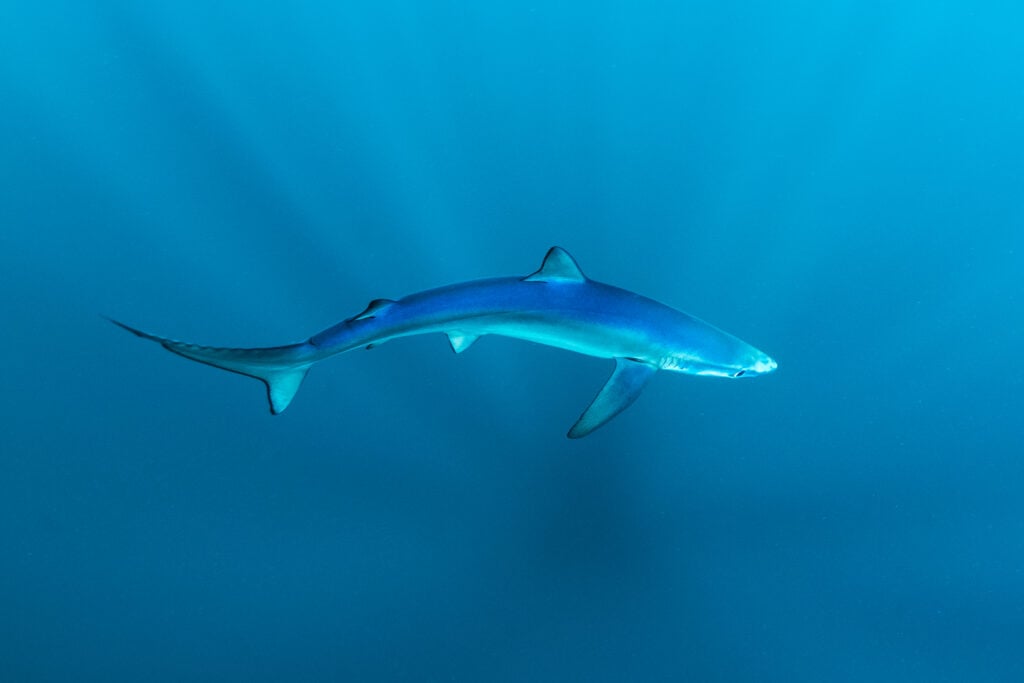
The Blue Shark is an open-ocean (or pelagic) species that visits UK seas in summer months. In the Atlantic, they appear to follow a clockwise route, following the Gulf Stream to the UK from the Caribbean and returning there following the Atlantic North Equatorial Current.
Blue Sharks are active predators and feed mainly on small fish and squid – though they have been known to take seabirds and other small sharks too. They even feed on fish that live near the seabed and have been recorded at depths of up to 350m. The largest blue shark ever caught in UK seas weighed a whopping 256lbs (116kg) and measured over 9ft (2.74m).
Key Facts
- A slim torpedo shaped shark with metallic blue colouration on top and white underneath. They have distinctively long pectoral (front) fins.
- Blue Sharks give birth to live babies! The fertilised eggs remain within the mother’s uterus where they are nourished by a yolk-sac. Over time, the depleted yolk-sac interlocks with the lining of the mother’s uterus which then acts a bit like a mammal’s placenta. Blue Sharks give birth to an average of 35 pups.
- Length: 4m
Status
Globally, the blue shark is listed as Near Threatened on the IUCN Red List. In the UK, it is a Priority Species under the UK Post-2010 Biodiversity Framework.
Seasonality
June to October