
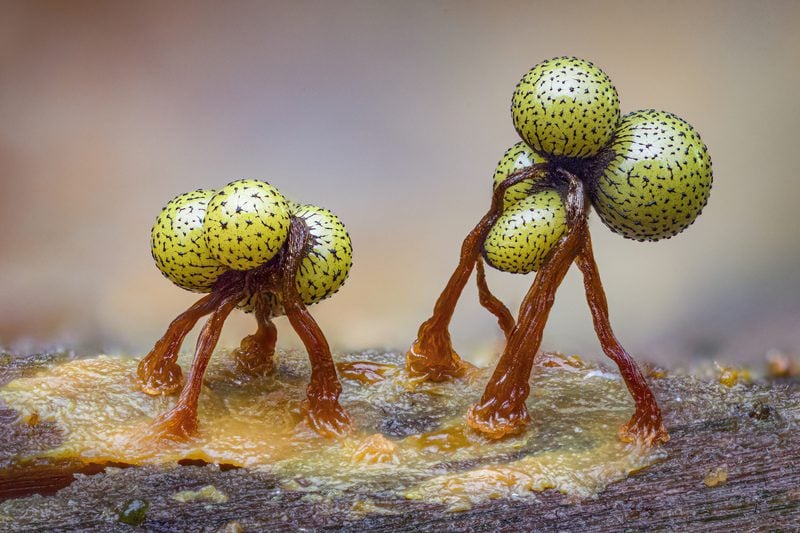
How do you go about finding slime moulds? Do you have incredible eyesight? Do you get sore knees?
I definitely don’t have incredible eyesight! I think it’s more about patience, observation and knowing where to look. I usually search in damp woodlands, looking carefully at decaying logs, fallen branches and leaf litter. I often turn over small pieces of fallen wood or examine the bark closely, looking for anything unusual.
Many slime moulds are only 1–2 mm in size, so they’re incredibly easy to miss. Once you start looking for them, though, you realise how much is happening in the woodland that most people never notice. I sometimes use a magnifying glass to check potential subjects before getting my camera out.
And yes, my knees definitely take a bit of a battering! I spend a lot of time crouching or kneeling on the woodland floor to get the right angle. Sometimes I can spend hours photographing something just a few millimetres tall, so finding a comfortable position is important.

What do you know about slime moulds?
Slime moulds are fascinating organisms. Despite their name, they are not fungi; they have a very different biology and life cycle.
During one stage of their life, many slime moulds exist as a plasmodium, which is a living mass of material within a single cell containing many nuclei. It can move slowly across a surface while feeding on microorganisms. When conditions are right, the slime mould produces tiny fruiting bodies, which are the structures I photograph.
These fruiting bodies come in an incredible variety of shapes, colours and textures. Some look like miniature trees, others like tiny pearls or delicate sculptures. They can also develop and change within just a few hours, which makes finding and photographing them particularly exciting.
Slime moulds are an important part of woodland ecosystems. They feed on microorganisms and contribute to the natural processes involved in breaking down organic matter and recycling nutrients. I think they deserve much more attention because they are such an interesting part of the natural world.

What got you interested in them in the first place?
I started photographing slime moulds in October 2024 after joining a slime mould identification group on Facebook. At that time, I realised that there are so many different species and that I could potentially find more than 300 species in the UK. I decided that I wanted to find and photograph as many as possible.
I began exploring local woodlands, and before long, I was completely hooked. During 2025, I spent most of my photography time concentrating on slime moulds. Every new discovery felt like finding hidden treasure, and I was constantly learning about new species and their fascinating characteristics.
I still get excited whenever I find something I haven’t seen before. There is always something new to discover.
What draws you to things that are overlooked by most people?
I think it’s the feeling of discovering a hidden world. When I first started photography, I photographed butterflies, bees, flowers and birds. Over time, I became increasingly interested in smaller subjects and the details that people often walk straight past.
I love that you don’t need to travel to an exotic location to find something extraordinary. You can visit a local woodland, look closely at a piece of decaying wood, and discover a whole world of life.
Photography has taught me to slow down and look more carefully at my surroundings. I hope my images encourage other people to do the same and help them appreciate organisms that might otherwise go unnoticed. Even the smallest things have an important place in nature.

Tell us a bit about your macro photography workshops.
I run different types of workshops throughout the year, including slime mould-finding and photography workshops, macro photography workshops and fungi workshops in the Arundel area. I also travel to other locations for workshops when there is sufficient interest.
My slime mould workshops are a little like a woodland treasure hunt. Rather than simply showing participants subjects I have already found, I encourage them to explore and discover slime moulds for themselves. Seeing someone find their first tiny specimen and then discover its intricate details through their camera is one of my favourite parts of teaching.
I welcome photographers with different levels of experience and adapt the workshop to their equipment and interests. My aim is to help people develop their skills while enjoying the experience of exploring and discovering the natural world.

When you’re not looking for tiny things to photograph, how do you like spending your time?
I enjoy spending time with my wife and children. Photography takes up a lot of my time, so family time is very important to me.
I also enjoy exploring woodlands and spending time in nature. The funny thing is that even when I go for a walk without my camera, I still find myself looking closely at logs, leaves and the woodland floor to see if I can spot something interesting!

What, of the other work featured in the Wildlife Photographer of the Year exhibition, have you particularly liked this year?
There is so much incredible work in the exhibition, and I love the diversity of subjects and the different ways photographers tell stories about the natural world.
I particularly admire photographs that reveal something we might not normally see, whether it is unusual animal behaviour, a rarely witnessed moment or a fresh perspective on a familiar subject. I also appreciate images that make people think about conservation and our relationship with nature.
See Kutub’s work in the Natural History Museum’s Wildlife Photographer of the Year exhibition, on until July 2027
Leave a Reply