
By Rich Black
Senior Land Advisor
Walking by a watercourse at this time of year, you might spot forests of tall upright stems, often over six foot, with great masses of bonnet-shaped flowers in shades of pink and purple. This is Himalayan Balsam (Impatiens glandulifera), which the Victorians introduced from the Himalayas because of its pretty flowers.
Himalayan Balsam is an all-round bad influence on British wildlife. Having no predators, the plants can reach heights and densities that they couldn’t in their Asian habitat. In doing so, they outcompete our native herbaceous plants, resulting in a monoculture – and that means a lack of biodiversity. Even the fact that Himalayan Balsam is a good nectar source is a problem because this diverts pollinators away from native plants, meaning that they don’t get pollinated.
Many of our native insects are very specific when it comes to the plants they need. If those plants disappear, so do those insects and, consequently, the species that rely on them. This was starkly illustrated to me recently when I led a work party pulling up Himalayan Balsam in a wildflower meadow. The middle area of the meadow was a colourful and diverse mix of native plants and was humming with life – butterflies, grasshoppers, bugs, bees, flies, wasps, beetles, spiders and more everywhere we looked. However, all around the edges was a mass of encroaching Himalayan Balsam where there was no insect life at all apart from a few bees visiting the flowers. The contrast was startling.
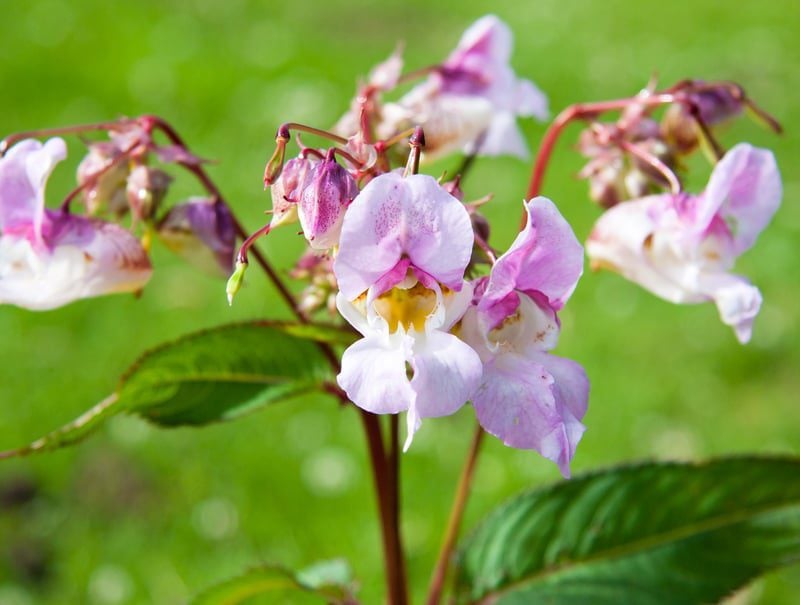
Himalayan Balsam can also cause riverbanks to erode, because it dies after seeding and has no deep root system to hold the bank together. This creates long stretches of bare earth along the banks so that erosion and collapse is almost inevitable. After the flowers come the seed pods, which explode and propel the seeds up to seven metres. As each plant produces hundreds of seeds, which will float downstream to infect new areas, it’s easy to see why it spreads so quickly.
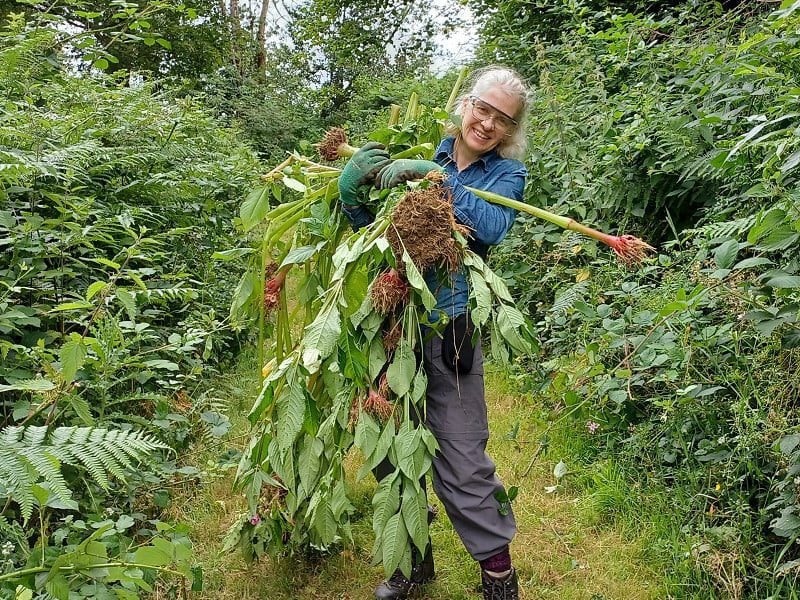
Every summer, Wilder Horsham District’s conservation volunteers go out to tackle this pernicious invasive. We coordinate our efforts with local landowners and community groups, first to establish the scale of the problem and then to remove as many of the plants as possible before they set seed. This is usually done by pulling out the whole plant or strimming it below the first node, but cutting off the flowers is also effective. Although the plant is an annual, seeds can last in the ground for two or three years, so several seasons of pulling is usually needed to clear a site. Luckily, this is easily done and a day in the outdoors pulling Himalayan Balsam can be very therapeutic!
These days, I find it impossible to pass one of these plants without wanting to pluck it out of the ground. By working from the top of the catchment down, we know we can gradually remove Himalayan Balsam from our local watercourses, with huge benefits for wildlife and habitats. By joining the ranks of Wilder Horsham District’s volunteers, you can be part of this solution, as well as having the opportunity to participate in a wide variety of other conservation tasks across the District throughout the year. To find out more about how to get involved, visit our volunteering webpage.
Wilder Horsham District is a partnership between Horsham District Council and Sussex Wildlife Trust, working since 2020 to delivery a Nature Recovery Network for the Horsham District.
More information on Himalayan Balsam:
https://www.wildlifetrusts.org/wildlife-explorer/wildflowers/himalayan-balsam
https://www.cabi.org/invasivespecies/species/himalayan-balsam/


Leave a Reply