
Ever discovered an unexploded WW2 bomb? Nor had Dr. Greg Valerio of Great Barn Farm, Wiston, until he started restoring and digging a pond on his land!
Greg was one of our first-ever recipients of the Nature Recovery Award and recently completed his exciting project to restore a large pond on the South Downs. We caught up with him to learn more about the journey, and the rather unexpected surprise along the way…

Dr. Greg Valerio

The site of the former pond, full of overgrown vegetation and rubbish. Greg planned to restore the site, adding vital habitat to the South Downs where the drying of former ponds has very likely led to the decline of many species, including the increasingly rare Turtle Dove.
What motivated you to recreate the pond?
Our vision for the farm is to create an ecologically biodiverse habitat, that is both good for food production but equally ensures that nature flourishes. The previous farmer had filled in the old pond and disconnected it from the chalk stream ditch. Having a sizeable water catchment – a pond – is a very important part of ecosystem restoration.
How long did it take to restore? What was the journey like?
Once we started it took only a week, to clear the overgrowth, open up the access, remove over 5 tonnes of rubbish and metal that had been dumped in it, excavate out with a 9-ton digger the contours of the original pond and edge with topsoil.
Dramatically we uncovered a WW2 bomb in the pond, so we had to call the Bomb Squad (Royal Navy) to come and safely blow it up! So we think we will call the pond Bomb Pond. All very dramatic.
Another encouraging part of our restoration work came in the discovery that the original pond had been clay lined, so we had a lot of quality clay to work with. An old man walking down Mouse Lane said that when he was a teenager in the early 60s at Steyning Grammar School they used the lane as their cross-country course. He was delighted to see the pond restored. He remembered it being twice as large as it is now.

The site for the large pond once it was cleared and ready for water (above), and after an initial fill with water (below) before the vegetation was introduced and settled in.

What are your plans for the future – will you be doing any more work around the pond, or the site as a whole?
The pond excavation is phase 1 of our work. Phase 2 is to plant up the margins, and the borders, replacing some of the scrubs we had to remove so as to restore an undergrowth for the birds.
In terms of wildlife, we will let the pond find its own level. We did find some common newts in the restoration phase, so we trust they will take up residence.
Phase 3 for us will be the restoration of the chalk stream as much as possible and the creation of secondary areas of water catchment behind the main buildings. Hopefully, we will work in partnership with Sussex Wildlife Trust again on the chalk stream restoration.

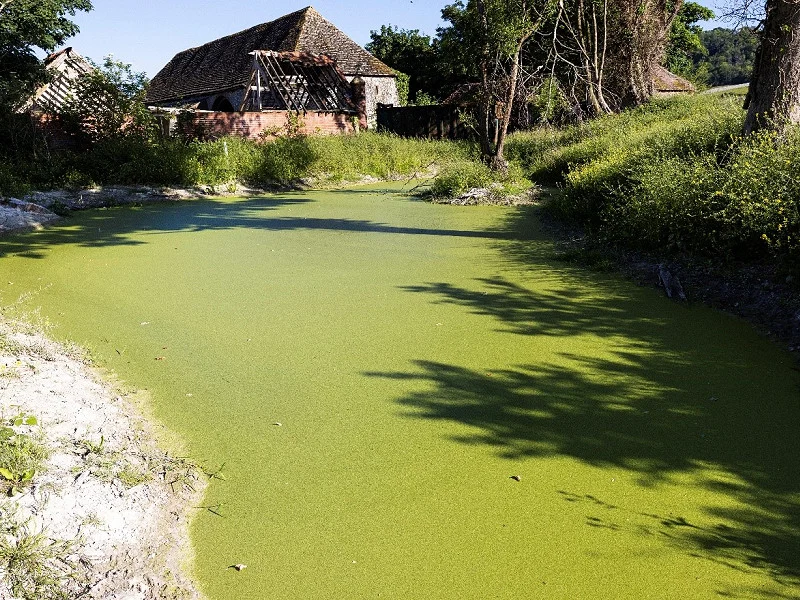
The pond as it is now – an incredible transformation.
Are you a landowner or a community group? Do you have a project that will help expand and improve networks for wildlife across Horsham District? Then we would love to receive your application for our Nature Recovery Award! For more information on how to apply for up to £5,000 of funding, please click here.
Leave a comment