Take action
Become a member
Memberships builds our community and gives us a predictable income, which lets us plan and sustain longer projects that can have a greater impact. The more members we have, the more we can do to protect the Sussex countryside and coast.
Make a donation
Membership builds our community and gives us a predictable income, which lets us plan and sustain longer projects that can have a greater impact. The more members we have, the more we can do to protect the Sussex countryside and coast.
Overview
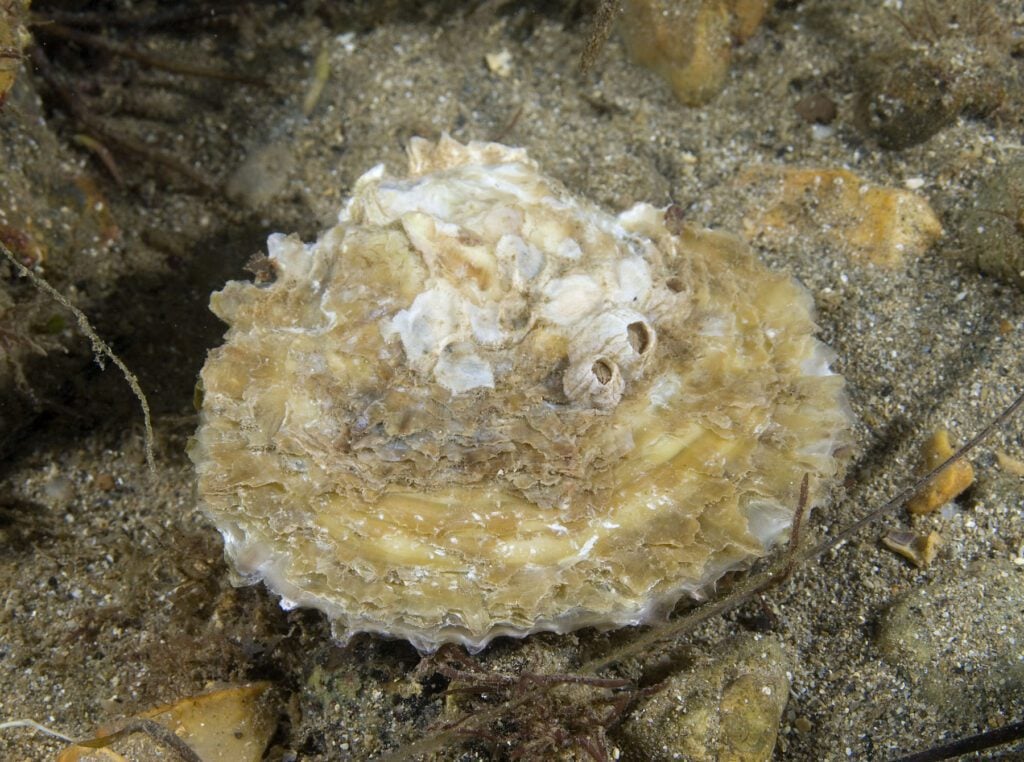
Common, or native, Oysters, live on the seabed in shallow coastal waters and estuaries and will form dense beds where conditions are favourable. Oysters are filter feeders, filtering plankton and detritus from the surrounding water column.
They are a type of bivalve (meaning two shells); but their two shells are not identical. One shell is rounded and the other is flat, like a lid.
Key Facts
- Oysters have a large, flattened, clam-like shell. The outside of the Oyster is rough, scaly and dark grey with obvious concentric growth lines. The inside of the shell is smooth and pearly white – however, Native Oysters don’t produce commercially viable pearls.
- Oysters have been an important food source for centuries – the Romans even exported them back to Italy! They are supposedly an aphrodisiac – though there’s little scientific evidence to back this up.
- Oysters start life as males, but can change sex regularly throughout their lives depending on the temperature of the water.
- Length: up to 11cm Average Lifespan: 6 years
Status
Classified as a Priority Species under the UK Post-2010 Biodiversity Framework and a Feature of Conservation Importance for which Marine Conservation Zones can be designated.
Seasonality
All year round