
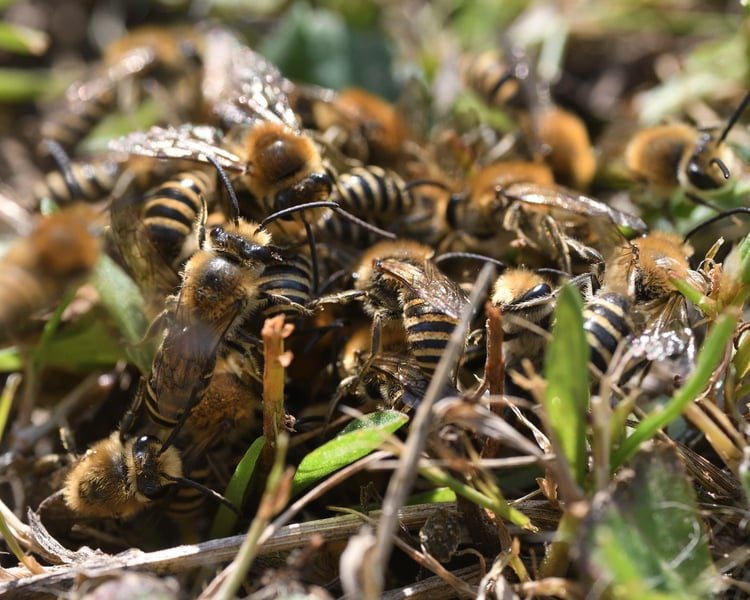
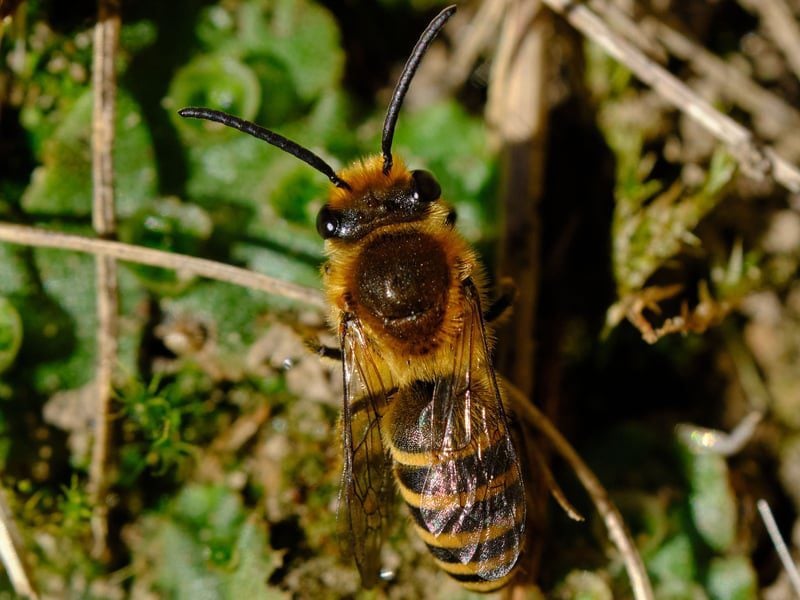
Ivy Bees (Colletes hederae) are rather beautiful solitary bees, that look similar to a honey bee; with an orangey-brown, hairy thorax, and distinct black and yellow stripes on their abdomen. Females are almost as big as honeybees with males a bit smaller. Male bees don’t have a sting and are completely harmless. The females have a sting but have rarely been known to use it on people. You’d need to be behaving in a seriously annoying way to provoke one.
Ivy Bees were first recorded in Britain in 2001, and in Sussex in 2004 in Hastings. They have since colonised most of the county. They are usually found anywhere with flowering Ivy.
At the beginning of September, male bees emerge about two weeks before females, when scores of males can be seen flying low over the ground with an audible hum, much like honeybees around a hive. They are waiting for the first females to emerge. When one does, all the male bees try to mate with her, and this is when you might see a mating ball – as you can see in this amazing image, taken in Wadhurst churchyard and sent to us by Michael Howard. Any Suzy Izzard fans out there might bring to mind her ‘Covered in bees!’ sketch!
When a male succeeds in getting a female, they often fly off together, leaving the rest of the males to seek another female.
After mating, the female digs out a nest tunnel of around 30cm deep. which has side chambers. She supplies each of these chambers with pollen and nectar, then lays a single egg in each.
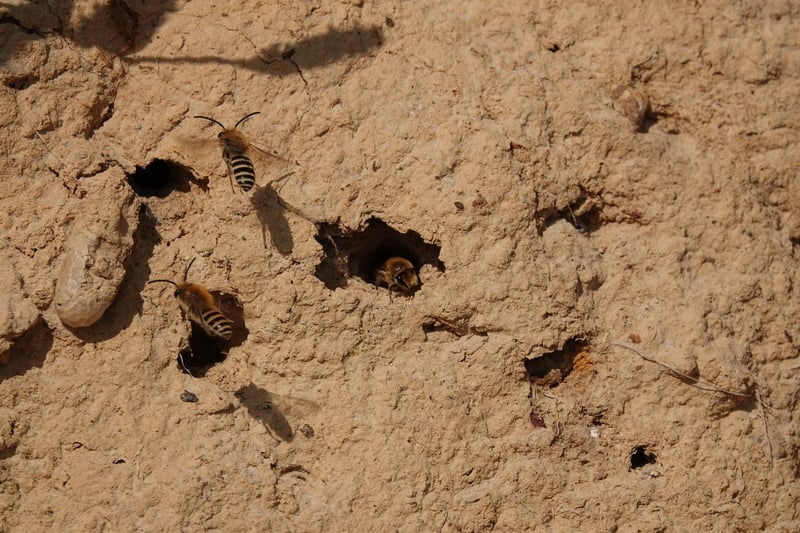
The females gather pollen exclusively from Ivy flowers, but will take nectar from other flowers as well. Female bees can be seen foraging on Ivy flowers before returning to their nest tunnels with yellow Ivy pollen on their hind legs.
The egg hatches into a larva, which eats the pollen and nectar which was provided by the female bee. Male bees do not contribute to nest building or provisioning.
As the larva grows, it sheds its skin several times, like a caterpillar. It eventually turns into a pupa and then undergoes metamorphosis to become a bee, like a caterpillar turning into a moth or butterfly.
The new bee emerges from the nest tunnel the following September and the cycle starts all over again.
For further reading on Ivy Bees, see this great post by the Friends of Earlham Cemetery. For more information on the bees you can find in our county – see James Power’s book The Bees of Sussex




Leave a Reply