
Mile (ish) High Club
By James Duncan
Engagement Officer
February may typically cast the bleakest weather across the UK. Biting Arctic winds and higher-than-average seasonal rainfall may dissuade all but the hardiest to venture out for (lockdown-restricted) daily exercise. However, as the days lengthen toward the Spring Equinox, many birds are focused on something quite different - courtship. Now is the time to keep one’s eyes on the sky, for if you’re very lucky you may witness elaborate aerial displays undertaken by British Birds of Prey.
Amongst our Hawks, Harriers, Falcons, Kites and Eagles, all choose to nest within a home range or territory. Depending on the species, a territory is usually occupied, hunted within and strongly defended. Some species typically refrain from disputes with their neighbours, displaying a rather relaxed attitude to territorial overlaps. The Kestrel is a prime example of such behaviour. Some may occupy a Sussex home territory all year round, those such as Common Buzzard, Sparrowhawk and Peregrine, whilst others are seasonal visitors, such as Hen Harrier and Merlin. However, should a Raptor wish to demonstrate residence in its nesting territory, a nuptial display is undoubtedly the way to proceed. This serves not only as a way of attracting a suitable partner, but reinforcing the bond between long-standing pairs.
This may take a variety of forms. Some may choose to forego the aerobatics and resort to a relaxed ‘perch and call’ approach. When a male finds himself a commanding vantage point he’ll enthusiastically emit a powerful display call. Sometimes, a female won’t be outdone and may commit to the same behaviour. Others will take this behaviour to the sky, soaring whilst continuing the repetitive vocalisations. In an effort to show off, swooping and diving frequently add to the visual spectacle. But the most magnificent of all are undoubtedly the mutual display flights; feats which often result in aerial inversion, claw-grappling, high-velocity stooping and perhaps even a ‘rollercoaster.’ This ‘mock fight’ between a pair involves both a locking of talons and a rapid tumbling descent - a most magnificent sight. It’s been described regularly amongst Eagles, gaining literary reference from 19th Century American poet Walt Whitman in ‘The Dalliance of the Eagles.’ Admittedly it was based upon a North American species, the Bald Eagle.

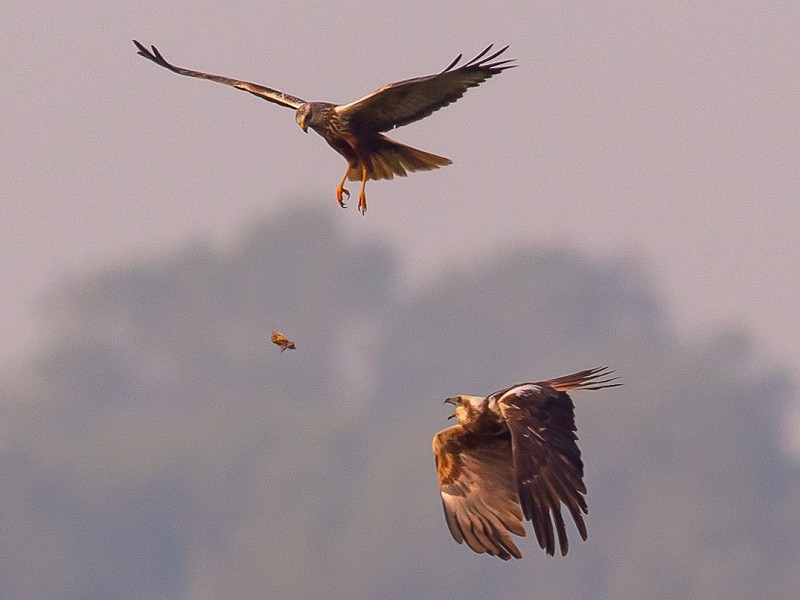
Marsh Harrier © Toby Houlton
Though a ‘rollercoaster’ may be an unlikely observation in Sussex, it’s certainly conceivable to witness a breathtaking ‘sky-dance.’ This is a display employed by Harriers; with breeding Marsh Harrier in Sussex it’s a ritual you may be lucky enough to spot. A male will rise to great height, before hurtling earthwards in a rapid, spiralling descent, twisting, jerking and spinning before bouncing back up to repeat the performance. He has all the appearance of an avian bungee-jumper. In the manner of the most impressive of aeroplanes, he may even execute an impressive ‘loop-the-loop’ at the top of the upwards stoop. Of course, this feat has an audience, a female, who watches carefully from the reed-bed. In fact, she may participate in more active courtship, inverting and presenting her talons in a symbolic movement that will later be used for passing food between the pair in beautiful synchronisation. Presenting prey in this manner is sure to get her attention and is a tactic often used by males with a rather sneaky strategy - those who impersonate females by both having representative plumage and behaving like them; thus flying under the radar of more typical males - behaviour well documented in parts of Europe.
As one of our most fiercely territorial raptors, the Common Buzzard has a rather substantial number of social behaviours. These vary hugely, from wing waving to display stoops, to deep dives, to slow wing-flapping. In fact, like Harriers, they may even ‘sky-dance’, though this seems more common in other Buzzard (Buteo) species. It’s not unheard of for them to indulge in the cartwheeling ‘rollercoaster’, though it isn’t always clear whether this is reserved for intruding males as opposed to courtship. Nuptial displays demand fine sunny days (essential for soaring) where a pair will ascend to great heights, whilst circling and calling. Males gain height more quickly, owing to lower weight (wing loading), enabling them to plummet toward the females, shooting past and screaming back up - a performance to be repeated multiple times. Occasionally this may prove sufficiently invigorating for a perched female who, successfully wooed, will take to the wing and join him.

Common Buzzards © Phil Winter
Our ultimate aerial speedster, the Peregrine, is another resident Sussex raptor who engages in a number of display tactics. Tending to roost close to their nesting ledges throughout winter, pairs often commence spectacular feats of aerial agility, whizzing after each other from great height, swooping and soaring in close proximity. When not airborne, a male will frequently bow slowly up and down, calling to her, a ceremony thought to overcome the female’s natural aggression. With sexual dimorphism common amongst raptors, the larger females may pose a significant threat to the smaller males - a similar ceremonial tactic is employed by the Sparrowhawk for the very same reason. With a variety of ledge displays complete, Peregrines may also indulge in rather balletic food transfer on the wing and, in common with other raptors, when perched.
Of course, these are not the only raptors to partake in such nuptial displays, so now’s the perfect opportunity to brave the cold and keep eyes peeled and ears tuned for such a spectacle.

Peregrine © Dave Kilbey