
Species of the day: Buzzard
James Duncan
Learning and Engagement Officer
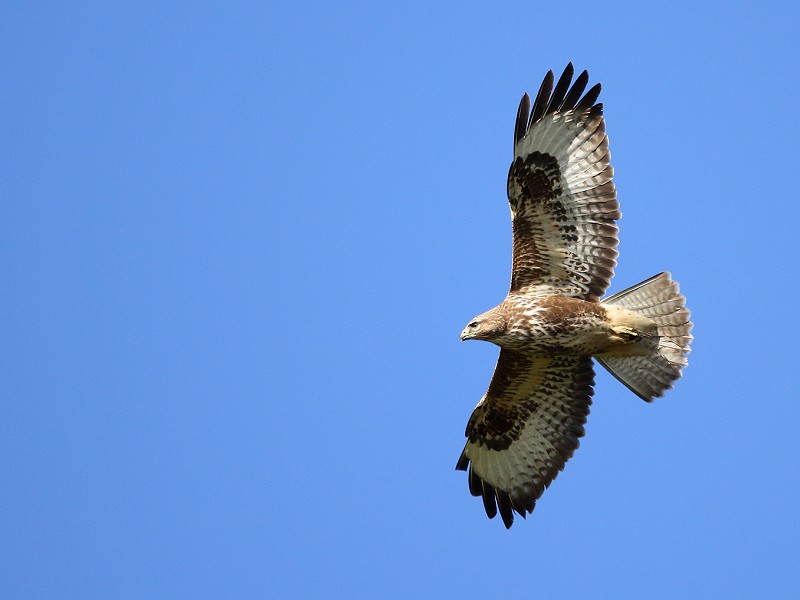
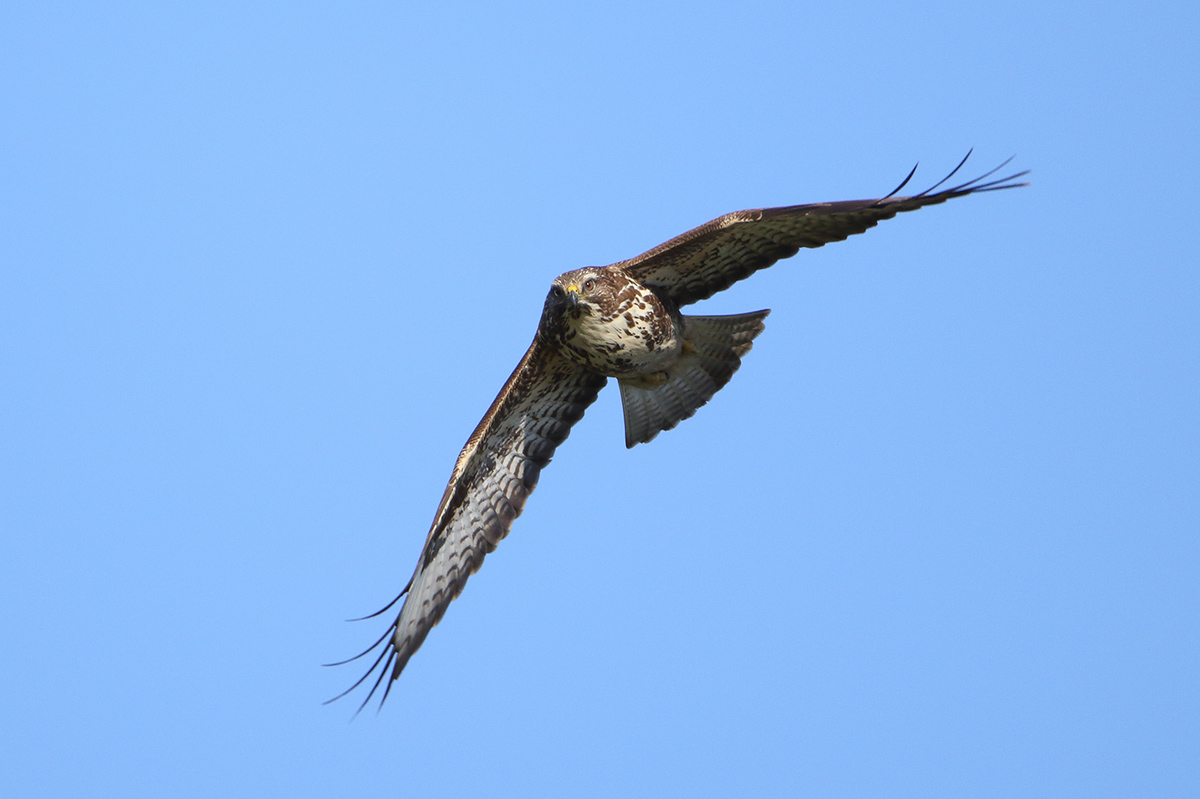
The Common Buzzard (Buteo buteo) has in recent years displaced the Kestrel as the UK's most widely distributed and observed raptor species - it can now be seen in every county. Its recent fortunes have well and truly shifted - high levels of persecution and extensive use of the pesticide DDT (dichlorodiphenyltrichloroethane) meant this species had all but vanished across the British Isles by the mid twentieth century. Unfortunately, despite being afforded legal protection since 1880, it remains one of the most numerous victims of continuing wildlife crime. Its diet makes it particularly vulnerable to illegal poisoning with feeding habits that revolve largely around scavenging. This was brought into sharp perspective with the spread of myxomatosis in the 1950s, where Buzzard numbers dropped in synchrony with rapidly declining rabbit populations. By raptor standards the Buzzard is not particularly agile or powerful and may be regarded as a somewhat lazy (but adaptable) opportunist, feeding on a huge variety of prey preferably with the minimum of hunting. Roadkill provides them with easy sustenance, though don't be surprised to see them feasting on Earthworms - a particular favourite in winter. Studies have shown that generalist raptors such as the Buzzard have a particularly effective digestive system, with long intestines, enabling them to gain nutrition from even the lowest quality of diets - the perfect explanation for their diverse feeding strategy.
With at least seven times the wild population since the 1960s, the Buzzard now offers the perfect opportunity to spot an impressively large raptor in UK skies. In fact they're one of the easiest to spot on a car journey, gliding effortlessly on outstretched wings held in a shallow V, seemingly with barely a need to flap - they appear to find altitude-increasing thermals with relative ease. They're also the most likely raptor to be seen sat perched on a fence-post or telegraph pole, another of their opportunistic hunting tactics. Spring is the time to catch the males undertaking some spectacular aerobatics as they seek to impress the females with the fabulously named 'rollercoaster.' Sexual dimorphism (common in raptors) dictates the females generally outgun the males, with a wingspan pushing 1.2 metres in some cases and a maximum bodyweight of around 1.3kg. The impressively bulky appearance of this bird has long dubbed it the 'tourist eagle' in Scotland, through confusion with the larger Golden Eagle.
As well as sexual dimorphism, they also display high levels of colour polymorphism, with a trio of morphs typically seen - imaginatively described as light, intermediate and dark. These can cause confusion with other raptors, though most typically between other species within the Buteo genus. Buzzards may also be seen imitating Kestrels, displaying an ability to hover, though this has more to do with a mastery of the wind than an innate characteristic. You may well hear a Buzzard long before spotting one as their far reaching cat-like call is distinctive - a somewhat mournful sounding 'peee-yaa.'
Buzzard © James Duncan
Comments
I have been watching a pair displaying over our house in Shoreham for the past few days. Combination of mirror soaring ,spiralling round one above the other, with talon locking and the male roller coasting. Strange thing was the local herring gulls were totally calm, whilst they were displaying but as soon as they split up and got a fraction closer both birds were mobbed.
09 Apr 2020 19:29:00
I have horses and I see the buzzards and hear them every day One regularly sits on the gate to my boys field occasionally it doesn’t move when I open it
25 May 2021 10:33:00
I’ve just seen six buzzards all in a soaring group above Preston Park, they quickly spiraled high then left in loose formation towards Woodingdean and Lewes. Extraordinary.
17 May 2022 14:56:00
I regularly see buzzards while riding in the woods that Fringe Ashdown Forest’s wide open spaces. Occasionally one will swoop low over us and the sit in a tree ahead of us and then once we’ve passed swoop over us again. I wonder if its hoping the horse will flush a rabbit or a pheasant for it to take?
12 Jun 2022 06:26:00
I regularly see buzzards while riding in the woods that Fringe Ashdown Forest’s wide open spaces. Occasionally one will swoop low over us and the sit in a tree ahead of us and then once we’ve passed swoop over us again. I wonder if its hoping the horse will flush a rabbit or a pheasant for it to take?
12 Jun 2022 17:07:00
i watched a bird today soaring really high in a beautiful clear blue sky.i dont know much about birds but could it have been a a buzzard? i see from some search on the computor that buzzards are in my area.
26th august 3.3opm 2022
26 Aug 2022 21:01:00
I’ve just seen one
Swanborough
East Sussex
16 May 2025 15:11:00