
Species of the day: Kestrel
James Duncan
Learning and Engagement Officer
It's thought-provoking to consider that a mere half century ago the Kestrel (Falco tinnunculus) was likely to be the only Bird of Prey regularly seen across Britain.
The persecution of raptors has unfortunately been ongoing for millennia, increasing dramatically in the nineteenth century following the advent of game hunting. Fast forward to the late 1950's and the use of organochlorine pesticides began to take a huge toll, certainly until its complete ban in 1984.
Though it suffered extensively in line with other species, the Kestrel was the one bird of prey you stood a good chance of spotting, most likely hovering above a roadside verge - its colloquial name of 'motorway hawk' reflecting this. It should however be noted that this term assigns the kestrel to the wrong family, as it is in fact a Falcon, not a Hawk.
Now overtaken by the Common Buzzard as our most numerous raptor, along with the Sparrowhawk it's the only bird of prey to be found here with numbers in five figures, showing just how small raptor populations truly are. It's sad to say but numbers continue to decline, most likely owing to a dependence on agricultural land and loss of suitable nesting sites. The Kestrel is heavily reliant on a diet of small mammals, in particular the Short-tailed (Field) Vole - the sensitive management of grassland and rough field margins is imperative to maintaining populations of these mammals, though unfortunately our tidy living habits typically maintain quite the opposite.
Though truly a 'vole specialist,' the Kestrel is a surprisingly adaptable hunter, probably one of the key reasons for its widespread, if still declining distribution. It'll often hunt larger mammals ranging from rats to rabbits, smaller bird species, earthworms, lizards and a variety of insects, the diversity of diet particularly important for birds living close to, or even in the middle of, urban areas.
Remarkably, considering its diminutive stature, the Kestrel will often rob both Barn and Short-eared Owls of their prey. Paradoxically it was seen as a poor hunter in the Middle Ages, assigned the very lowest hierarchical status in an era when falconry was extensively practiced. Whereas Eagles, Gyr Falcons and Peregrines were assigned to the highest ranks in society, the Kestrel was designated as the bird of the knave, or servant, a bird fit for catching only mice.
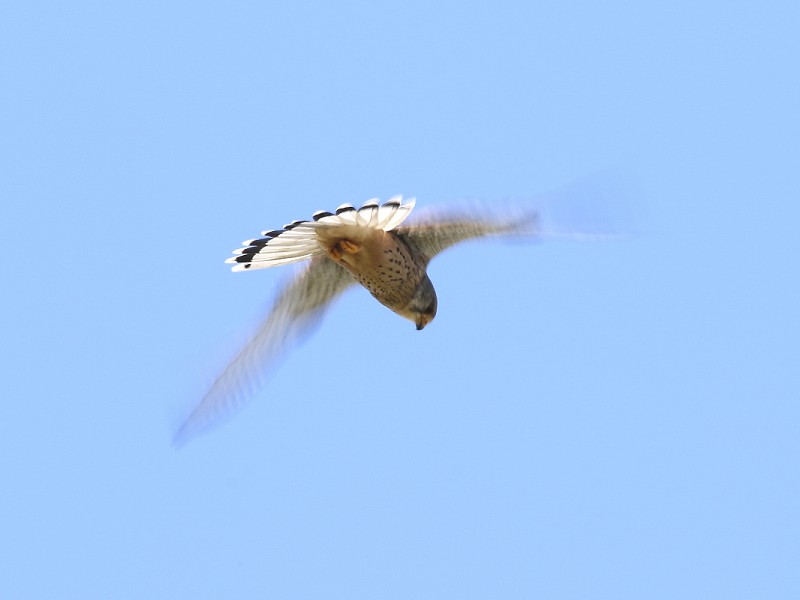
The Kestrel is almost certainly renowned for the one distinct characteristic, that supreme ability to remain stationary midair. There can be no more familiar sight amongst birds of prey than a Kestrel hovering flawlessly, delicately manipulating wings and tail to remain effortlessly in place. Much of the time the bird may not truly be stationery, for it'll match its flight with the opposing wind speed, though if anything this only serves to compliment its mastery of the air. When hunting in this way, the Kestrel's staggering focus is unmissable for the head (and therefore, eyes) move no more than a few millimetres in any given direction.
Considering the body may be subject to significant buffering, it's clear the all-round coordination of the Kestrel is utterly astonishing. Many animals give their name to human inventions, particularly in the world of transport. The Kestrel's abilities in flight were deemed worthy of Hawker Siddeley's affections, for their world-famous 'jump jet' was originally named 'Kestrel' during development in the 1960's.
It subsequently went on to become the 'Harrier', though clearly its vertical take-off abilities were more suited to the former. The Kestrel's proficiency in the sky has garnered it the nickname of 'the Windhover,' expressed most beautifully by English poet Gerard Manley Hopkins, in his poem of the same name which he described as the best he'd ever written.
"I caught this morning morning's minion, king-
dom of daylight's dauphin, dapple-dawn-drawn Falcon, in his riding
Of the rolling level underneath him steady air, and striding
High there, how he rung upon the rein of a wimpling wing
In his ecstasy! then off, off forth on swing,
As a skate's heel sweeps smooth on a bow-bend: the hurl and gliding
Rebuffed the big wind. My heart in hiding
Stirred for a bird, – the achieve of, the mastery of the thing!"
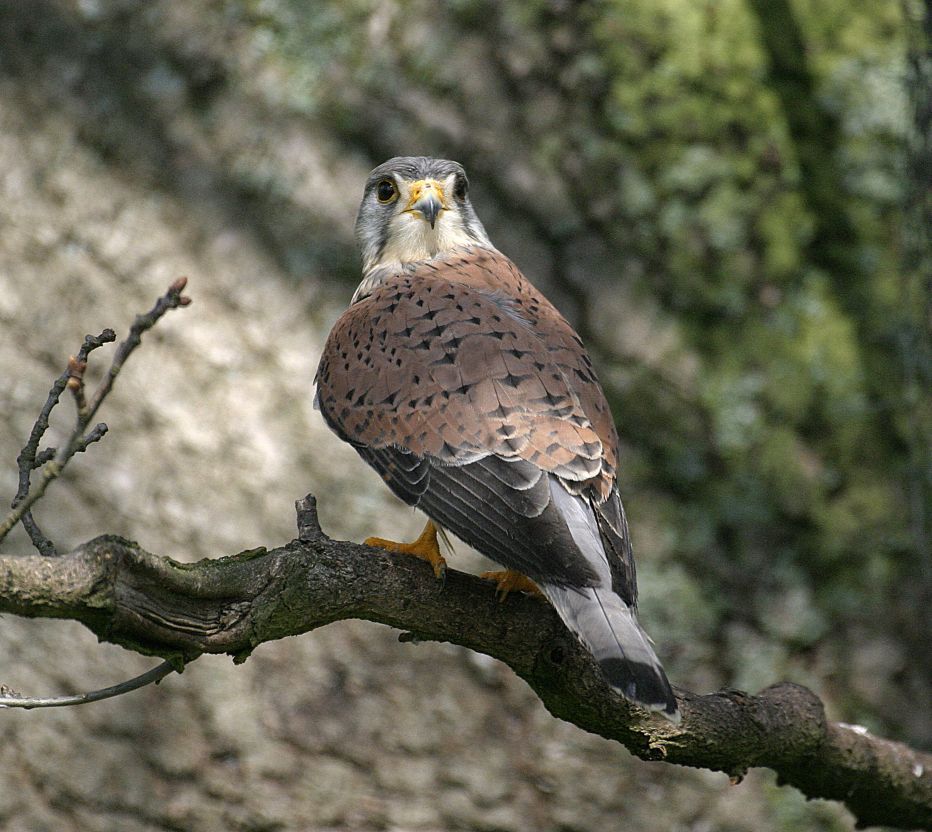
Male Kestrel © Darin Smith
This post was originally published in April 2020.
Comments
I loved your piece about the kestrel, esp. the reference to the GMH poem.
06 Oct 2020 13:00:00
A very enjoyable piece on this Falcon. The ID photos concentrare on the male Kestrel with the brown/chestnut back and grey head, one needs to know what the females and the juveniles look like, as they have much less brown over the head and body, and far less grey (if any) on the head. The colouration can be important in field ID along with the behaviours you point out.
15 Sep 2025 11:33:00
Thank you, informative as always, loved the addition of the poem. More like that please .
15 Sep 2025 13:18:00
Darin Smith’s photo is fantastic!
15 Sep 2025 15:15:00
Thank you for the info.One thing I would like to know is how does a bird of pray’s hearing and sight compare to ours and how can this be demonstrated for the different species?
15 Sep 2025 17:47:00
Great photos and very informative information about the Kestrel.
15 Sep 2025 18:14:00
One of my favourite poems about one of my favourite birds.
15 Sep 2025 19:23:00
Congratulations on a sensitive and informative introduction to a wonderful little bird of prey.
15 Sep 2025 21:55:00
Good piece and great idea to do this. Would love more photos/video in flight. It is trying to identify birds of prey in flight, often at distance that we all struggle with.
Thank you
17 Sep 2025 15:04:00
I liked the poem on the kestrel, and the rest of the information, it would be nice to have more poems in the future
17 Sep 2025 16:48:00
One of my favourite poems about one of my favourite birds.
18 Sep 2025 22:02:00
One of my favourite poems about one of my favourite birds.
20 Sep 2025 20:13:00
Great, appropriate length and very informative.
Thanks
01 Oct 2025 20:44:00
Really enjoyed the read today about the Kestrel, thank you!
02 Oct 2025 12:54:00
An enjoyable read. Really like the poem. A few more pics of female and juvenile birds would be helpful too. Thank you for the info. 😊
12 Oct 2025 19:36:00
An enjoyable read. Really like the poem. A few more pics of female and juvenile birds would be helpful too. Thank you for the info. 😊
13 Oct 2025 08:02:00
Such a beautiful bird, a joy to watch.
19 Oct 2025 14:00:00
This is a brilliant idea, thank you
22 Oct 2025 07:33:00
It would nice to have some sound files too
23 Oct 2025 16:33:00
Thank you for the information on our birds of prey , it has helped me identify it was a Kestrel i saw today . Beautiful sight
31 Oct 2025 20:24:00
Fantastic, great information. The poem was a lovely touch.
12 Dec 2025 11:48:00
Wonderful post. Thank you so much for reminding us of this essential beauty to support.
22 Dec 2025 13:37:00