
Species Spotlight: Merlin
By James Duncan
Learning and Engagement Officer
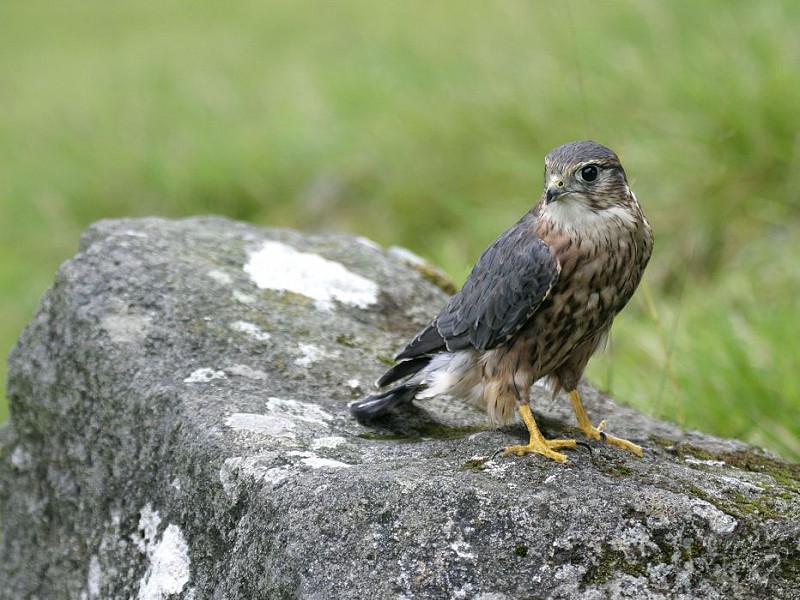
It's eminently possible many living in Sussex may never have seen a Merlin (Falco columbarius). This robust and rather muscular Falcon is in fact our tiniest bird of prey, even smaller than the much more familiar Kestrel. Following a regular theme amongst raptors, the males are thoroughly outgunned by the females and barely exceed a Mistle Thrush in length. Their diminutive size may well contribute to low visibility, but it's largely seasonal movements that explain their relative scarcity in the south. For, like a huge array of birds, the Merlin is a migrant, a breeding inhabitant of chilly northern latitudes. The British Isles are ultimately their most southerly breeding ground across the Palearctic. Autumn and winter therefore offer the keen Sussex observer the very best opportunity to spot a dashing Merlin, often on salt-marsh and coastal farmland. Rather fortunately they often display a propensity for perching upon rocks and posts, suitable spots for scouting potential prey. When they do take to flight, the Merlin is an explosive and superbly agile predator. Whereas Buzzards, Peregrines and Kestrels all search for prey whilst soaring high, the compact Merlin inhabits a band of air space just a few feet from the ground, keen to utilise speed and the element of surprise. The surprise may not be limited to the Merlin's prey, for should a flock of Meadow Pipits explode into action near you, a Merlin may well turn out to be the cause.
Should you wish to view breeding Merlins, you'll likely need to take a trip to the UK and Ireland's northern uplands, typically at altitudes above the tree line. Their favoured nest sites are amongst the heather, on moorland, a specialised habitat that in many areas continues to decline or remains in poor, unviable condition. Overgrazing degrades the quality of moorland and commercial plantations continue to take over former sites for breeding. Some Merlins have even adapted to living on the edges of plantation woodland, a rapid adjustment to modern-day landscape change. The Merlin displays a remarkably strong affinity with heather, both useful for concealing its nesting areas and holding a ready supply of food. Somewhat conversely bird numbers upon moorland are relatively low, so the Merlin has little choice but to hunt over large, wide-ranging territories. Individuals may consume a startling amount of food, owing to the vast amount of energy expended in aerial pursuit - common to many animals sharing an explosive hunting strategy.
Back in Medieval times the powerful, yet petite Merlin was prized for falconry, far more so than the lowly Kestrel, and was regarded as a 'falcon for the lady.' Known colloquially in the United States as the 'Pigeon Falcon', the scientific naming of columbarius translates to much the same ('of the pigeon') though it's typically the larger and more aggressive females that catch such prey. Their versatile abilities enable them to predate an array of small passerines such as Pipits, Skylarks and Chats, using their rather oversized, bright yellow legs and feet - somewhat comedic in look, but not in the razor-sharp weaponry they deploy. Rewind forty to seventy years and the UK situation for the Merlin looked particularly bleak. The extensive use of organochlorine pesticides and continuing human persecution wreaked havoc across almost all raptor populations. Unfortunate Merlins were the frequent recipients of trapping, poisoning and shooting, although their diet rarely encompasses larger game birds. The conservation picture has improved a little from historical levels though sadly it's made a recent return to the Red-List of Birds of Conservation Concern in Britain. The protection of heather-dominated moorlands is pivotal for their ongoing survival, as is the case for a number of highly threatened raptor species. For now, keep your eyes peeled and you might just catch a glimpse of one of our most magnificent aerial predators.
Comments
I walked across the reserve at Rye , in the vicinity of the castle, when my path was crossed by a low fast flying falcon . It was no more than one or two feet off the ground , following the contours of the grassland . A thrilling sight, and I thought possibly a merlin ? What do you think. Also a relaxed sunbathing fox in front of the castle hide.
Could be John, but may also be Sparrowhawk. The Merlin's dashing flight is typically composed of rapid wing-beats interspersed with short glides. Sparrowhawks will also fly in much the same manner, just feet from the ground, though as a whole they're slightly larger and longer-tailed with broader wings that comprise more rounded wing-tips - as opposed to the pointed wings of the Merlin. Always thrilling to spot a fast flying bird of prey, and Rye Harbour's a great place to spot them!
23 Oct 2020 13:48:00
Just saw a small, stubby, powerful, fast-flying bird scattering a flock of small game birds. It was on a glide/burst attack at head-height over Plummers Plain. It chased its prey through a wooden margin, when I lost sight of it. Quite dark all over, perhaps it was a juvenile Merlin?
09 Sep 2024 15:54:00
Sussex Wildlife Trust:
The bird in question is significantly more likely to be a Sparrowhawk. 'Most' Merlins don't appear in Southern Britain until October as they've bred much further up North. Merlins disperse to coastal areas in winter and almost all (reported) 'inland' Merlins are Sparrowhawks. Sparrowhawks also regularly display the 'flap flap glide' flight style and hunt frequently within woodland (& margins), which Merlin don't. Juvenile Sparrowhawks are just as dark as Merlin and unless an exceptional view is obtained are very hard to split by plumage alone.
Walking by the Ouse in Lewes… past 3 days have seen what I think is a female Merlin ; I’m totally obsessed now… never seen here before…could be a sparrow hawk? When perched on a wire, looks pigeon shaped …
01 Dec 2024 11:31:00
Sussex Wildlife Trust:
It’s very difficult to say without a photo – if you can get a photo next time that would be great!
We can’t rule it out - Merlins are winter visitors to the Southeast, and commonest near the coast. Sparrowhawk is a confusion species for the females, but the Merlin’s wings are more pointed, and the tail is shorter. Pigeon sized sounds more like a Sparrowhawk than a Merlin but it’s tricky to say as there is a difference between male and female.
21st April 2025 – Caught a brief glimpse of a male Merlin today, in our secluded garden (between Chichester and Birdham). Jumped from the top of a pole where we hang bird food, onto a garden table then quickly off. Very small distinctive falcon shape, sort of pigeon grey and the most amazing bright yellow feet. Wasn’t sure till I looked it up. I’m delighted and feel so fortunate.
21 Apr 2025 12:27:00
Sussex Wildlife Trust:
Wonderful!
Pretty sure I saw a Merlin today on a country lane near Herstmonceux…..flying fast and low in front of my car – VERY swept back pointy wings, no larger than a big thrush, dark gray maybe bluish, back. I’ve seen them before around here….less than once a year but perhaps 3 or 4 times over 12 years, always in winter. Quite like a blackbird or thrush that he been remodelled for extreme speed.
25 Jan 2026 17:11:00