
Himalayan Balsam: A Big Annual Problem For Nature
By Rich Black
Senior Land Advisor
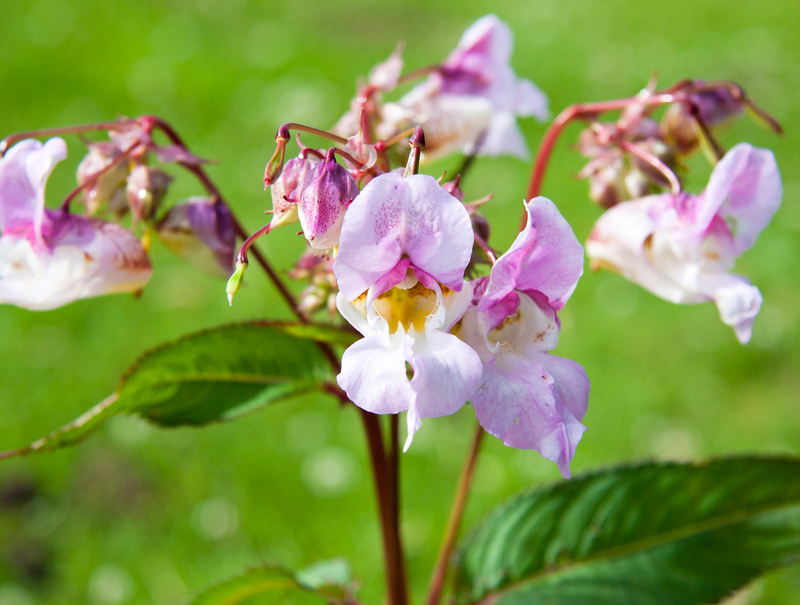
Walking by a watercourse at this time of year, you might spot forests of tall upright stems, often over six foot, with great masses of bonnet-shaped flowers in shades of pink and purple. This is Himalayan Balsam (Impatiens glandulifera), which the Victorians introduced from the Himalayas because of its pretty flowers.
Himalayan Balsam is an all-round bad influence on British wildlife. Having no predators, the plants can reach heights and densities that they couldn’t in their Asian habitat. In doing so, they outcompete our native herbaceous plants, resulting in a monoculture – and that means a lack of biodiversity. Even the fact that Himalayan Balsam is a good nectar source is a problem because this diverts pollinators away from native plants, meaning that they don’t get pollinated.
Many of our native insects are very specific when it comes to the plants they need. If those plants disappear, so do those insects and, consequently, the species that rely on them. This was starkly illustrated to me recently when I led a work party pulling up Himalayan Balsam in a wildflower meadow. The middle area of the meadow was a colourful and diverse mix of native plants and was humming with life – butterflies, grasshoppers, bugs, bees, flies, wasps, beetles, spiders and more everywhere we looked. However, all around the edges was a mass of encroaching Himalayan Balsam where there was no insect life at all apart from a few bees visiting the flowers. The contrast was startling.
Himalayan Balsam can also cause riverbanks to erode, because it dies after seeding and has no deep root system to hold the bank together. This creates long stretches of bare earth along the banks so that erosion and collapse is almost inevitable. After the flowers come the seed pods, which explode and propel the seeds up to seven metres. As each plant produces hundreds of seeds, which will float downstream to infect new areas, it’s easy to see why it spreads so quickly.
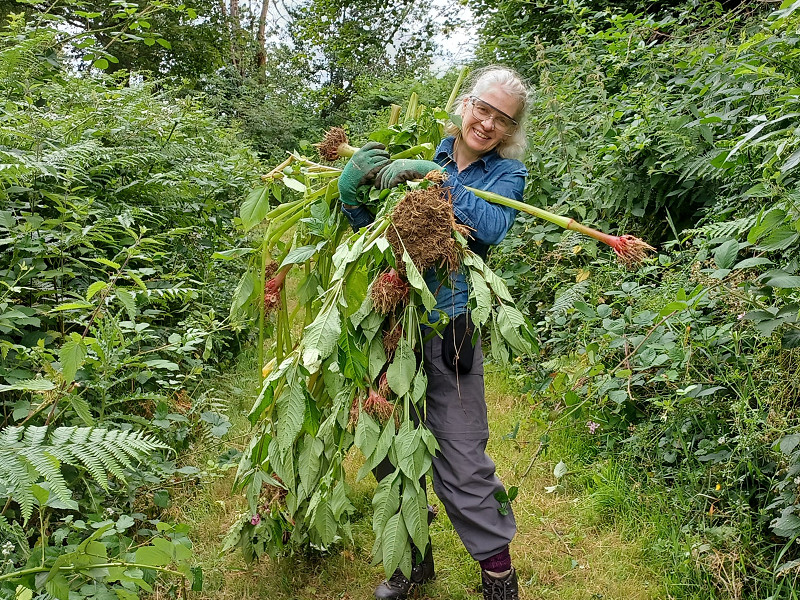
Every summer, Wilder Horsham District’s conservation volunteers go out to tackle this pernicious invasive. We coordinate our efforts with local landowners and community groups, first to establish the scale of the problem and then to remove as many of the plants as possible before they set seed. This is usually done by pulling out the whole plant or strimming it below the first node, but cutting off the flowers is also effective. Although the plant is an annual, seeds can last in the ground for two or three years, so several seasons of pulling is usually needed to clear a site. Luckily, this is easily done and a day in the outdoors pulling Himalayan Balsam can be very therapeutic!
These days, I find it impossible to pass one of these plants without wanting to pluck it out of the ground. By working from the top of the catchment down, we know we can gradually remove Himalayan Balsam from our local watercourses, with huge benefits for wildlife and habitats. By joining the ranks of Wilder Horsham District’s volunteers, you can be part of this solution, as well as having the opportunity to participate in a wide variety of other conservation tasks across the District throughout the year. To find out more about how to get involved, visit our volunteering webpage.
Wilder Horsham District is a partnership between Horsham District Council and Sussex Wildlife Trust, working since 2020 to delivery a Nature Recovery Network for the Horsham District.
More information on Himalayan Balsam:
https://www.wildlifetrusts.org/wildlife-explorer/wildflowers/himalayan-balsam
https://www.cabi.org/invasivespecies/species/himalayan-balsam/
Comments
When I was physically able to volunteer I would join with others to pull up arms full of this dangerous beauty. I continue the campaign against it whenever occasion offers. Unfortunately exotics are on sale which though not as big and strong still seem likely to clog up watercourses. Red stalked devils which throw their seed from front gardens into the nearby leading to a crop to start causing blockages. I found Sainsburys supermarket to be selling something of the sort and gave the assistant manager on duty an earnest talk about Himalayan Balsam and similar plants.
07 Aug 2025 12:02:00
There is a lot of this along side a stream by
Path Type: Footpath
Path Number: COW-1752
Near Cowfold
07 Aug 2025 12:13:00
Is ragwort also a problem with only one caterpillar that seems to use it? Far too much taking over fields and roadsides.
07 Aug 2025 12:19:00
Sussex Wildlife Trust:
We feel very differently about ragwort. It's a native plant, some 27 species rely on it entirely, and the flowers are a fantastic food source for over a hundred species of insect. We'd like it to be recognised as a wildlife boosting wildflower, and a key help in wider nature recovery.
Excellent article. Revelatory! I know it’s pretty and pretty unpopular. But I had no idea exactly why it’s so undesirable.
07 Aug 2025 12:47:00
We are lucky to own a small piece of ancient woodland near the Bluebell Railway. A section of the Ouse Navigation forms our northern boundary so we fight an annual battle against Himalayan Balsam. We also make a point of ‘spreading the word’ to folk who only see how pretty the plant is but don’t understand what a pest it is. More power to your elbow as my dad used to say!
07 Aug 2025 12:48:00
Himalayan Balsam is also a major problem in the Cuckmere Catachment and also needs tackling from the north end of the Cuckmere valley before it reaches Michelham Priory. I have just finished pulling cutting off flower heads and uprooting the whole plants from a dense patch measuring at least two square metres. The plants have been shading out native plants including Red Campion, Gypsywort, Common Hemp Nettle and Water Mint. This invasive alien plant is a national problem. Where it has spread on steep river banks it is not possible for volunteers to remove. Surely clearing the Balsam at least from river banks should be a job for the Environment
Agency?
07 Aug 2025 16:35:00
I took over some land next to a small river . The Himalayan Balsam was every where up to about seven feet tall , one could not even see the land it was on . It has taken a number of years to remove from at first just cutting it down to now pulling the odd plant up . The wild flowers and grass have returned .But a watchful eye is needed as the Balsam wants to return .
07 Aug 2025 16:45:00
It would be useful to be told at what time of year the Himalayan Balsam is to be removed… there is much growing on the River Ouse north of Lewes but I suspect that once it is in full flower it is too late to remove it. This article is therefore a couple of months too late to be useful for this year?
07 Aug 2025 19:47:00
Sussex Wildlife Trust:
As the article mentions, Summer is the best time to pull Himalayan Balsam. You need to remove plants before the seeds mature and drop. The plant flowers from mid-May to mid-August, depending on the year: it's best to pull at this life stage as the stems are hardy enough not to break and the pink flowers make identification as easy as possible. Keep an eye out for patches emerging next Spring!
Living in Robertsbridge with streams and rivers everywhere, there are literally thousands of these invasive plants. On every walk I pull up loads ,but it doesn’t seem to help much.
07 Aug 2025 20:43:00
Is Himalayan Balsam the same as Japanese Knotweed? Lots of local authorities do not seem concerned by the growth of these plants – especially in Wales as I noticed last week.
08 Aug 2025 07:47:00
Sussex Wildlife Trust:
They are different plants - find out about Japanese Knotweed here:
Japanese knotweed | The Wildlife Trusts
Are there any volunteer groups working around the Isfield/Uckfield/Lewes area that we could join?
08 Aug 2025 08:12:00
Sussex Wildlife Trust:
Hi Katie, there are a few community groups on the map here that could be worth contacting.
Find a community group | Sussex Wildlife Trust
Thank you. The clear photo of Himalayan Balsam flower and description of height etc has made it much easier for me to identify the plant….and pull it up wherever I find it!
12 Aug 2025 15:49:00
Hi there, Sussex Wildlife Trust team,
https://www.nonnativespecies.org/assets/Himalayan_balsam_fact_sheet_-_Sussex_Wildlife_Trust.pdf
You have an awfully good ‘pdf’ on getting rid of ‘Himalayan balsam’ – but the ‘pdf’ is ‘undated’. Here’s the weblink (see above). It is an awful pity to see that it’s undated. (I am retired as a ‘tutor librarian’, but when I did my employment at a FE College, one of the two most common ‘invasive aliens’ at the UK the lecturers were teaching the students to get rid of was ‘HB’).
I will be most grateful if you ‘date your pdf’, please? I should think some ‘councils’ up and down the UK will be most grateful to see your ‘pdf’ dated as well, please.
Thank you very much – Anna Coles; 22 September 2025; 13:00
22 Sep 2025 12:43:00
Sussex Wildlife Trust:
Hi Anna, thanks for bringing this to our attention: we'll look into it.