
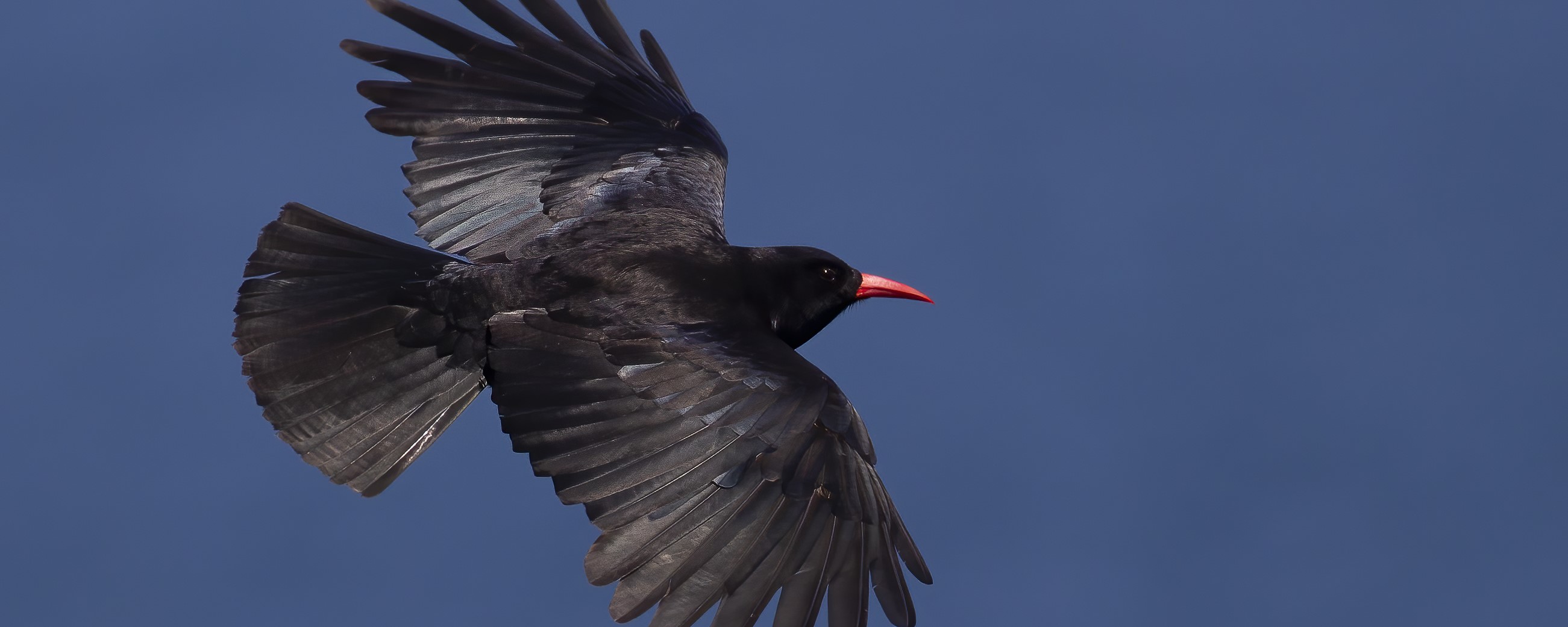
Chough
The Red-billed Chough is a rare, charismatic crow species whose identity is steeped in legend dating back to the death of Thomas Beckett some 850 years ago. Due to habitat loss, changes in farming practices and historical persecution, Choughs have been missing from many areas of the UK for centuries.
Choughs in Sussex were famously documented by Gilbert White. His Natural History of Selbourne (1786) contains the first key references to Choughs in letters he wrote to famous ornithologists of the time. In 1770 '...Cornish Chough builds, I know all along the chalky cliffs of the Sussex shore', and in 1771 'Cornish Choughs abound and breed on Beachey-Head and on all the cliffs of the Sussex coast'.
In Sussex, Chough disappeared as a breeding species in the early 1800s, but there was one sighting recorded by the Sussex Ornithological Society of a lone bird at Beachy Head on 23rd October 1996. Kent Wildlife Trust (KWT) and the Wildwood Trust have formed a partnership to reintroduce Choughs to Kent. Kent lost its Chough population around 200 years ago, and they are still present in much of the local imagery, appearing on pub signs and the Canterbury coat of arms. In 2022, six Choughs from Paradise Park in Cornwall joined a breeding programme at the Wildwood Trust. They were then released at a chalk grassland site near Dover in July 2023. Click here to find out the latest updates on the Kent project or email [email protected].
Sussex Wildlife Trust supports the restoration and/or natural recolonisation of this iconic species to its original habitat. Due to staffing limitations we are currently unable to support the Chough project directly. However we will be providing landowners and KWT with advice and information where we can and we hope to see Choughs back in the County soon.
The return of Choughs to Kent & Sussex will:
- demonstrate the incredible potential of conservation work to return missing species, and will pave the way for further habitat and species restoration across our Counties
- encourage farmers and landowners to reduce the use of worming treatments etc. in livestock, thereby benefitting the whole ecosystem, and particularly insects
- help engage communities in conservation due to their cultural and historical significance
Support our Species Recovery Fund appeal
