
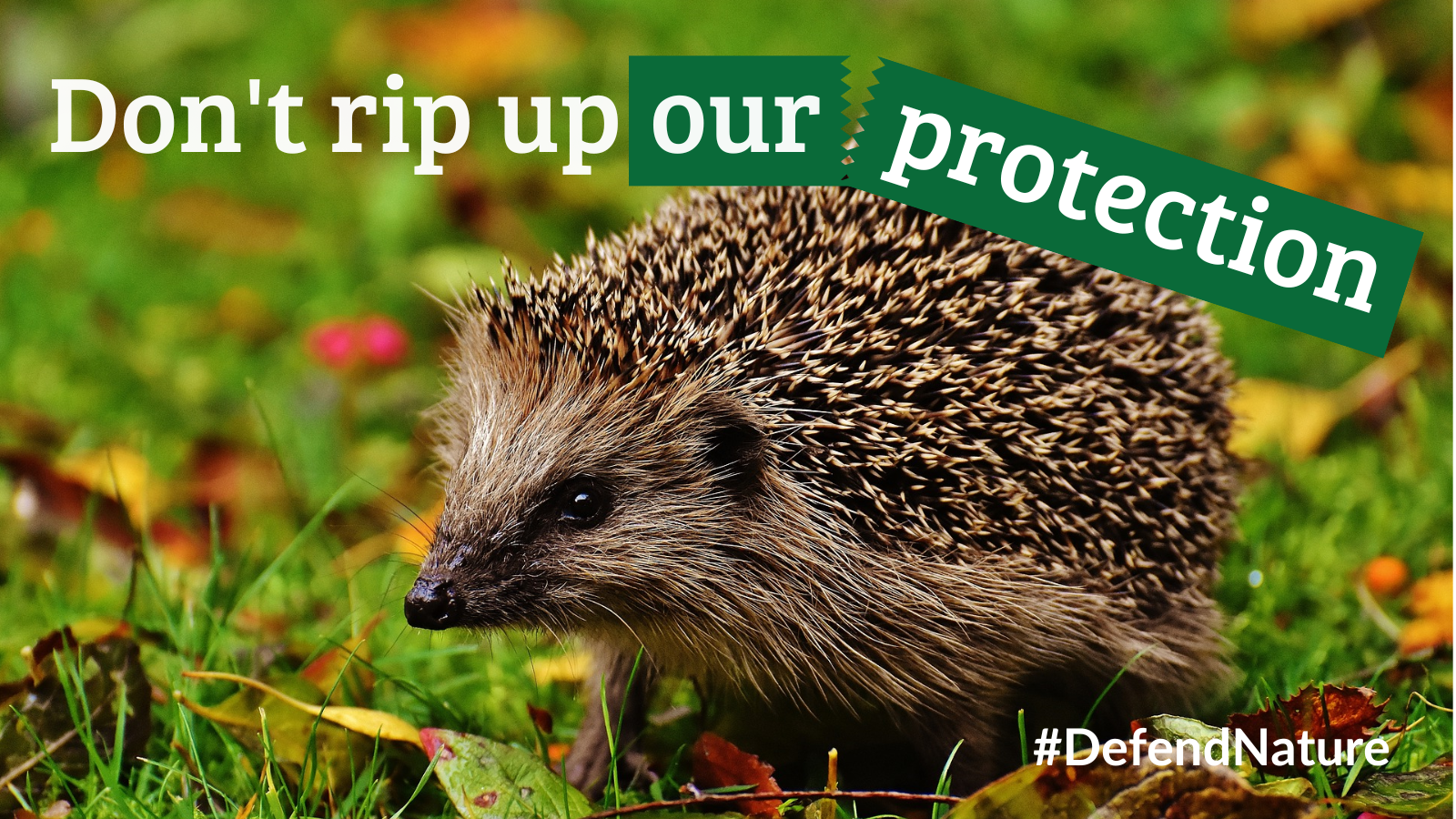
REUL Bill - don't rip up our protection
What is the REUL Bill?
The Retained EU Law (REUL) Bill will give the UK government the power to rip up a range of environmental protections, without any requirement to replace them. This Bill was introduced by the then-Business Secretary, Jacob Rees-Mogg, on 22 September 2022 and was pushed through by the government, with the intention of removing Retained EU Law from the UK as part of post-Brexit deregulation.
This has the potential to be a disaster for the environment, as it risks removing or weakening hundreds of fundamental environmental laws and regulations that protect wildlife and important nature sites, along with air quality and water pollution rules, standards for our ocean and much more. At a time when we’re facing huge declines in our wildlife, loss of local greenspaces, increasing pollution and a worsening climate crisis, nature needs more protection - not less.
The REUL Bill is controversial and has been widely criticised by trade unions, legal groups, civil society groups and academics as well as the environmental sector. However, the REUL Bill has been pushed through the Commons and the House Of Lords, where significant concerns have been raised. A number of helpful amendments were proposed, which would have safeguarded environmental protections, but MPs repeatedly voted against these. The REUL Bill will now become law without the promise of maintaining environmental protections.
Latest Update - 27 June 2023
Unfortunately, the REUL Bill will become law without the promise of maintaining the existing level of environmental protections.
Despite the best efforts of the Lords and some robust debate, the Westminster government rejected the two amendments on the interlinked issues of strengthening parliamentary scrutiny and preventing the regression of environmental protection.
This was the fourth round of ping-pong – the transit of the Bill between the House of Commons and the House of Lords – and the debate had become somewhat political, with concerns that the government was not following the usual process of making concessions. But neither Lord Anderson nor Lord Krebs pushed their amendment to a vote. The Bill will therefore now receive royal assent without those additional environmental safeguards.
However, the Lords were given some extra verbal assurances. These include:
- the Environment Act setting the context for the REUL powers
- recognition that the process should have due regard to the Environmental Principles Policy Statement
- a commitment to public consultation on all REUL.
We have worked with the Greener UK coalition to galvanise public pressure to influence the outcomes for the REUL Bill, and can count the deletion of the sunset clause as a significant win.
Despite this, our concerns remain that the refusal to offer proper parliamentary scrutiny will make it easier for future governments to weaken environmental protection, water quality standards and other EU-derived protections. But we hold onto the fact that Ministers are now on the record at every turn with promises not to weaken environmental protections, and will challenge them to keep to these promises.
Update - 12 June 2023
On 12 June, MPs voted on the latest amendments to the REUL Bill, which would have safeguarded the laws that protect nature.
Disappointingly, the government continues to oppose adding an environmental safeguard on the face of the bill and the majority of MPs voted against these amendments, meaning they were defeated for a second time (by 269 votes to 204) - despite the united voice of the public, the environment sector, experts, businesses, peers and the government's own independent watchdog (The Office for Environmental Protection) all supporting the sensible addition of an environmental safeguard.
The REUL Bill will return to the House of Lords for further debate on 20 June; and then pass back to the Commons on 21 June.
Update - 7 June 2023
The REUL Bill is now in a 'ping pong' phase, moving back and forth between the Commons and the Lords as various amendments are proposed until a final version is agreed. During this process, the same amendment cannot be made twice but with some careful re-working, a new amendment with the same overall effect could potentially be re-inserted. This is what we hoped to see when the REUL Bill returned to the House of Lords on 6 June, and we are delighted to say that two new amendments (which The Wildlife Trusts have been working on behind the scenes) have been put forward by a majority vote in the House of Lords:
- Lord Krebs laid a new Amendment 15, which still focused on non-regression of environmental laws and no weakening of International Conventions;
- and Lord Anderson laid Amendments 6 and 42, which asked for transparency and more scrutiny by Parliament.
The REUL Bill will now return to the Commons for MPs to consider and vote on the latest batch of amendments. Since the government has a majority, there's a risk they will vote the same way again and remove these amendments - but with such a clear majority in the Lords, we hope the government will take note of this clear signal to safeguard the environment.
Update - 25 May 2023
A crucial vote took place on Wednesday 24th May that could have serious ramifications for nature. Thousands of Wildlife Trust supporters acted fast to ask MPs to vote for an amendment to the Bill to ensure that the laws that protect nature are not weakened.
Disappointingly, despite almost 10,000 of you contacting MPs, the government and Conservative MPs voted down this amendment. The Bill will now be voted on in the House of Lords on 6th June, where we hope an amendment will be reinserted to ensure our environmental protections are not watered down.
Although the amendments were voted down by Conservative MPs, opposition MPs did back them and environmental concerns dominated the debate - because so many of our supporters wrote to their MPs.
We're still encouraging supporters to send postcards to their MPs as the Bill enters the final stages..
Update - 22 May 2023
A crucial vote is taking place this Wednesday 24th May that could have serious consequences for nature. Read more in our latest blog.
Important amendments to the REUL Bill were put forward last week in the House of Lords. MPs will be voting on these amendments this Wednesday 24 May. They provide a crucial, but small, window of opportunity to change the worst parts of the Bill, and we need all MPs to vote Yes to these amendments on 24 May. We will be contacting all Sussex MPs direct but we also need your help.
We asked you to contact your MP via our e-action, asking them to support Amendment 48. A huge thank you to everyone who did - in total, 187 emails were sent to Sussex MPs, with all 16 MPS contacted. Across the UK 8,969 emails were sent to MPs in less than 48 hours, sending a strong message that the public does not want to see the laws that protect nature weakened.
Update - 15 May 2023
The UK government had been forging forward with a ‘sunset clause’ on the Retained EU Law Bill that would bulldoze hundreds of important laws that protect nature and people at the end of the year (2023).
On 15 May 2023, UK government announced that it had scrapped the ‘sunset clause’, which means many vital environmental laws will remain in place in 2024. Your passionate postcards, emails and tweets to MPs raised the alarm. Thank you for your support. However, the fight is not yet over.
Craig Bennett, chief executive of The Wildlife Trusts, says:
“We won’t be congratulating UK Government for its decision to stop doing something it should never have even thought about in the first place. The UK Government’s Retained EU Law bill has been a shambles from the very beginning. Now it has ditched the ‘sunset clause’, which threatened to dismantle most Retained EU Law at the end of this year and posed an immediate threat to vital laws that protect nature and people. However, the huge problem posed by the bill still remains because it will allow future governments to revoke important laws at whim, whenever they want to.
“Ministers should never be given carte blanche to pick and choose which laws should be kept or binned without public consultation or scrutiny – that is fundamentally undemocratic. The uncertainty created by UK Government over Retained EU Law has caused huge problems for business, as well as organisations working to protect nature. Ministers must stop seeing environmental law as a burden because it helps stop more sewage entering our rives and ensures food is safe to eat. Given the urgent need to address the nature and climate crisis, they should be strengthening protections, not ripping them apart.”
Update - 10 May 2023
Today the government announced an amendment to the REUL Bill to remove the problematic 'sunset clause' - its self-imposed deadline of 31 December 2023, which would have seen all Retained EU Law binned automatically unless it had been specifically 'saved' beforehand. You can read the official government statement here: https://questions-statements.parliament.uk/written-statements/detail/2023-05-10/hcws764
This is good news, since hundreds of vital environmental protections and regulations were at risk, alongside thousands of other laws protecting public health and wellbeing. Instead of the sunset clause, the government has now proposed a list of 600 pieces of Retained EU Law to be scrapped, with 371 of these belonging to Defra. Of these, the majority (338) are listed as redundant, 18 as duplicate or superseded, and 15 are amendments to regulations also in the revocation schedule. We will be looking at this list in more detail to make sure that nothing important is lost.
However, the UK's fundamental EU-derived environmental protections and regulations are not necessarily safe. The REUL Bill will still allow the government to remove or weaken environmental protections and other laws at whim in the future, without consultation or scrutiny; and the Bill still contains a worrying clause stating that any reform of regulations cannot increase the 'regulatory burden', even if that burden amounts only to 'administrative inconvenience'. This means that regulations cannot be strengthened and if the government continues to see environmental protections as a burden, there's a risk they will be weakened - at a time when nature urgently needs more protection, not less. The controversial REUL Bill therefore remains a major threat and our Defend Nature campaign will continue.
Currently, the REUL Bill is passing through the House of Lords, where the next debate will begin on 15 May. We hope to see further amendments to address the issues that remain with this controversial Bill and will be contacting MPs later this month to encourage them to support any amendments made in the Lords.
What's wrong with the REUL Bill?
This blog from Wildlife and Countryside Link sets out the fundamental problems with the REUL Bill, but in summary:
- There are thousands of pieces of legislation up for review, including fundamental environmental protections and regulations
- Unless specifically saved by Ministers, laws will automatically be “turned off” on 31 December 2023 - including laws that Ministers haven’t even looked at because they didn’t know they contained EU-derived parts - UPDATE: the government amended the REUL Bill to remove the 'sunset clause' on 15 May 2023
- Ministers will be able to chop, change and cherry pick laws with no requirement for expert advice, public consultation or test of effectiveness. There is huge scope for error and unintended consequences.
- There is a deregulatory 'lock in' which means that laws can’t be changed in a way that would “increase the regulatory burden” on businesses. This means laws cannot be made stronger, and follows an out-dated view of regulation that focuses entirely on the costs to business and ignores the real world benefits that the people living and working in Sussex receive.
- The work involved in reviewing thousands of pieces of legislation in a year will divert people and resources away from other important pieces of work that the UK government desperately need to prioritise.
Defra is already shockingly behind schedule, and the immense workload and tight deadline presented by the REUL Bill will cause even further delays to critical work underway in Sussex to progress elements of the government's new Environment Act. Much of this work is waiting on detail from Defra, which they won't be able to provide if their staff time is diverted to reviewing legislation. Defra has already missed its first environmental deadline under the Environment Act; it is delayed on River Basin Management, its pesticides plan, chemicals policy, waste and resources management, animal welfare reform and more. This environmental programme is fundamental to achieving the government’s manifesto promises on the environment and will be even further delayed by the huge volume of work created by the REUL Bill - a delay we simply cannot afford as we strive to respond to the climate and biodiversity crisis.
Which laws are at risk?
The UK government’s own interactive dashboard includes over 2,400 pieces of Retained EU Law, but this does not represent a final list – civil servants are still doing the work to identify how much REUL is on the statute books.
So far 1,671 of these relate to the environment. The rest relate to other important issues including your right to paid annual leave; equal pay for men and women; minimum food hygiene standards; food labelling for allergens; as well as banning cosmetic testing on animals and trading goods that may be used abroad for capital punishment.
Some of the key environmental laws at risk include:
- The Conservation of Habitats and Species Regulations 2017: rules that protect hundreds of wildlife sites from unsustainable development and safeguard threatened species from destruction, including Rye Harbour Nature Reserve, the Ashdown Forest, Ebernoe Common and Pagham Harbour.
- The Water Environment (Water Framework Directive) (England and Wales) Regulations 2017: the laws that set strict standards for rivers and streams, guarding against pollution and over-abstraction (unsustainable use of water).
- The Air Quality Standards Regulations 2010: imposing limits on toxic air pollution, such as particulate matter, which is responsible for widespread environmental harm and serious harm to human health.
- The Marine Strategy Regulations 2010: requiring government to implement plans for the protection of our seas and vulnerable sea life.
How you can help
Thank you to everyone who has supported our Defend Nature campaign by contacting their MP or sending a campaign postcard.
Environmental protections remain at risk, and nature is facing threats at every turn. We all need to act together NOW to #DefendNature.
Send a postcard to your MP today