
The Sussex Trug
Guest blog by Sarah Page from The Truggery
The Basket of the Weald
On a clear day, looking beyond the criss-cross stacks of chestnut poles and willow clefts, over on the other side of the Levels I can see the outline of the ancient ruins of Pevensey Castle. To the right is Eastbourne and the shadowy South Downs. I marvel at this view most days and think how fortunate I am to work in such surroundings. This area behind my workshop in Herstmonceux is piled up with the wood needed over the next year to make traditional Sussex Trugs. The little shingle tiled workshop houses tools and equipment that were used by Reuben Reed who came here in 1899. I have lived here since 1995 and worked alongside people who worked with trugmakers born in the early years of the twentieth century, each generation passing on their acquired knowledge. Little has changed. The use of a mechanical saw was introduced in the 1930s and the steamer went from wood fired to electric in the 1970s. The drawknife used to shave the frames and boards by hand remains the most important of the trugmaker’s tools.
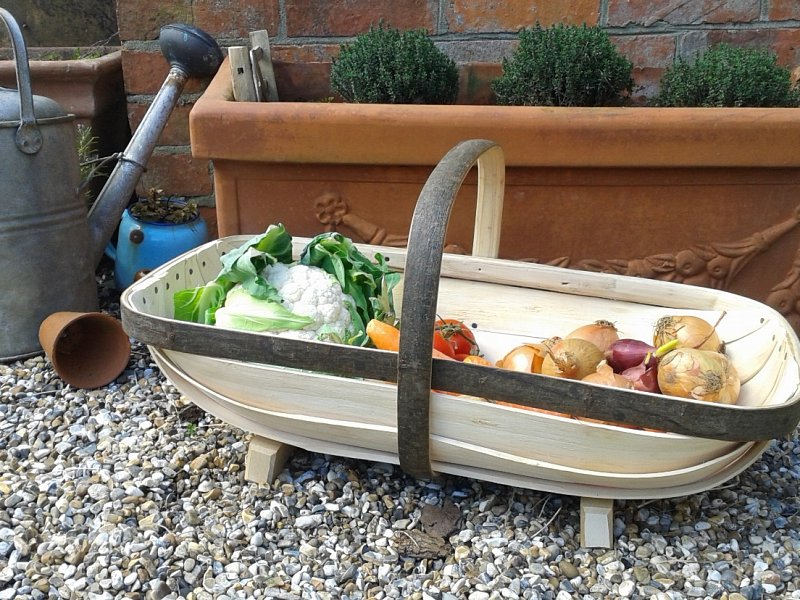
People who are not native to Sussex may look bemused when they hear the word ‘trug’, but if you point out the wooden garden basket often seen in period dramas or carried by famous gardening gurus, they will soon understand. So – why ‘trug’, and why ‘Sussex’? Firstly, the word trug is derived from the anglo saxon ‘trog’ meaning boat shaped vessel. It also has origins in Old Norse and Old German. In modern german it is a verb form of ‘carry’. We can see the roots in our modern words of truck and trough which are both movable containers. Secondly, historically trugs seem rarely to have been made outside of Sussex. There have been a few makers in Kent and Surrey and inevitably some itinerant workers who would have made trugs as well as many of the other products of the underwoodsman.
It is said by some that the Sussex Trug was invented by Thomas Smith from Herstmonceux in East Sussex in the early eighteen hundreds. However, records show trugmakers in the sixteenth century working in Slaugham in West Sussex, also in Hellingly and Newhaven in East Sussex. There are roads, farms and houses with trug in the name that date back hundreds of years. It is possible that early trugs may have been more like a carved out trough and later refined but I imagine that changes in design would have taken place gradually over very many years. There are certainly links to hoopers who made the wooden hoops that go around casks and barrels. Trugmaking families in East Hoathly and Cowbeech claimed to have been making trugs earlier than Mr Smith but this is unproven since both businesses suffered devastating fires and there is no written record.

A.H.Rich of East Hoathly Steam Works
Crops need to be harvested - in the past this was all done by hand and placed in a basket. Most regions had their own particular basket fashioned from their local materials, for example the swill basket from Cumbria with its hazel frame and riven, boiled oak slats. Somerset and Norfolk are well known for their woven osier willow baskets. One feature which stands out is that the trug is a basket held together with nails. The Weald had an important iron industry from pre Roman times meaning that nails could be used perhaps much earlier than many other regions. Our coppiced woodlands, a lot of which was managed to provide fuel for smelting and forging iron as well as producing charcoal and gunpowder, provided wood of ideal size to make the trug frames. This was often ash and later sweet chestnut. The boards of the trug are made of willow which grows well on our marshlands and close to the fast running ghylls and streams, although since the mid twentieth century it is mainly the offcuts from cricket bat willow that are used.

Sweet chestnut coppice
Herstmonceux became known as a centre for trugmaking following the success of the Great Exhibition of 1851 where Sussex Trugs were shown and consequently admired by Queen Victoria. The maker, Thomas Smith, was awarded a medal and received an order from the Queen. He completed the order, loaded the trugs into a wheelbarrow and, with his brother Stephen, walked all the way to Buckingham Palace to deliver them personally. The commercial directories at the turn of the nineteenth century record a number of trugmakers working in very close proximity so there must have been plenty of trade. It is notable too that most of them were in some way related, particularly the families of Smith, Reed and Newnham.
As trugs were mainly used in agriculture their use has diminished and they are not the essential tool that they once were. Modern farming methods could have rendered the craft of trugmaking redundant but the gardener still has not found a better alternative. Fortunately there are still those who appreciate a hand-made object that is as attractive as it is useful. Trugmaking is a skill that takes a long time to master. It is painstaking and laborious work with few practitioners. People who earn their living from trugmaking can now be counted on one hand. Recently the Sussex Trug Basket Makers Association was formed to try and protect the craft. Members must uphold the traditions, use the correct materials and make their trugs according to strict criteria. Approved members are allowed to use a special stamp on trugs they have made. Hopefully this will help keep standards high, the craft alive and also avoid confusion with inferior copies. This very localised craft was highlighted in May 2015 with the Gold Medal winning design of A Trugmaker’s Garden to show how important it is to preserve and pass on the trugmaker’s skills.
Sarah has kindly donated a Sussex Trug to be raffled at the Sussex Prairies Open Day on Sunday 26 June in aid of the Sussex Wildlife Trust.
Comments
I am retired living in Lamberhurst where my grandfather made trugs amongst other things. I’m looking for a short course in trug making sometime after April. Can you help please.
Many thanks, Martin
02 Mar 2020 05:22:00
What a fascinating article ! Although I’m an actor I love working with wood, carving mostly. I just hope that the skills, not only of trug making but hurdles and turning too plus many other wood working skills keep alive.
10 Oct 2025 10:45:00