
Jersey Tigers: sign of the times
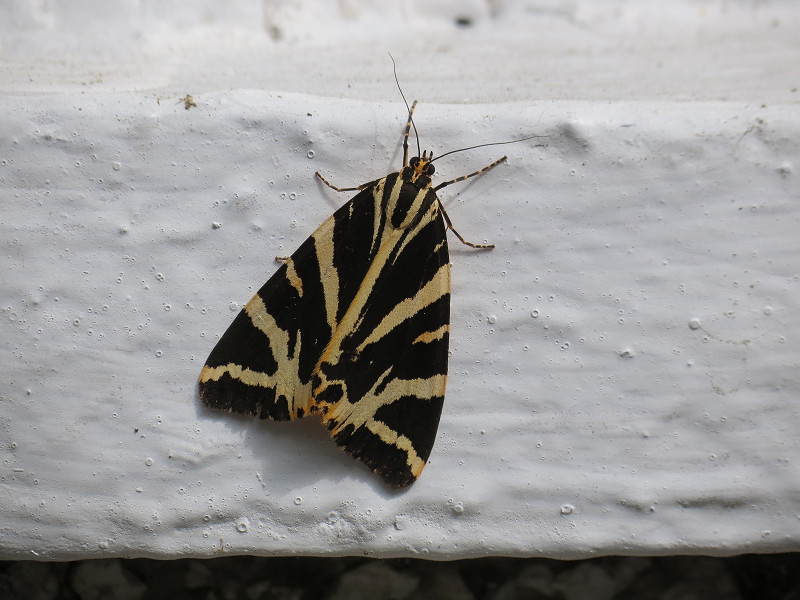
It started a couple of weeks ago, after we published a post about black and white butterflies. We began getting messages about an insect we hadn't featured - not a butterfly, but a big, day-flying moth with stripy almost-black-and-white wings, and which many people hadn't noticed much before.
Until just a few years ago, Jersey Tiger moths were scarce and localised in the UK. The name is a clue - Jersey in the Channel Islands (and a small part of Devon) being about as far north as you could reasonably expect to see one.
Many of our familiar insect species are vanishing, and overall numbers of insects continue to plummet. Some 59% fewer insect 'splats' were recorded on car registration plates last year in the UK compared to five years before, according to research by Buglife and Kent Wildlife Trust - that's approximately one in every five of our insects disappearing each year.
There are lots of factors at play here - from the water quality of our rivers and ponds to pesticide use and destruction of habitats. And one of the biggest appears to be the breakdown of our familiar climate, with wetter winters, drier summers and new heat extremes that are all too obvious in July 2026.
Sussex is on the frontline of climate change in the UK, and exotic southerly species becoming established here are a sign of the times. We're seeing it with the appearance of butterflies such as the Long-tailed Blue, with dragonflies such as the Norfolk Hawker, and with moths such as the Jersey Tiger.
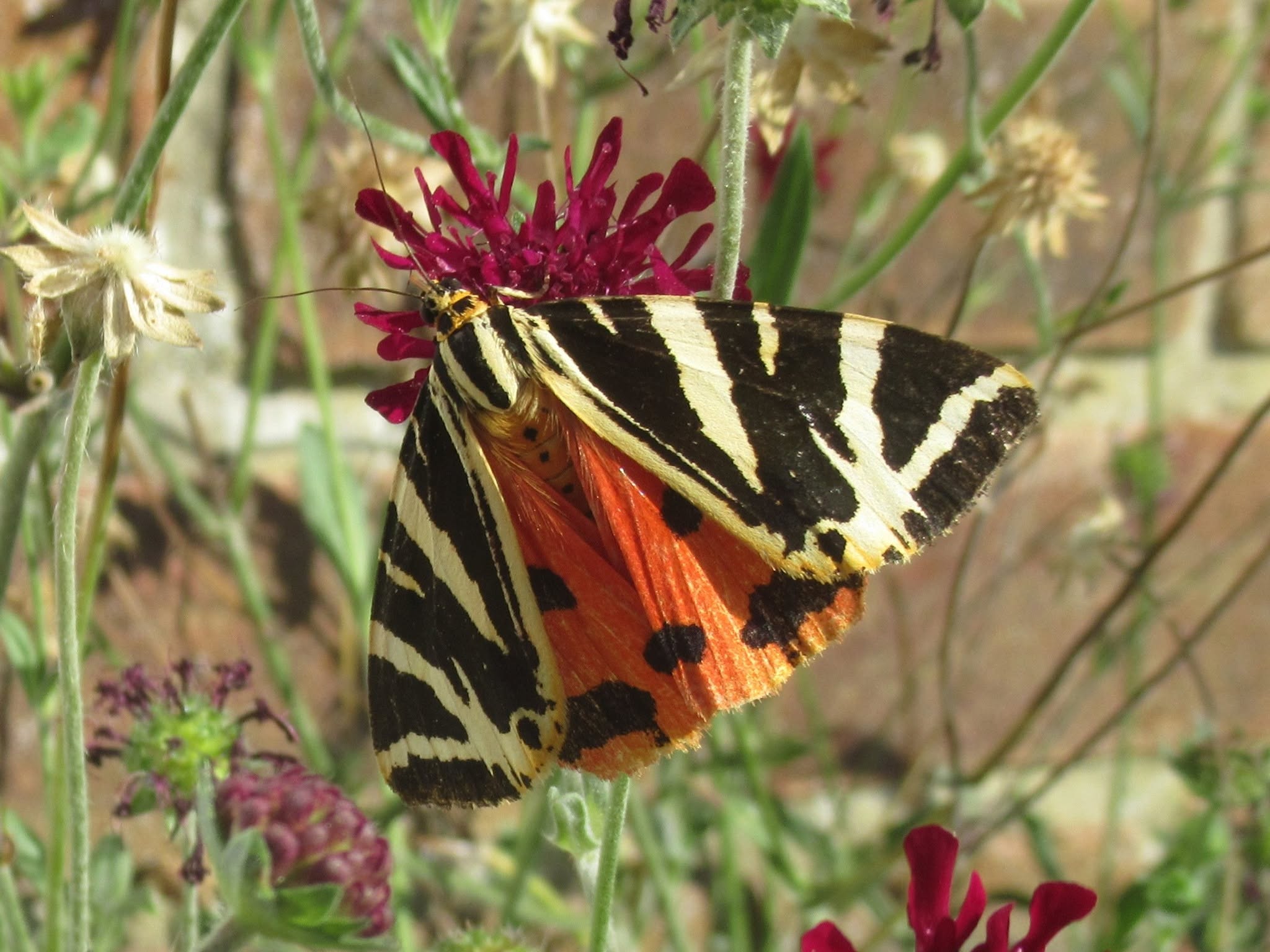
The Jersey Tigers, in particular, are not going unnoticed.
Last Friday, we posted an image of one to social media and asked who was seeing them where they live. Three days later more than 5,000 people had commented on Facebook to report their sightings.
They are being found in gardens, parks and green spaces across Sussex, and way beyond, in London, in the West Country, in Wales and further north. People are rescuing them from conservatories, kitchen windowsills and sometimes from ponds.
A lot of people are snapping them with their phones - they tend to be "polite enough to pause for a photo" as one Facebook contributor put it.
But it's also because they're really rather swish. As if the cream-and-black streaking and shapely swept-back wings weren't enough, they flash a deep orange on their hindwings when they fly (and sometimes when at rest too).
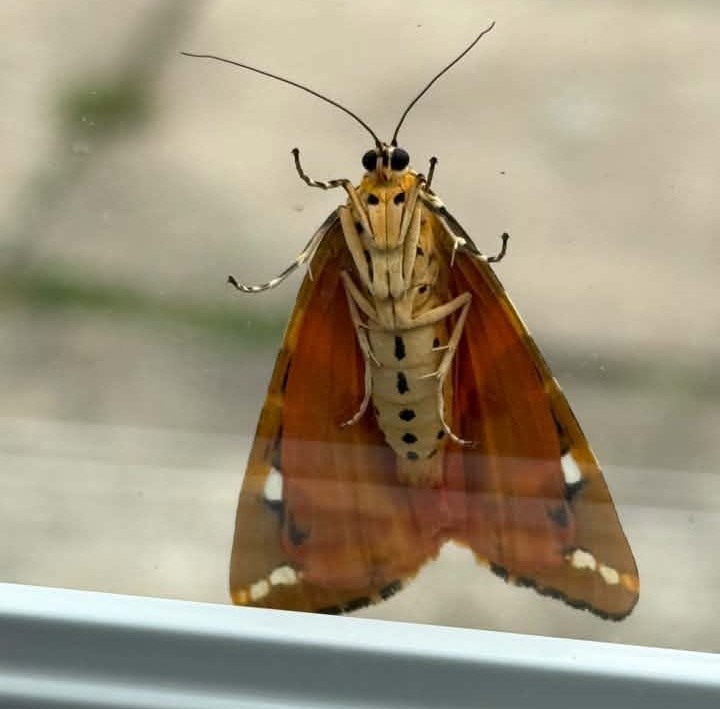
They even look great 'the wrong way round', as several people noticed from the other side of a pane of glass.
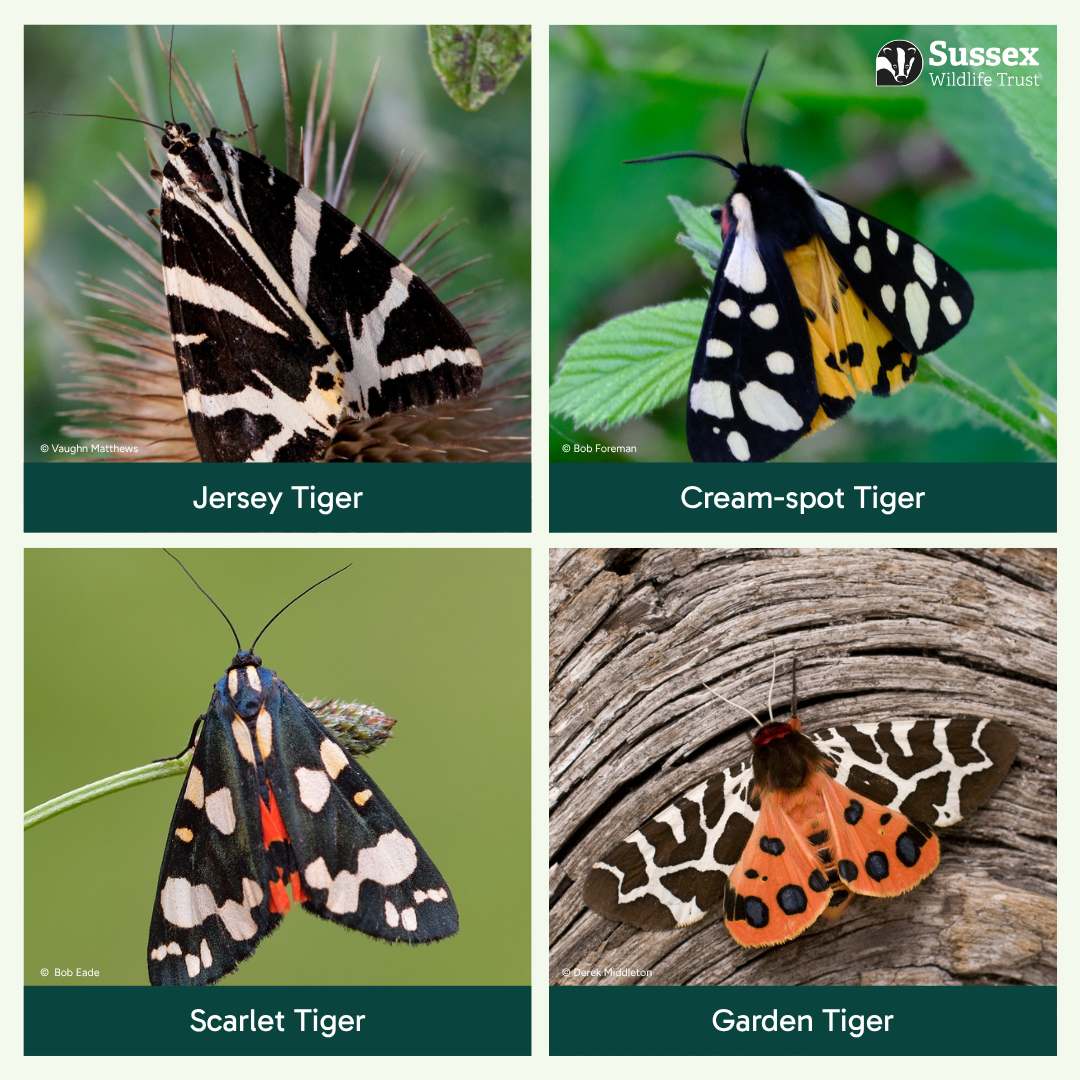
The pattern on the upper wings is particularly distinctive. As one commenter put it: "This looked like one of my son's school shirts many years ago when I was ironing and got distracted by something on telly."
The stripiness, rather than spotty or blobbiness, is a helpful way to tell them from our other 'tigers'.
Have you counted for the Big Butterfly Count yet? Jersey Tigers are one of the non-butterfly species you can include on your 15-minute count.
Comments
We saw a Jersey Tiger on Sunday, at the top of Castle Fields in Berkhamsted Hertfordshire, having seen one last year on Hayling Island.
30 Jul 2026 11:18:00
I Saw one in my garden on my raspberry bush last week in Hastings, East Sussex. I wondered what it was and now I know.
30 Jul 2026 11:28:00
Have been getting 3/4 Jersey Tigers in my trap for the last 10 days
30 Jul 2026 11:42:00
Saw a Jersey Tiger about 3days ago and could identify on the Butterfly count. Not a great fan of moths but was amazed at this one.
30 Jul 2026 11:55:00
Hummingbird hawkmoth(s) seen in 2 separate gardens in Grove Road chichester po19 8ap. Want to add to big butterfly count but can’t find a way. Any suggestions? 30.07.26
30 Jul 2026 12:49:00
I came across a Jersey Tiger in my garden in Crowborough for the first time on Monday
30 Jul 2026 13:04:00
I live near Eastbourne East Sussex and I have had the pleasure of seeing a beautiful Jersey Tiger moth over several days this week. I don’t know if I am seeing the same individual or there are more than one.
30 Jul 2026 14:13:00
Can confirm they’ve arrived in Crawley 29/07/2026
30 Jul 2026 14:26:00
Seen my first Jersey Tiger on our front steps at home in centtral Brighton on tues 28th. It imediately flew off, and settled in the shade of a hubcap on car parked outside. Stayed perfectly still once there.
We’ve had lots of Scarlet Tiger’s in Brighton for last 6 years. They breed on our allotment site but not seen Jersey ones.
30 Jul 2026 14:28:00
I’ve seen both scarlet and jersey tigers in my garden or near my house in Eastbourne in the last few years. I don’t recall seeing them before about 7 or 8 years ago.
30 Jul 2026 15:09:00
I’ve see two – both in my kitchen, in rural Surrey.
I’ve also seen Hummingbird Hawk Moths this summer and shared a video with The Butterfly Conservation.
30 Jul 2026 15:30:00
Saw one this week in our garden near the sea In Rustington.
30 Jul 2026 16:01:00
Very striking mothI haven’t seen one yet.
30 Jul 2026 16:26:00
Very striking mothI haven’t seen one yet.
30 Jul 2026 16:26:00
We had one in our hallway in Lewes in the evening two days ago. It was so beautiful and distinctive and we couldn’t identify it until now
30 Jul 2026 16:38:00
We had a Jersey Tiger Moth in our garden this week in East Sussex
30 Jul 2026 17:05:00
I am excited to read your piece on jersey tiger. My grand daughter saw one in deep park london. I saw one in a garden in lewes. I was trying to find what it was and then saw one in a house in barcombe and managed to take a photo.
30 Jul 2026 21:18:00
I have had a Jersey Tiger Moth in my garden in July every year for past three or four years. Beautiful creatures that sleep on my roses, Laurel or a patch of Ivy.
31 Jul 2026 08:04:00
I have had a Jersey Tiger Moth in my garden in July every year for past three or four years. Beautiful creatures that sleep on my roses, Laurel or a patch of Ivy.
31 Jul 2026 10:12:00
I had a Jersey Tiger Moth flying about in my house (Steyning West Sussex) last week. Managed to get a picture of it at rest complementing my gorgeous colourful curtain. After a few days it decided to fly away and found a way out.
31 Jul 2026 15:51:00
I am staying at my sister’s in Dartford and saw this beautiful butterfly..
01 Aug 2026 05:33:00
I had a Jersey Tiger Moth in plant undergrowth in my garden on 4th July 2026, and on the same day I watched a Hummingbuird Hawk moth on my clump of Phlox flowers. I also had a pair of Jersey Tiger Moths in Wisteria at the Horsham Museum Garden about three years ago.
01 Aug 2026 09:20:00
I had a Jersey Tiger Moth in plant undergrowth in my garden on 4th July 2026, and on the same day I watched a Hummingbuird Hawk moth on my clump of Phlox flowers. I also had a pair of Jersey Tiger Moths in Wisteria at the Horsham Museum Garden about three years ago.
01 Aug 2026 09:20:39
We have seen a Jersey Tiger several times in our garden this year. It flies around our damson trees and our privet hedge. We live in Farnham, Surrey, GU9 7DD
01 Aug 2026 16:02:00
Just seen a pair of Jersey Tiger moths in Bexhill this evening, on a wooden fence and a gate.
01 Aug 2026 21:19:00
Spotted a jersey tiger on 16th July. It was camouflaged landed on a piece of hessian drying on my washing line. It was so unusual with its stripes that I looked it up to identify it.
02 Aug 2026 08:26:00
I’ve see two – both in my kitchen, in rural Surrey.
I’ve also seen Hummingbird Hawk Moths this summer and shared a video with The Butterfly Conservation.
02 Aug 2026 19:03:00
Yes had one on double glazed conservatory door so
Took images both sides. Lovely to see a new friend in the garden. Will keep looking for the others.
Love to everyone who cares for nature. At 83 I love to sit and watch all the birds I feed and water of course. P
03 Aug 2026 13:42:00
Seen in Pevensey and Hankham
03 Aug 2026 13:49:00
Our two year old daughter was absolutely fascinated by one of these we saw outside Arundel Cathedral. But we wouldn’t have known what it was if it wasn’t for the wonderful Sussex Wildlife Trust – thank you, SWT!
04 Aug 2026 10:20:00