
Fungi Rainbow
By Clare Blencowe
Sussex Biodiversity Records Centre Manager
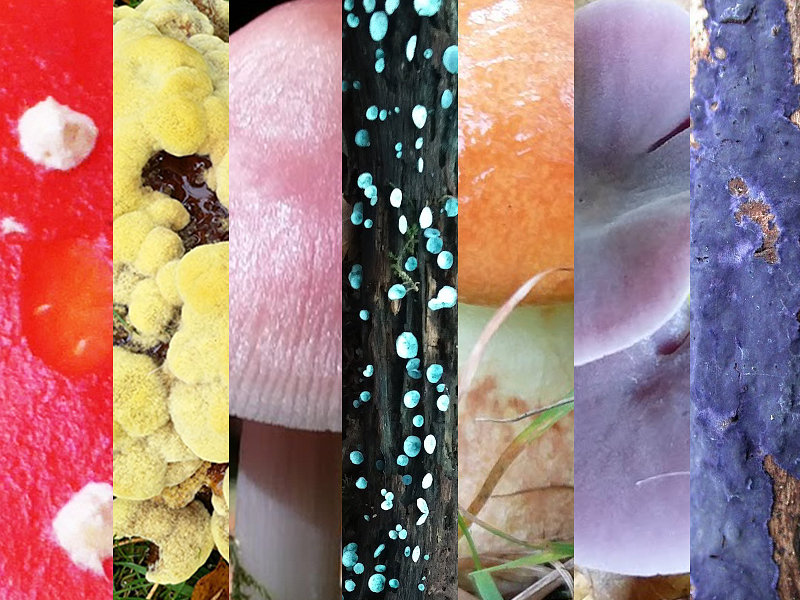
With UK Fungus Day just around the corner, I thought I’d share a few of the fungi that have caught my eye recently. It’s been a great season so far, and you can find fruit bodies in all the colours of the rainbow, right here in Sussex.
RED – Fly Agaric
This well-known red mushroom with white spots on top was standing proud in Worth Park, Crawley, last weekend. Proving you don’t have to venture into the wilds of Sussex to find amazing mushrooms – they’ll be popping up in parks and gardens too.

YELLOW – Dyer’s Mazegill
This can appear as a really freakish-looking thing! It grows on buried roots or stumps of conifers. The young fruit bodies appear as a yellow, felty, spongy mass but can look very different as they mature, as they turn red-brown and develop into a bracket shape. It was traditionally used in dyeing yarn various shades of yellow, orange and brown.

PINK – Rosy Bonnet
It’s quite common to come across pink mushrooms growing among leaf litter in the woods. There are a few different species that can look very similar. These mushrooms smelt strongly of radishes, which I think makes them rosy bonnet.

GREEN – Green Elfcup
If you’ve ever seen rotting branches lying around on the woodland floor which look like they’ve turned green, what you’re seeing is the green elfcup fungus. Most of the time it lives in the wood, as a ‘mycelium’ – a branching mass of minute fungal threads – but if you’re really lucky you may see the fruit bodies, which are what gives this species its common name: green elfcup.

ORANGE – Larch Bolete
On a Sussex Fungus Group foray in Tilgate Park last weekend, with Kevin Lerwill from the Gatwick Greenspace Partnership, we came across this patch of young larch boletes. As well as being really orange, they’re REALLY SLIMY! But I think they’re gorgeous.

PURPLE – Amethyst Deceiver
Another gorgeous-looking mushroom which is quite common in woodland. It comes from a group of mushrooms called ‘the deceivers’ because they can be very variable in how they look. You need to find them when they’re young and fresh to see their vivid colours; they will turn a pale grey or beige as they age.

BLUE – Cobalt Crust
This is a species I’ve never seen, but Sussex Wildlife Trust ecologist Graeme Lyons found it at Sussex Wildlife Trust’s small reserve in Brighton: the Deneway, back in January.
This striking blue crust fungus is unmistakable. I’d love to find it!

All photos by Clare Blencowe, except cobalt crust by Graeme Lyons
Comments
Fungi is fascinating! This is a great read!
03 Oct 2020 12:30:00
Very well received and helpful.
28 Sep 2021 10:17:00