
Woods Mill, home of the Turtle Dove

Chris Corrigan, Interim CEO
For a nature lover like me, there are many downsides to working in an office. However, a short stroll from our Woods Mill office takes me to Nightingale Bridge, where (of course) a Nightingale belts out it’s incredible song and a Turtle Dove purrs quietly nearby. This combination is rare indeed, although Sussex is one of the last strongholds for both these wonderful birds.
Although it is a privilege to have a Turtle Dove so close to the office, the tragedy is that Turtle Dove numbers have collapsed since I first moved to Sussex in 1990. Even by that point, the population decline was well underway. The autumn flocks of 50 or more in the 1960s and 70s are hard to imagine in 2023, when seeing even one is a birding red-letter day. Indeed, monitoring by volunteers and co-ordinated by the British Trust for Ornithology (BTO), shows the population declined by a staggering 99% between 1967 and 2020. The Turtle Dove has the unwanted top spot as the fastest declining UK bird and there are now only just over 2000 pairs left.
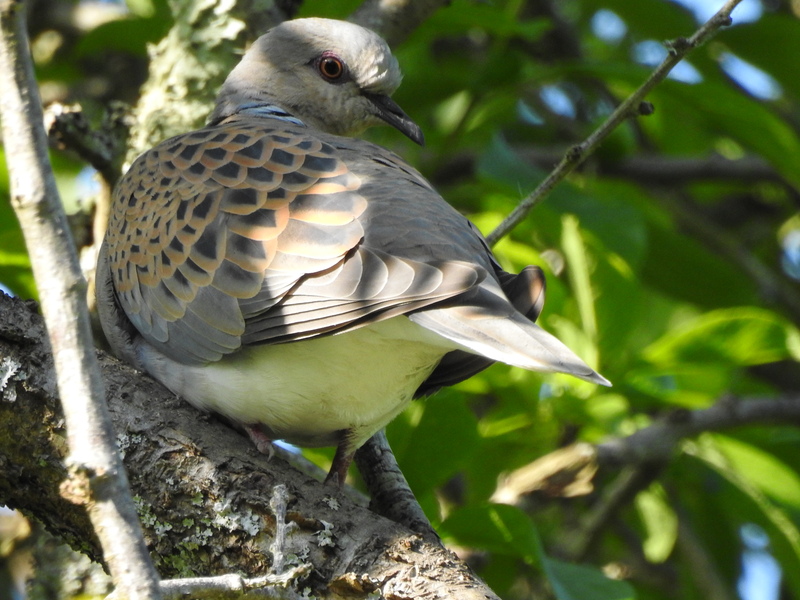
This is a tragic situation and reflects the multiplicity of challenges facing the Turtle Dove. Like many farmland birds, they have been affected by agricultural intensification, including the loss of hedgerows and the disappearance of arable plants (a term I prefer to ‘weeds’). Pairs now make fewer nesting attempts and raise only half as many chicks as in the 1970s, probably linked to food availability. They are also hunted in their millions on migration and on their wintering grounds in sub-Saharan West Africa. In the UK they are also susceptible to a new disease called Trichomoniasis. With such a heady mix of challenges it is no wonder it is a bird in such big trouble.
This all sounds gloomy. However, there is hope and the Turtle Dove, like so much in the natural world, can be remarkably resilient if we can create the conditions for success. The biggest difference would be to double the number of chicks produced in the UK, back to the level of the 1970s. This would go a long way to halting and reversing the population decline despite the hunting (although we need less of this!) and habitat degradation which is likely to be a factor in the African wintering grounds.
At Woods Mill we have the thick scrub and habitat conditions perfect for nesting. No wonder we still have birds when they have disappeared from so much of Sussex. Knepp has also shown that Turtle Doves can flourish if we create the right conditions of thick hedgerows and less intensive management with access to good feeding habitat (lots of lovely natural seeds, the more ‘weeds’ the better)
A few years ago, I brought my children to Woods Mill to listen to the Turtle Doves. I was afraid they would be gone from Sussex by the time they became adults, and this was an insurance policy so the Turtle Dove would be a real memory rather than a bird they knew about only from my stories. I am proud of our work which means that my children are now in their 20s and the Woods Mill Turtle Doves are still here. However, to truly succeed we need to make sure Turtle Doves increase and escape from the last remnant populations clinging on to a few small sites like ours.
Meanwhile, I will continue to thoroughly enjoy the purring Turtle Dove a short stroll from my desk. I live in hope that we can transform the fortunes of this iconic bird. We know what needs to be done and we are committed to being part of the challenging but essential recovery effort.
Comments
What a lovely story, thank you for sharing. Albeit the decline of the Turtle Dove is shocking we can make a difference as Woods Mill proves.
06 Jun 2023 10:47:00
So sad & so easy to improve habitat to sustain them. Let’s hope it improves soon.
08 Jun 2023 10:39:00
Thank you for the beautiful pictures of a beautiful bird.
08 Jun 2023 10:52:00
Pleased to hear that they are still in Sussex.
About 8-10 years ago a pair arrived on our property near Battle. They came for a few years but have not seen them for quite a while. At the time I didn’t realise how special they are.
08 Jun 2023 11:15:00
A few years ago, on a walk near our East Ashling home, we heard one purring. Magic! We couldn’t catch a glimpse because it was on private land. We haven’t heard it since but we don’t go that way often so hopefully it is still returning there.
08 Jun 2023 11:35:00
How lovely as i to get turtle doves in my garden?
08 Jun 2023 11:53:00
And the accompanying requirement is to protect their flyways such as that linking Sussex to the Gambia
08 Jun 2023 12:50:00
We love to hear the Turtle Dove at Woods Mill and my husband has managed to get a photo or two. So sad that they are in such decline. Hopefully they will always make it back here .
08 Jun 2023 13:20:00
I live in East Wittering and we had a Turtle Dove in our garden in May 2021. I presume it was passing through. I took photos.
08 Jun 2023 13:24:00
Your work is great and producing wonderful results, keep it up ! am planting hedgerows in my modest garden in Surrey and often think I can hear a gentle purring but haven’t identified the source. I live in hope.Eileen Slater
08 Jun 2023 15:18:00
I lived in Burwash as a teenager between 1949 and 1958 and turtle doves could be heard every summer from our garden on the edge of the village. Leaning out of the bathroom window late on summer evenings Nightingales could be heard singing in nearby woodland. Keep up the good work – we don’t get either species up here in Anglesey but we still have Swifts!
08 Jun 2023 20:34:00
Morning Chris,
I echo your comments totally, in fact you have made me think that i to should take my Son and Grandson to Woods Mill to enjoy such an experience. I am also “fighting” my own local battle to save the last small pocket of nesting swifts in Southwick. P.S. Last year a Turtle Dove stopped off in our garden for 5 glorious days!
David Smith
09 Jun 2023 04:50:00
Are there any orgs in Africa that are working to lessen the devastating effect their killing has?
09 Jun 2023 09:21:00
Sussex Wildlife Trust:
Visit the Operation Turtle Dove website
Thank you Chris for your most informative article. And Neale for the superb photo.
09 Jun 2023 11:40:00
The decline of 99% in the 63 years up to 2020 is so staggering it’s almost impossible for me to contemplate. 1967 is a very real year for me as I started at university, yet for younger people who don’t have a point of reference it is literally time out of mind, so extremely hard to understand what a relatively short time this is. Well done to all the young people who are campaigning. That’s the problem for so much in the sphere of climate or biodiversity, people generally find it all unreal.
As for hunting, it’s incomprehensible that anyone wants to go out & shoot anything that moves, but the politics of it & hanging on to votes is so entrenched that even when the majority in a country are against hunting the politicos rarely follow the general will.
I’m delighted to hear of the doves’ presence at Woods Mill, and thanks for the beautiful photos.
09 Jun 2023 12:39:00
I moved to a semi rural, agricultural area of W. Sussex, in 2015. There are overgrown hedgerows, untended grass verges with weeds a plenty. Rough grass paddocks and arable, plus salad crop, open fields. My lane is now a dead end, due to the building of a bypass. There is a LNR at the end of the lane, a wet woodland area along a rife. In the summer of 2016, there was the purring call of a turtle dove to be heard in the scrubby hedgerow. I recorded this with the BTO but, sadly, no further calls were heard, since then. Similarly, we had regular visits from cuckoos and nightingales but these have also declined. I am aware of the “Project Turtle Dove “ which involved putting out seed in specific places. This fragment of rural Sussex is under major threat of development. The big, local landowner being one of the property developers. I have contacted several organisations but no one is interested in nurturing this area and wildlife.
09 Jun 2023 15:11:00
Thanks for that helpful information. I hope that the decline can be reversed.
Padraig
09 Jun 2023 21:50:00
Thank you for your work to help this bird. I moved to Arlington, East Sussex 9 years ago and used to hear them all the time in summer. However I’ve not heard a single one fir the last 2 years. I’m so sad. Nightingales also have hugely declined here, and this year I’ve only heard a cuckoo twice. With all this, it’s good to hear of the positive work the SWT does to help these birds
10 Jun 2023 06:24:00
Lovely article albeit stressful to read. Is there a policy to create captive breeding programs for wildlife?
10 Jun 2023 09:57:00
Thank you for your work to help this bird. I moved to Arlington, East Sussex 9 years ago and used to hear them all the time in summer. However I’ve not heard a single one fir the last 2 years. I’m so sad. Nightingales also have hugely declined here, and this year I’ve only heard a cuckoo twice. With all this, it’s good to hear of the positive work the SWT does to help these birds
11 Jun 2023 00:56:00
Thanks Chris.
Sadly, the EU has failed to act to protect these endangered, once so common, birds.
Hopefully there will be more rewilding as time goes on. I’ve not heard one for years.
13 Jun 2023 14:41:00
It is so very sad to hear about any decline in our wild life. I do wish that while the blame is always apparently first loaded onto agricultural practices, there is never a mention of the amount of habitat that is lost through the current urbanisation and housebuilding events that are stealing apparently every last square metre of the open countryside we once had across the land.
18 Jun 2023 14:53:00
Thank you for your article. Can you tell me – What are the critical interventions we can make to land and vegetation in West Sussex to support the Turtle Dove?
04 Jul 2023 13:50:00
Sussex Wildlife Trust:
This link has a really comprehensive set of actions
https://www.rspb.org.uk/our-work/conservation/conservation-and-sustainability/farming/advice/helping-species/turtle-dove/#:~:text=Maintain%20shrubby%20edges%20to%20woodland,habitat%20without%20shading%20the%20pond.
I think you are doing a good job.
01 Oct 2023 15:48:00