
Wood Pigeon
By Charlotte Owen
WildCall Officer
They’re big, they’re loud and they’re everywhere – but most of us wouldn’t give a wood pigeon a second glance. They’ll occasionally trick us into thinking we’ve seen something interesting taking off in the distance - but no, it’s just a pigeon, and our attention soon flits elsewhere in search of a bird less ordinary. But pigeons are far from boring, and even the commonest creatures have their secrets.
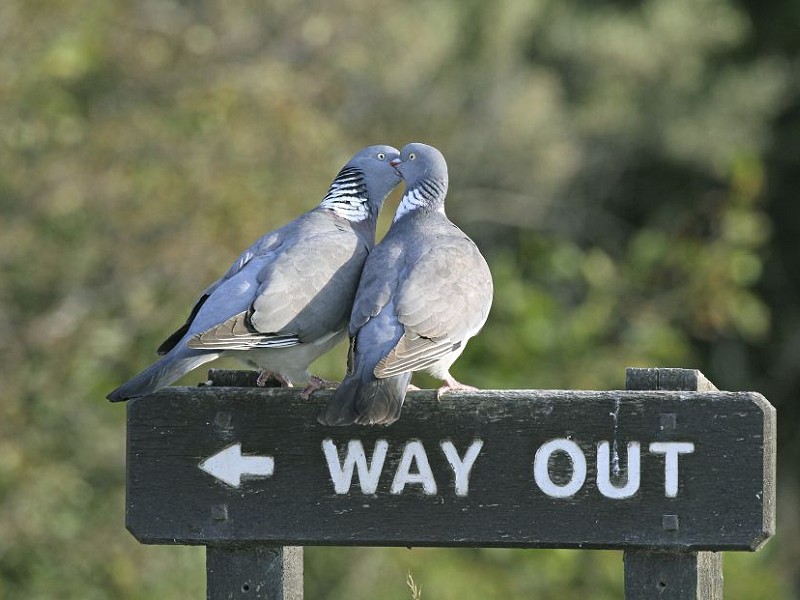
One of the best kept is the secret of baby pigeons, or squabs. Wood pigeons can breed all year round and with more than 2.5 million breeding pairs in the UK there ought to be plenty of baby pigeons flapping about – but have you ever seen one? Most young birds are fairly obvious, hopping after their parents with an extra-wide gape and distinctive juvenile plumage. But wood pigeons are different. They spend an extended period in their twiggy treetop nest, fed on high calorie crop milk secreted by their parents, as well as seeds, leaves and protein-rich invertebrates. By the time they fledge they have a full set of adult feathers. Well, almost. The only feature they lack is the flashy white collar around the neck, which in adults is topped with a beautiful patch of shimmering turquoise, and this is the only way to tell them apart.
At this time of year, wood pigeons gather in flocks to forage on farmland, pasture, parks and gardens where they’ll feast on berries, often dangling upside down in pursuit of the juiciest fruit. Most mouthfuls will be stored in their crop – an expandable throat pouch – to be digested overnight, and it’s said they can store an incredible 150 acorns, 200 beans or 1,000 grains of wheat. Clearly someone has been paying attention to wood pigeons because we also know they feed at 70 pecks per minute in the morning, increasing to 100 pecks a minute as dusk descends. But there is still at least one thing we don’t know. Sometimes, vast flocks of up to 150,000 wood pigeons are seen along the coast in November, migrating to a mystery location. Maybe one day we’ll discover their destination but for now, their secret is safe.
Comments
We have an adult wood pigeon and a squab in the garden. Squab is adult sized but only one adult has been near it, feeding it once or twice. Squab is huddled facing into a corner and adult keeps pulling some feathers out of it. It seems to be short of the long feathers on one wing tip. Worried it will be caught by a cat. Is it likely to be unwell? It’s still fluffy under its beak but seems to have adult feather on back and wings, with the exception of one wing tip as mentioned. It just seems to have no energy whatsoever which is why we are worried about it. Can you please give us some advice.
22 Sep 2022 17:29:00
Sussex Wildlife Trust:
It's impossible to say we're afraid, it might be fine or it might not be. It could be any number of things, including bird flu, but if you are still concerned, please contact a wildlife rescue for advice: sussexwildlifetrust.org.uk/injuredwildlife