
Why so many ladybirds?

With the onset of autumn, ladybirds are gathering in clusters on the insides of windows and in the corners of sheds, preparing to hibernate.
They sometimes accumulate in large groups, piled on top of each other, to protect themselves from the worst of the weather. As temperatures drop, their natural food supplies dry up and we see more ladybirds taking shelter indoors.
This film shows large numbers of ladybirds gathering at Woods Mill nature reserve in 2018.
Ladybirds are a successful group of insects, thriving in a variety of habitats including towns and gardens, grassland, woodland, farmland and heathland.
We have over 46 species of them in the UK, but not all are bright red with spots. Some are really quite dull looking and not instantly recognisable as ladybirds. Others have red spots on black or black spots on yellow and the number can vary from 2 to 22.
Our commonest and best-known is the Seven-spot Ladybird, which is easily recognised by its red wing cases and pattern of three spots on each wing, with one central spot touching both.
Enter the Harlequin
In recent years, Britain has become home to the Harlequin Ladybird too.
Harlequins can be hard to identify, as they can have over a hundred different colour patterns with different numbers of spots on their wing cases. However, they are never smaller than 5mm long, and have distinctive orangey-brown legs.
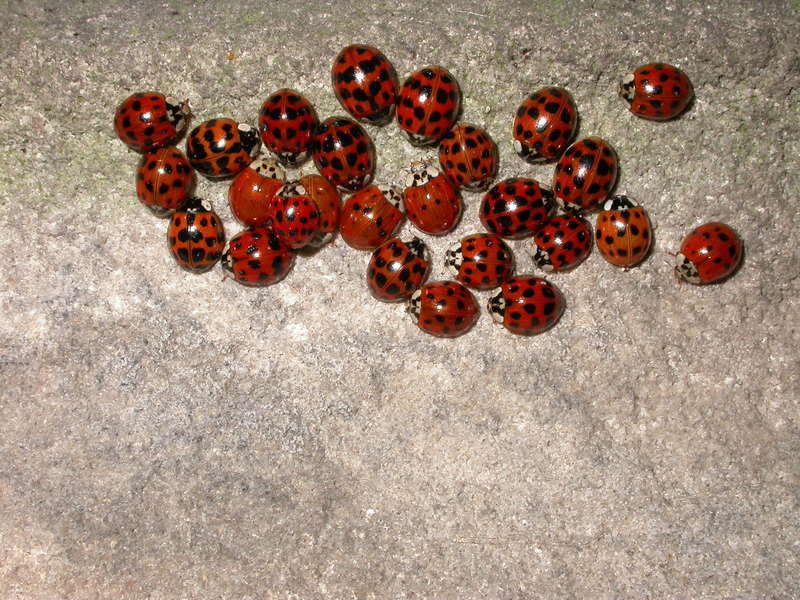
Native to eastern Asia, the Harlequin is one of the most invasive insects in the world. They were introduced in Europe to feed on and control aphids, and made their way to the UK in 2004.
Unfortunately, they don’t stop at eating aphids. The eggs of other ladybirds, as well as those of butterflies and moths, are also targeted. As such, they outcompete the UK’s own native ladybirds for food, which may be contributing to the decline of our native Two-spot Ladybird.
However, don't be tempted to try to destroy these interlopers if you find a group on your windowsill, as there can be native species mixed in with large clusters.
Colourful warnings
The bright colours of many ladybird species warn potential predators such as ants and birds that they won't make good eating.
When attacked, ladybirds exude a yellow fluid called ‘reflex blood’, which is very smelly and contains toxins that make ladybirds off-putting to many predators.
Their capacity to munch aphids make them a friend to the gardener, with the Seven-spot eating up to 5000 aphids during its year-long lifespan.

It's a good reason to resist tidying up flowerbeds until the spring, as seed heads, hollow plant stems and leaf litter provide perfect homes for ladybirds to sleep in through the winter.
Another way to help hibernating ladybirds is to provide a home for them by drilling holes in a log or block of wood and placing it on a wall or fence near to plants in need of aphid control.
If you're lucky you may be rewarded by a 'loveliness' - yes that's a recognised collective noun! - of ladybirds where you are.
A version of this post was originally published in 2018.
Comments
We have moved from West Sussex to Oxfordshire but have also noticed the huge numbers of ladybirds are doors and windows. We bought a bag of ladybird larvae in early summer and they did a wonderful job on the greenfly on our roses.
09 Oct 2025 11:08:00
We were delighted to see hundreds on the front of our house this week and I’m even more delighted to learn that they are referred to as a ‘loveliness’. We have lived out here in the countryside for over 30 years and this is only the second time we have experienced this ‘loveliness’.
09 Oct 2025 12:15:00
I look forward to welcoming this “loveliness “( first time I heard of this term)- and recall the fabulous, fantastic loveliness of 1976 when the pavement/gutters and even the floors of the Brighton open top buses were awash with ladybirds!
09 Oct 2025 13:16:00
Very interesting facts.👍
09 Oct 2025 14:00:00
Many have been trying to come into our summerhouse but they can’t then get out so we have had to shut the door……I have a wildlife friendly garden do hopefully they will find a cosy place to over winter
09 Oct 2025 15:22:00
In my lounge yesterday 9/1
10 Oct 2025 02:25:00
We had a ‘loveliness’ swarm our house near Horsham on Monday this week, we didn’t understand why at first – now I know! They were everywhere by the time we realised, as we had windows open with the unseasonably warm October weather. I did have fun spotting (coff…) the various species as I gently evicted them from our bathroom and hallway.
10 Oct 2025 05:53:00
Loved this. What a lovely idea to not tidy the garden weeds in the autumn so that the ladybirds can hibernate for the winter.
10 Oct 2025 11:26:00
There are lots of ladybirds inside the double glazing of my friends’ bedroom. They got in so I am hoping they will find their way out and not bake between the panes of glass.
11 Oct 2025 08:56:00
I did not know about there overwintering under leaf litter. I will warn neighbours.
11 Oct 2025 14:46:00
It is commonly said that the red colour of ladybirds warns predators to keep off – but if that is so, why do birds eat holly berries, yew berries, strawberries or pyracantha ?
14 Oct 2025 18:03:00
Sussex Wildlife Trust:
Hi Susan, that is a great question! The tactic of using bright colours to suggest toxicity to warn off predators is called Aposematism. Ladybirds do this, as do many other species, including some plants. However, some plants use colour to attract pollinators. It's not clear why birds would know that colour in one example represents danger and in another it doesn't, but many species have evolved to know what is and what isn't safe to eat. Healthy ecosystems will include many species which can consume things that others can't - so what is toxic to one species might not be to another.
A loveliness of ladybirds! How wonderful 😊
21 Oct 2025 06:07:00
A loveliness of ladybirds! How wonderful 😊
21 Oct 2025 12:45:00