
What's spiky under the sea?

By Ella Garrud
Living Seas Officer
The underwater world of Sussex is bursting full of fascinating and diverse life. But what is the spikiest creature to be found under the waves?
Common sea urchin (Echinus esculentus)
The common sea urchin, also known as the edible sea urchin, is a good contender for the spikiest marine creature. Their scientific name Echinus comes from the Greek word ‘echinos’ meaning ‘a hedgehog’, and it’s easy to see why! Their test (or shell) is covered in sharp spikes which protect them being eaten by predators. Like hedgehogs, they are also omnivorous, eating seaweeds, barnacles and other invertebrates.

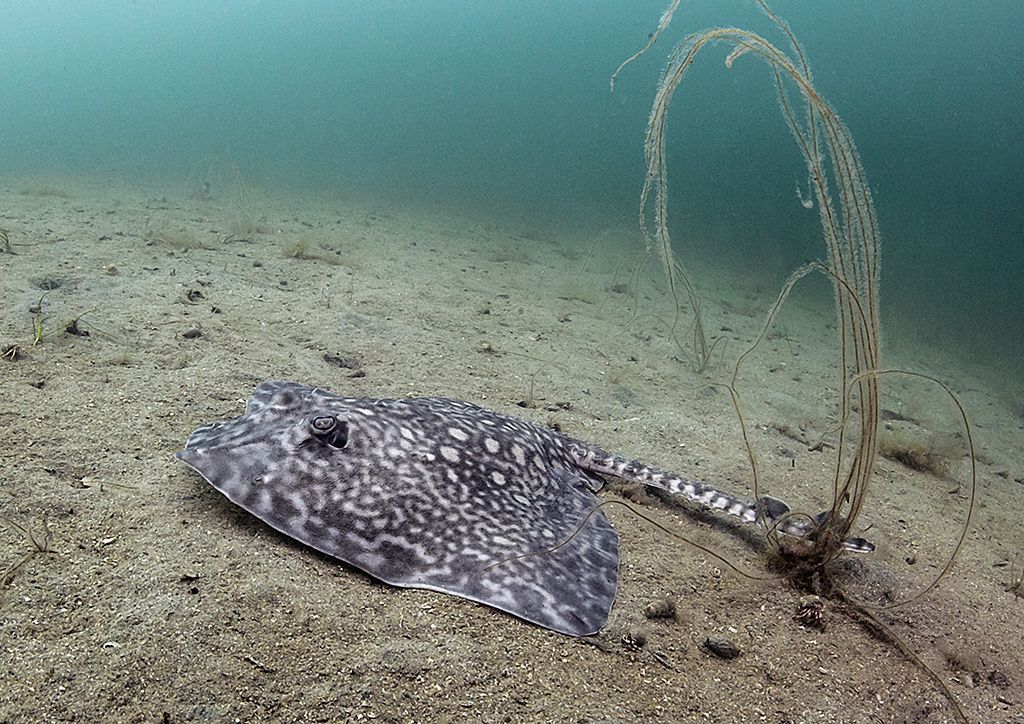
Thornback ray (Raja clavata)
Coming a close second is the thornback ray. As their name suggests, they have backward facing thorns scattered over their backs which are called buckles. They are also covered with coarse prickles. You can find evidence of thornback rays on the beach. Keep a look out for mermaid’s purses, which are the egg cases of sharks, skates and rays. You can identify and record your findings with the Shark Trust.
Compass jellyfish (Chrysaora hysoscella) (main image)
Jellyfish may not seem like an obvious contender for spikiest marine creature. They are after all soft bodied animals with no skeleton or shell. However, jellyfish have stinging cells in their tentacles called cnidocytes. Each cell contains a spiky barb, is coiled and sensitive to touch. When triggered, it is fired like a harpoon. Once in the flesh of its prey, the nematocysts release toxins which immobilise the animal, allowing the jellyfish to feed. Compass jellyfish are found in Sussex and can give a nasty sting to humans, even when washed up on the beach, so be careful and don’t touch!