
What’s a wasp and who’s a hornet
By Kerry Williams
Communications Officer - Conservation
Stinging, nests in great numbers and sometimes just not getting the hint has earned wasp and hornet species a bad reputation.
With an increase in UK sightings of Asian Hornets, an invasive species which threatens our native pollinators, it’s important to know who is, and who isn’t, worth being concerned about.
The UK is host to a whopping 9,000 or more species of wasp, from social to solitary, parasitic to paper-producing. Here, we focus on some of the social wasp species (and some outliers!) that you could confuse for an Asian Hornet.
Common Wasp (Vespula vulgaris)
Starting with the ultimate uninvited picnic guest; the Common Wasp, or Yellowjacket. Their unrelenting approach has earned these wasps an unfair ‘pest’ label, but although they have a habit for haranguing, they are in fact excellent controllers of smaller insects which can cause garden and summer evening irritation. Adult wasps bring these invertebrates back to the nest for larvae. They themselves feed mostly on sugar, whether this be from the nectar of a flower or the jam of your scone.
But who among us hasn’t embarrassed ourselves after overdoing it on the Panda Pops? These striking and hard-working pollinators are an incredibly important cog in our ecosystem and do deserve a little patience.

Median Wasp (Dolichovespula media)
There are three Dolichovespula species in the UK, the most common of which is the Median Wasp. Larger than a Common Wasp, queens resemble European Hornets, due to their orangey-red tinge, and the workers, who have notably darker stripes on their abdomens, are unfortunately also misidentified as Asian Hornets.

European Hornet (Vespa crabro)
At 30 – 35mm long, the European Hornet is our largest sociable wasp species, and larger than the Asian Hornet. Despite their size, European Hornets are typically docile, only exhibiting aggressive behaviour if their nest is attacked or disturbed.
As our native Hornet species, they are of great importance to our ecosystem and tend to consume a varied diet including flies, bees, caterpillars, aphids, tree sap, fruit, and even carrion. European Hornets are active at night and attracted to light, unlike other sociable wasp species. As a result, you may be more likely to spot one at dusk, particularly if you have lights on.

Asian or Yellow Legged Hornet (Vespa velutina)
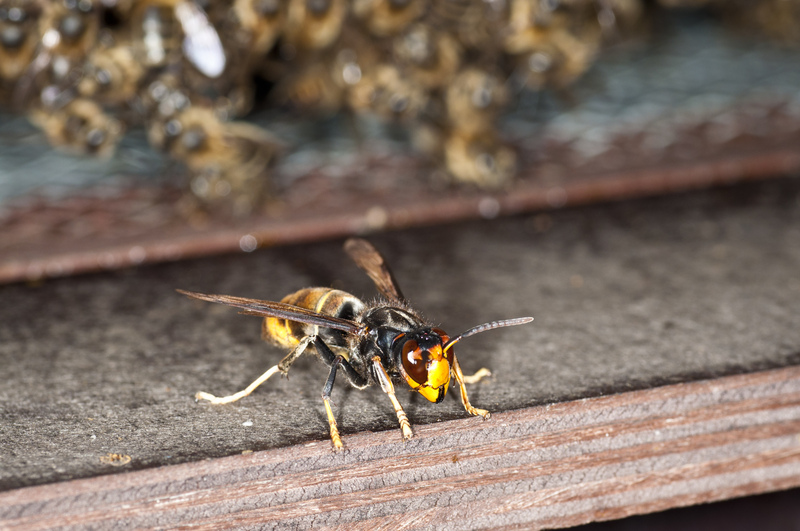
We get to the unfortunate bad guy. As an invasive non-native species, the Asian Hornet is a risk to UK pollinator species and should be reported.
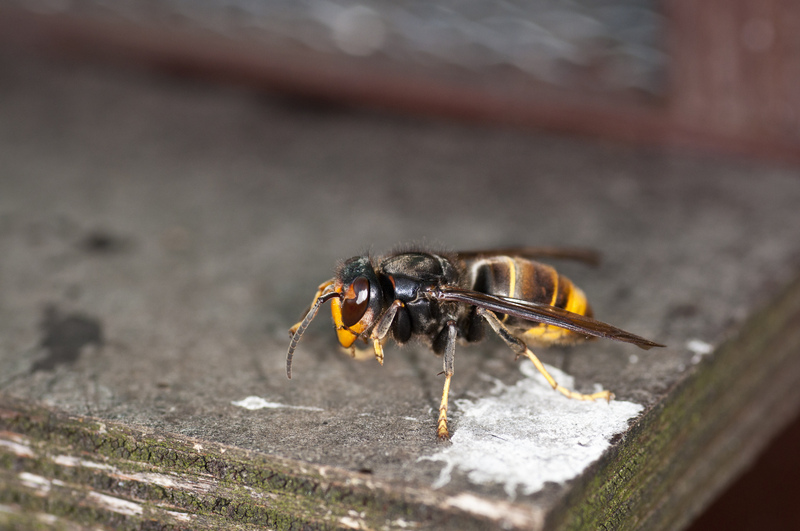
Smaller than the European Hornet at 25 – 30mm, the Asian Hornet has a notable darker body and yellow-tipped legs. The species is not known to be active at night, unlike its native counterpart.
The Asian Hornet is a skilled predator, especially of Honeybees, and is aggressive in its hunting style, returning to the scene and hovering in wait, or ‘hawking’, once a food source has been discovered.
Vigilance in sightings, identification and reporting is important and can be done by downloading the Asian Hornet Watch App or online here.
Not a hornet or wasp!
Hornet Mimic Hoverfly (Volucella zonaria)
Although it’s our largest hoverfly species, the Hornet Mimic is true to its name in everything but size, at 20mm long. With larger and more prominent eyes than a hornet, this hoverfly is smaller, broader and has no sting. Many hoverflies mimic bee and wasp species for protection from predation. This species can be found in gardens, urban areas and woodlands.

You can find more information on Asian Hornets including tips to identify and report the sightings here: