
The Wildest Walk in Sussex: New boots and feathers:
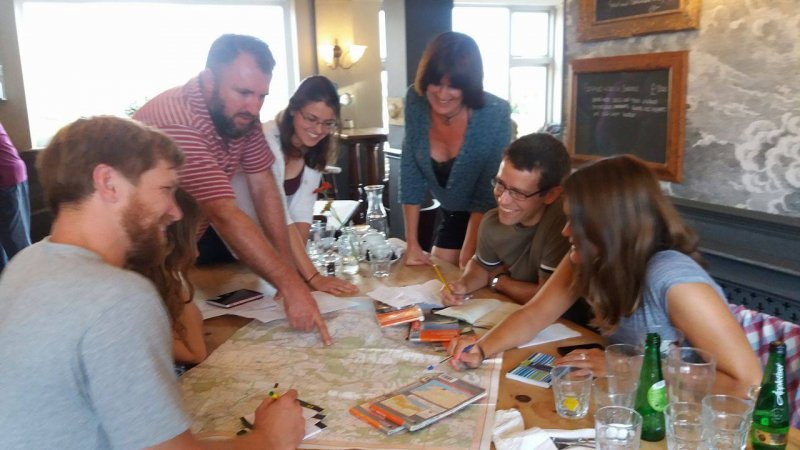
On Saturday 24th September I, along with seven Sussex Wildlife Trust colleagues (Nikki Hills, Olle Akesson, Jess Price, Katie Parker, Fran Southgate, Ryan Greaves & Tom Simpson) will be attempting to hike a winding trail through various Sussex Wildlife Trust reserves. Starting at Ebernoe Common near Petworth we're planning on walking all the way to Seaford Head. It's a journey of 62 miles.
On my recent training walks I've been accompanied by wheatears, blackcaps, whitethroats, redstarts, house martins and swallows. Like me these birds are also about to embark on a long journey; admittedly one which is a slightly longer than mine. The swallows and martins that were whirling 'round me on Ditchling Beacon on Sunday will soon be crossing The Channel and heading for their winter homes south of the Sahara. The swallows, as if to prove a point, take their migratory trip to Africa to the extreme limit by heading all the way down to the very bottom of the continent; a 6000 mile journey (each way) to South Africa.
Their journeys are filled with hazards, obstacles and danger just like the journey I am about to undertake (well, I have to negotiate a dodgy stile near Amberley and a pretty steep incline at Firle) and I now view these birds as fellow travellers. So I thought I would look to them to get tips on how I can succeed on my own 62 mile migration between Ebernoe and Seaford.
Navigation
It's important to know your route in advance - faffing around will cost you time and energy. Birds use the position of the sun and stars and the Earth's magnetic field to help them on their migration. Landmarks such as rivers, coasts and mountain ranges provide visual cues. Without these super-senses we've been relying on OS maps (numbers 133,134, 121, 122 & 123) and my colleague Olle has a fancy GPS app thing on his iPhone. Despite all this, on our walk from Ebernoe to Steyning the other day we still got really lost. Twice.
Equipment
The vital hardware required for a long aerial migration is a strong pair of wings. Over the breeding season bird's flight feathers would have become worn and weakened - not the sort of equipment you'd trust for a 6000 mile journey. So in the weeks leading up to the big flight birds would have undertaken a full moult; discarding all their feathers and replacing them with strong new ones. Of course they don't drop all their feathers in one go - they'd look like an oven-ready turkey. Instead each feather is replaced in sequence, the new feather pushing out the old as it emerges. It's a process that takes a few weeks and our birds tend to keep a low profile while it's happening.
When I looked at my travelling equipment I could see that I too needed an upgrade. My boots were worn down and falling apart - there was no way I could rely on them for a long journey. A trip to a hiking shop in Horsham soon sorted me out with a pair of new strong and sturdy trail shoes. And I forked out £25 for some special hiking pants - which is probably more than the total amount I've spent on pants so far this century.

Fuelling Up
You're going to need a lot of fuel to fly to Africa - so birds build up a tank full of fat to burn. Before migration birds will be feeding non-stop. They can change their metabolism to help increase their body fat levels and many insect eaters start binge eating berries. Birds can increase their body weight by 10% each day - garden warblers can double in weight over just a few weeks. Anyone who has been keeping track of the sheer number of sausage rolls and pasties I've eaten over the past few weeks will have noted that I too have been fuelling up. OK, maybe I haven't doubled my weight but I've been giving it a go. Olle reckons we stand to lose 9000 calories over the weekend.

Carrying body fat or carrying a backpack full of snacks creates another problem; the heavier you are the more energy it takes to climb the South Downs / fly to Algiers. You need fuel but you need to travel light. Birds have to carry an optimum amount of fuel and make re-fuelling stops all along their migration route. For us carrying food and water for the entire trip would be impossible. So, like the birds, we're making plenty of stops and we're grateful to have a number of colleagues positioned at strategic points on our route with water, chocolate cake and bacon to keep us watered, fed, motivated and moving.
If you'd like to virtually track our migration over the weekend you'll be able to follow us on the map on our webpage at:
https://sussexwildlifetrust.org.uk/wildestwalk
...where we'll also be updating our blog with photos from the route.
And if you're able to donate it'd certainly inspire us to get to the finish line!
https://www.justgiving.com/fundraising/wildestwalk...