
The spider pretending to be a wasp

Charlotte Owen
Conservation Officer
Large, brightly-coloured spiders have been appearing in gardens across Sussex in the last few years. The surprisingly exotic-looking Wasp Spider is named for its striking black and yellow stripes, which are a form of Batesian mimicry – a defensive strategy whereby a harmless species warns off potential predators by mimicking the appearance of something dangerous or inedible, in this case a spider pretending to be a wasp.
The Wasp Spider is closely related to the common garden spider but is native to the Mediterranean. It was first recorded in Britain at Rye in 1922 and has since spread along the south coast and further inland, where it inhabits meadows and low-growing grasslands. Only the female Wasp Spider is so brightly patterned and she is easy to spot as she sits on her web, waiting for grasshoppers, crickets and flies to blunder their way into her trap. The web itself is distinctive too and has a thick, white zig-zag of silk at the centre - the stabilimentum. Its purpose remains a mystery but it might help to attract prey by reflecting ultraviolet light.
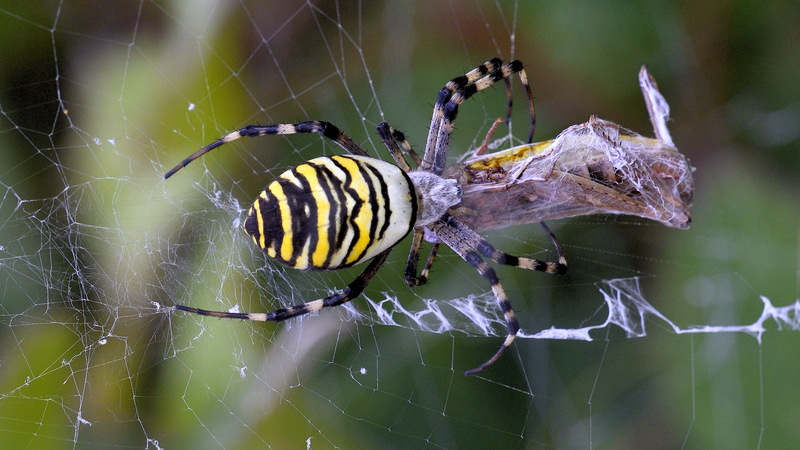
In contrast, the males are significantly smaller (just 4-6 mm long, compared to 14-17 mm) and a much plainer brown, which in itself makes them far less conspicuous, but they are also scarce towards the end of the breeding season for more sinister reasons. Like many arachnids, female Wasp Spiders are cannibalistic and any approaching male risks being eaten. Very few survive their first encounter with a female, and any that go on to mate again will risk their lives against terrible odds. To be in with the best chance, males wait at the edge of an immature female’s web until she starts to moult into her mature form. At this point, her body is fresh and soft and her jaws are far less dangerous, so this is the optimal time for a male to try his luck. If he is eaten in the process, at least he will help nourish his offspring and ensure their survival - as long as they carry his genes, the mating can be considered a success.
Comments
Hey, a male and a female one just showed up in my garden, I don’t wanna kill them. I couldn’t find anywhere how many babies they can have. Do you know?
30 Jul 2024 02:32:00
Sussex Wildlife Trust:
Quite a few! They are wonderful and harmless. Please don't kill them. Here is more information if you're interested
https://britishspiders.org.uk/wasp-spider
https://www.janvanduinen.nl/argiopebruennichi-engels.php
Thank you Charlotte very much for all your fantastic information on my spider Argiope bruennichi .From being concerned suddenly finding this wasp like spider in our garden I am delighted we now have a new neighbour!It is consuming vast numbers of grasshoppers which I know will slightly upset our cat as she also finds the grasshoppers tasty! Thank you once again.Anne.
22 Aug 2025 11:33:00