
The orchid that pretends it's a bee
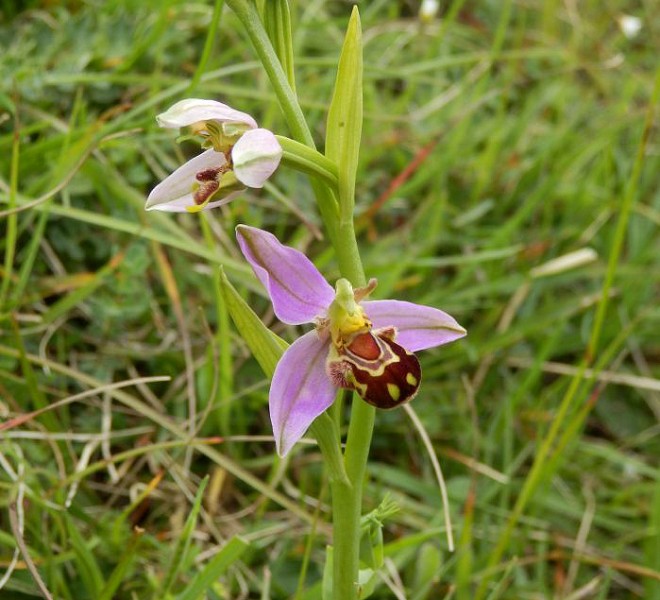
By James Duncan, Communities and Wildlife Officer
The orchids are a staggeringly large family of flowering plants found across the globe.
They are the supermodels of the botanical world, their iconic, elegant and truly exquisite flowers giving them a sense of mystique that sets them apart from all others. For nearly two hundred years, humans have been obsessed with their innate beauty and the Victorian desire for their discovery and collection was so intense that it's rather wonderfully known as 'orchidelirium’. Perhaps the feature that has seduced generations more than any other is their sheer uniqueness and diversity of form.
With estimates of more than 30,000 species worldwide, and many times more hybrids, a good fifty can be found in Britain.
Many orchids are incredible mimics, and this ability is usually linked to highly specialised methods of insect pollination. Orchids produce vast quantities of pollen but it's typically not free-floating, so cannot travel on the wind. Instead it is produced in sticky packets, ready for transportation by insect means, and some orchids employ ingenious strategies of sexual deception to lure in their potential pollinators. Strategies include pseudoantagonism, where male pollinators attack the flowers owing to their visual similarity to intruding insects; and pseudocopulation, as seen in the Bee Orchid, where male pollinating insects attempt to mate with the flowers due to their resemblance to a female insect. Both achieve the desired result of pollen transfer.
Bee Orchid flowers do a passable impression of a stripy female bee, complete with furry body, outstretched wings and an irresistible female scent. A passing male will make a beeline for these floral decoys and attempt to mate, gaining nothing but pollen in the time it takes to realise his mistake. The poor male will soon be duped again, spreading the orchid’s pollen to the next Bee Orchid flower he lands on in search of the elusive female his senses tell him exists. The Bee Orchid’s target bee species doesn’t actually exist here in the UK but thankfully the plants can self-pollinate. They can thrive on uncut lawns and verges, attracting a steady stream of human admirers.
Fertilised orchids go on to produce huge quantities of exceedingly lightweight seed. This seemingly wasteful strategy pays off thanks to symbiotic (mutually beneficial) relationships with fungus in the soil, which provide food for the emerging seedlings. In return, the orchid's roots protect the fungus. Some orchids may have this relationship with many species of fungus, some with just one, and some not requiring the relationship at all. This is just one example of the staggering complexity that has evolved over vast time periods. In fact, genetic sequencing has in recent years revealed that the evolutionary lineage of orchids may extend back far further than once thought - to at least 85 million years, a time in the late Cretaceous when dinosaurs still roamed.
Comments
Ok the female bee copied by the Ophrys no longer exists im the Uk. But it must have done so at one time for the orchid to develop. Do you know name of bee species and reason why no longer in uk. Does the bee exist say in Europe? If so does it still act as a pollinator?
12 Aug 2025 15:45:00
Sussex Wildlife Trust:
Hi Richard. The Bee Orchid is self-pollinating in the UK but may be pollinated by the Long-horned Bee, Eucera longicornis, elsewhere in Europe. This species is still present here, so as to why it doesn't perform this function here, we just don't know! Long-horned Bee - Bug Directory - Buglife