
The life cycle of Ivy Bees

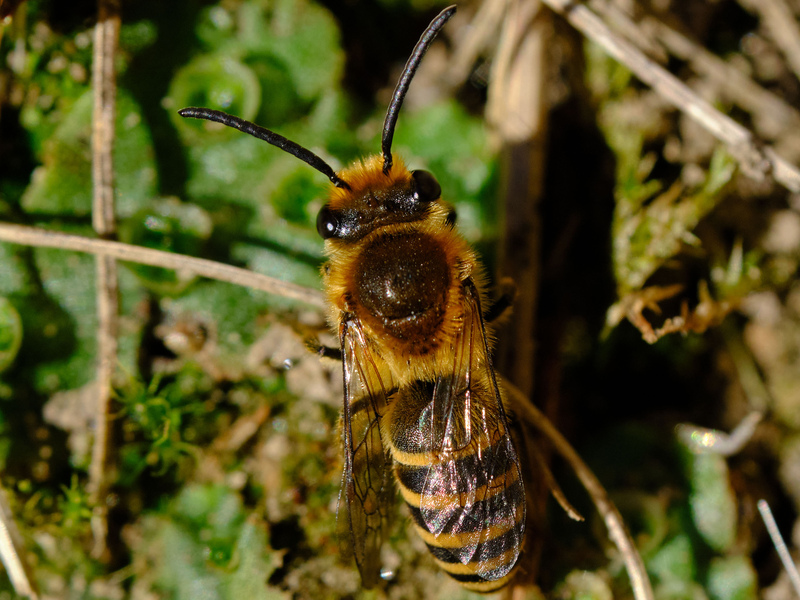
Ivy Bees (Colletes hederae) are rather beautiful solitary bees, that look similar to a honey bee; with an orangey-brown, hairy thorax, and distinct black and yellow stripes on their abdomen. Females are almost as big as honeybees with males a bit smaller. Male bees don't have a sting and are completely harmless. The females have a sting but have rarely been known to use it on people. You'd need to be behaving in a seriously annoying way to provoke one.
Ivy Bees were first recorded in Britain in 2001, and in Sussex in 2004 in Hastings. They have since colonised most of the county. They are usually found anywhere with flowering Ivy.
At the beginning of September, male bees emerge about two weeks before females, when scores of males can be seen flying low over the ground with an audible hum, much like honeybees around a hive. They are waiting for the first females to emerge. When one does, all the male bees try to mate with her, and this is when you might see a mating ball - as you can see in this amazing image, taken in Wadhurst churchyard and sent to us by Michael Howard. Any Suzy Izzard fans out there might bring to mind her 'Covered in bees!' sketch!
When a male succeeds in getting a female, they often fly off together, leaving the rest of the males to seek another female.
After mating, the female digs out a nest tunnel of around 30cm deep. which has side chambers. She supplies each of these chambers with pollen and nectar, then lays a single egg in each.
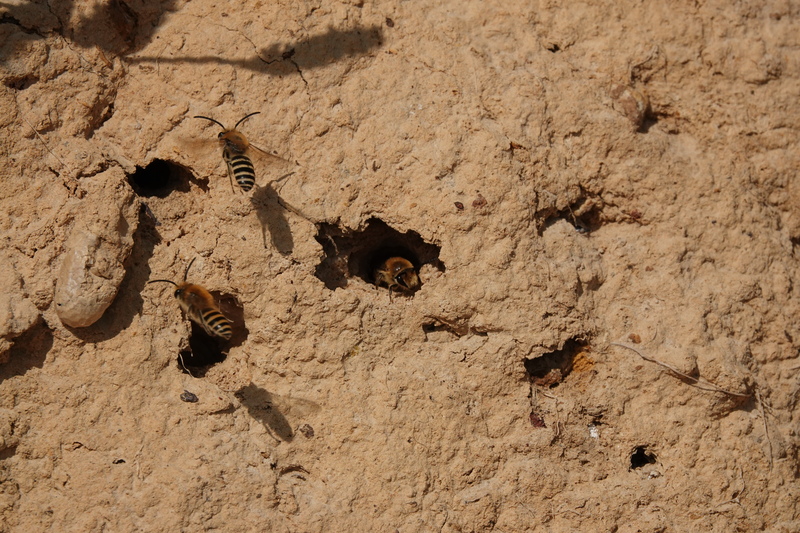
The females gather pollen exclusively from Ivy flowers, but will take nectar from other flowers as well. Female bees can be seen foraging on Ivy flowers before returning to their nest tunnels with yellow Ivy pollen on their hind legs.
The egg hatches into a larva, which eats the pollen and nectar which was provided by the female bee. Male bees do not contribute to nest building or provisioning.
As the larva grows, it sheds its skin several times, like a caterpillar. It eventually turns into a pupa and then undergoes metamorphosis to become a bee, like a caterpillar turning into a moth or butterfly.
The new bee emerges from the nest tunnel the following September and the cycle starts all over again.
For further reading on Ivy Bees, see this great post by the Friends of Earlham Cemetery. For more information on the bees you can find in our county - see James Power's book The Bees of Sussex
Comments
What happens to all the thousand male ivy bees – how long do they live ?
01 Oct 2024 09:50:00
Sussex Wildlife Trust:
They head to try to find another female! Adult bees live around 6 weeks
That’s absolutely fascinating. I have lots of Ivy in my garden which doesn’t flower so what type of Ivy should I plant ?
03 Oct 2024 11:05:00
Sussex Wildlife Trust:
Common Ivy (Hedera helix) is the best one for Ivy Bees and lots of other wildlife
These sound like the bees we’ve seen in our garden for several years. Thanks.
03 Oct 2024 11:27:00
Fascinating, I had no idea. We have lots on our ivy!
03 Oct 2024 11:49:00
Love this ! We have thousands on our bank which is high up by our house. Every September we see the swarms if ivy bees. When we first saw them my husband was petrified. So he called a specialist in who explained what they are. He said he had never seen so many his life ….we do have a lot of ivy so makes sense! I can see loads of tunnels….now I know what they are used for! I obviously don’t cut the grass or anything whilst they are out. Leave them be. We have never been stung, even with the amount of bees we have!
03 Oct 2024 15:32:00
Very interesting – thank you. I have a lot of ivy in both hedges and will be looking much more closely at the small bees that descend when it flowers.
03 Oct 2024 16:02:00
Thank you, I never really thought about this variety of bees having its own life cycle, only that they were addicted to ivy flowers!
03 Oct 2024 16:22:00
Great article. I had what I thought was a swarm in my garden over bare ground. Now I know they were either emerging or mating and laying the next generation. I did see a small hole in the earth
03 Oct 2024 18:41:00
We have a huge amount of a neighbours ivy over our wall, 2 weeks ago when it flowered it was covered
with these bees 🐝 drinking the nectar but almost more amazing had 30-40 red admiral butterflies at the same time doing the same thing, this lasted for about 4 wonderful days
04 Oct 2024 16:43:00
Thank you for this article. How fascinating the lives of these little creatures! They get on with their lives, minding their own business, oblivious to humans. What a pity some humans don’t follow suit and stop interfering with nature!
05 Oct 2024 07:15:00
Amazing, we first saw Ivy Bees near Barley Lane, Hastings 9th October 2023
06 Oct 2024 10:52:00
Great information, I will watch my ivy carefully and hope to spot an Ivy bee or 2!
07 Oct 2024 16:35:00
What happens if I accidentally walk on top of the nest tunnel of ivy bees?
25 Oct 2024 09:00:00
Sussex Wildlife Trust:
Ivy bees are pretty docile. If disturbed they can sting, but the sting has been equalled to that of a nettle. The tunnels are built with protection in mind with a cellophane-like waterproof lining and the females block the tunnels in while eggs are inside. Always take care to avoid disturbing the area if you know Ivy bees are present, but if you were to accidentally walk over one there is little risk involved.
A rather heart-warming tale of this bee’s life-cycle. I am wondering whether I have room in my garden for some ivy; though it would probably not be enough to attract a nesting be!
29 Oct 2024 19:17:00
Sussex Wildlife Trust:
Thank you. Definitely grow some!
Hey, thanks for this article; do you know if ivy bees are likely to nest in the same – or similar – spot, year after year? Would like to know if it’s safe to plant a rose directly next to a former nest!
(P.S. Nice on the Suzy Izzard)
08 Dec 2024 14:44:00
Sussex Wildlife Trust:
Yes, nesting sites are typically returned to year on year. The females will either re-use old tunnels or excavate new ones. If planting near the nest site, be sure to leave enough space for the bees to return!
I have had the pleasure of seeing these bees on my front lawn. They appeared about Wednesday 3rd September. It is a beautiful sight and sound as the males hover just above the grass waiting for a female.
06 Sep 2025 17:43:00
If you are interested. Have a large group of ivy bees. In a front garden in fairway crescent portslade BN41 2FL.
08 Sep 2025 14:53:00
Sussex Wildlife Trust:
How lovely.
Very interesting, thank you.
We have had Ivy Bees for two years now.
19 Sep 2025 15:30:00
We’ve had Ivy bees in our garden now for several years. They are a mind inconvenience because we cannot trim the lawn or attend to it in any way due te the risk of disturbing their existence. They seem to die down following the first frosts. On a walk yesterday on the downland above the village of Boscombe I came across hundreds more, i presume that this is a good thing but I don’t know.
22 Sep 2025 10:02:00
We’ve had Ivy bees in our garden now for several years. They are a mild inconvenience because we cannot trim the lawn or attend to it in any way due te the risk of disturbing their existence. They seem to die down following the first frosts. On a walk yesterday on the downland above the village of Boscombe I came across hundreds more, i presume that this is a good thing but I don’t know.
24 Sep 2025 22:32:00
Last weekend I saw what I thought were honeybees all around a sandy bank at the side of our drive. I goggled what to do and discovered they are Ivy bees. It’s brilliant watching them and we can see all the tunnels in the bank.
28 Sep 2025 18:19:00
Sussex Wildlife Trust:
How lovely