
Take two onions
By Pete Crawford
People and Wildlife Manager
Not the start of a recipe, but observations from my local patch. I live close to a wooded strip with a stream running through it, on the edge of town. It is a remnant of the countryside, built on in the 1970s to form a new housing estate, and all the more precious for it.
For all the excitement that bluebell time brings, and the countless photos of a sea of blue flowers, I am just as taken by another woodland bulb. Ramsons, or wild garlic or Allium ursinum, is in the same family as bluebell. It too grows in woodlands, but tolerates heavier, damper soils, often along stream banks. In 'my' bit of woodland, the ramsons is dominant, with thousands of plants carpeting the ground, and at this time of year, all producing a globe head of many starry white flowers. For me, it is just as spectacular as the show of bluebells.
I am told by a colleague that ramsons also boast their own hoverfly, whose larvae feed exclusively on the bulbs of the plant. Unseen and uncared for by nearly everyone, the ramsons hoverfly with its unique life cycle, shows why it is important to protect habitats where-ever they are located, town or country.
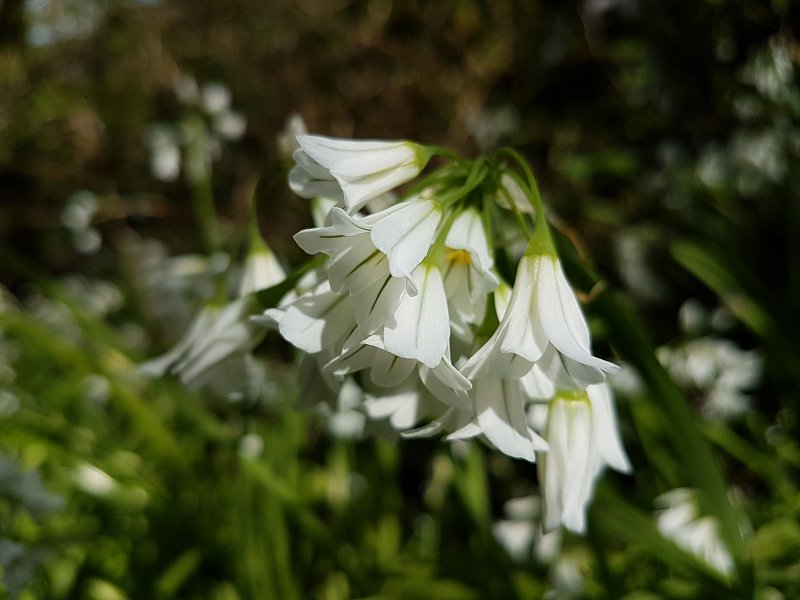
I have recently come across a second onion in my patch. Three-cornered leek, Allium triquetrum is also known as the white bluebell, because at first glance that is what it resembles. However, it has a strong garlic smell, isn't native and is invasive. It was introduced as a vegetable for cultivation and has escaped from gardens subsequently.
In Southern Europe, three cornered leek is used much as we might use chives or spring onions. Ramsons has recently become much loved by foragers and chefs alike, with recipes such as wild garlic pesto and ramsons with scrambled eggs featured in the Sunday supplements... Oh, we seem to have got back to recipes. Happy botanising and bon appetit!