
Syrphin' S.W.T.
There's a lot of concern at the moment for the decline of bees in Britain's countryside and the affect this will have on the pollination of our crops and other plants. But bees are not the only important pollinators hard at work out there. Hoverflies (Family: Syrphidae) also play a vital role in pollination but the importance of these insects is often overlooked. In order to address this I organised for hoverfly experts (and authors of 'Britain's Hoverflies') Roger Morris and Stuart Ball to visit Sussex Wildlife Trust's Woods Mill HQ to teach a two-day course in hoverfly identification to some keen Sussex naturalists.

Chrysotoxum festivum photographed by Mike Mullis
Hoverflies are amazing. These colourful insects have some incredible life cycles and throughout the year can be seen living up to their name by hovering and performing impressive aerial acrobatics in our gardens and across the Sussex countryside. One of their most impressive talents is mimicry and many species have adapted to look like bees, bumblebees and wasps. By putting on a passable impression of these more agressive insects the harmless hoverflies are hoping to trick predators and avoid ending up on the menu.
The first hoverflies of the year will soon be on the wing and so there was no time to waste - we needed to train up a team of hoverfly recorders who can get out across Sussex to monitor the county's hoverflies.

Photo: Super fly guys; Roger and Stuart talk hoverflies.
Over the weekend Roger & Stuart led us through all aspects of hoverfly ecology, the history of hoverfly recording, where to find hoverflies and other topics.
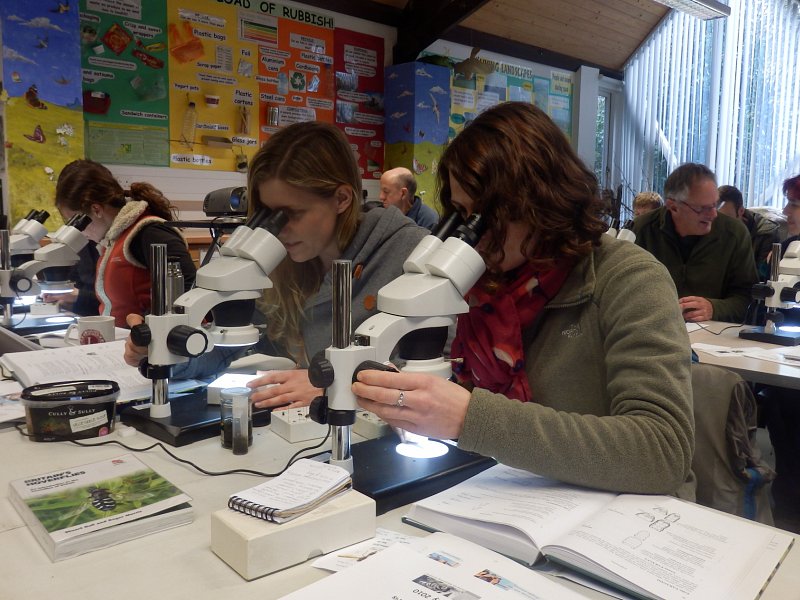
The main part of the weekend was spent identifying hoverflies using keys. By learning more about the anatomical features of hoverflies we were able to start identifying them. At first this seemed like quite a daunting task but gradually (by working out if the hoverfly had a flat frons, porrect antennae or a hairy humeri) the team were able to put names to the specimens. Working through a key and successfully identifying each insect was extremely rewarding. It was lovely to see the look of satisfaction on people's faces when Roger or Stewart gave their identifications the thumb's up. Everyone left with the confidence to make a start at identifying hoverflies in the wild. By finding out more about the distribution of these insects in Sussex we will hopefully be able to ensure that hoverflies and their habitats are protected.
A huge thank you to Roger and Stuart for leading this course and to all those who attended. From the amazing feedback messages I've received in the few hours after the course finished it seems that there are now 12 new determined dipterists who'll be recording hoverflies in Sussex in 2016.
If you'd like to learn more about wildlife Sussex Wildlife Trust run a packed programme of courses aimed at helping you fill your head with wildlife.
https://sussexwildlifetrust.org.uk/whats-on/catego...
Comments
Excellent weekend, Michael. Can’t believe how thorough Stuart and Roger were in covering all the angles. And I was chuffed to have got 9 out of 11 garden hoverflies from last year correct according to Roger, having used their book. As I said to Roger it reflects its quality. So, hoping to clock a few more up on Seaford Head and have pencilled in your dates
Thanks for getting me along Michael. Superb W/e.
Colin
07 Mar 2016 21:54:05