
Stonechat
By Charlotte Owen
WildCall Officer
Heathland is at its glorious best in late summer, with the sun beating down on a drift of purple heather and popping open the seed pods of coconut-scented gorse. Silver-studded Blue butterflies flutter gently by and all seems calm and quiet – but the heathland is alive with activity on a miniature scale as a wealth of hidden wildlife scurries busily through the undergrowth, from lumbering Minotaur beetles to nimble Sand Wasps dragging hapless caterpillars into their underground lairs.
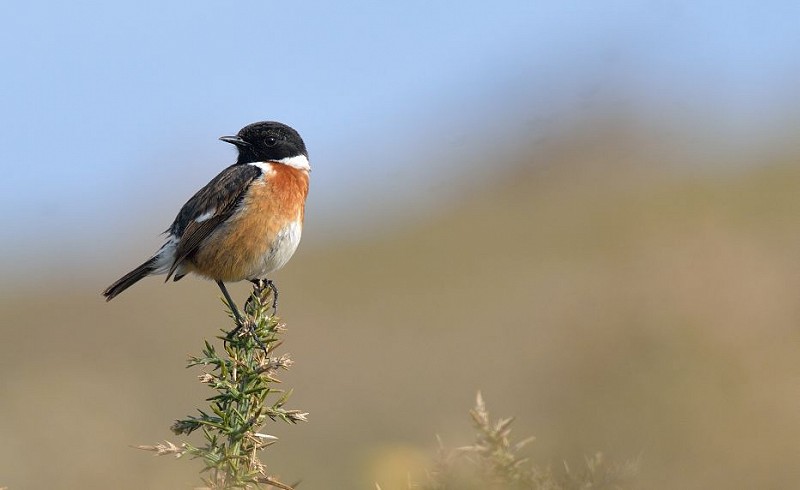
Every now and then a mysterious tapping sound will permeate the still and sultry air. Scanning the horizon through a shimmering heat haze, the tapping seems to originate from a distant birch tree where a robin-sized bird is perched, flicking its wings and uttering a loud alarm call that sounds just like two pebbles clacking together. This is the aptly-named Stonechat, a bird that breeds amongst the dense scrub of the heathland and feasts upon its insect inhabitants. Males are unmissable, with a black head and back, distinctive white collar and buff-orange breast. Females are browner and paler, like ghosts of the males, but just as good at chatting like stones. Their habit of perching in a prominent position makes them easy to spot and they are such reliable lookouts that other heathland birds are often found in their company, benefiting from their early warning of approaching danger.
Stonechats can raise three broods in a single season when conditions are favourable, so they may still have chicks in the nest during August. Hidden deep within a dense tangle of gorse, hungry nestlings can each devour a hundred caterpillars, flies and grasshoppers in a single day. With five or six chicks per brood, the adults are kept almost frantically busy catering to their needs. They will sometimes spiral upwards from their perch in pursuit of butterflies, damselflies and other winged insects but will more often drop to the ground to snatch a tasty snack. After two weeks of protein-packed meals the chicks will leave the nest but won’t go far, hiding among the heather and tall grass until they are ready to fly a few weeks later.
Secrets of the Heath returns for 2020 with a virtual event that includes something for all ages and interests.
Comments
I would be interested to have a linked recording of the stonechat.
03 Sep 2020 10:55:00
Lovely piece and have learned something. I usually see them on the scrubby bushes either side of Cuckmere Haven near the sea. But had not associated them with heather before. Thank you!
03 Sep 2020 11:30:17
Very interesting thank you. They look bit like a robin but are not and have a distinctive sound. Thanks for the info.
03 Sep 2020 12:11:45
Thank you for the info on this sweet little bird.
03 Sep 2020 12:36:30
@Jane Montague: You can hear a Stonechat call and song here
03 Sep 2020 17:38:00
I first saw these delightful little birds, with distinctive markings and colour, perched atop the gorse and hawthorn thicket up on the South Downs Way ridge beyond the Downs Golf course back in mid May chatting away
03 Sep 2020 19:45:00
I saw these while walking along the Tide Mills abandoned village between Seaford and Newhaven.
08 Sep 2020 10:54:00