
Species of the day: Zebra Spider

By James Duncan
Learning & Engagement Officer
To any arachnophobe, the notion of a spider that jumps must surely be the most terrifying thought. Fortunately the Zebra Spider (Salticus scenicus) is the true representation of "itsy bitsy" as it's a mere 5-9mm long. This is a spider with real personality, even reflected in its latin name which can be loosely translated to "dancing decorative". It belongs to a huge family of more than 5900 jumping spiders (Salticidae) which comprise a good deal more than 10% of all spider species currently recorded. Unlike many other members of its extended Arachnid family, the Zebra Spider is an active diurnal (daytime) hunter as opposed to a more typical denizen of the dark. You're most likely to spot one close to habitation, as when the sun is shining they'll be seen scampering around on walls, fences and window sills. It is of course their marvellous contrasting colouration that gives rise to the 'zebra' in their name, though this may be distinctly variable depending on their environment.
Perhaps one of the reasons they're so charmingly captivating to watch relates to the way they move. Their hesitant jittery motions are far more cat-like than spider-like. Their diminutive size totally belies their effectiveness as a predator, for they are masters of their art. Their tactic of hunting requires no web - having carefully stalked a selected victim, they'll cautiously sneak to within striking distance and pounce right on it, quickly injecting venom. Though tiny, their body size is actually relatively large for this style of hunting and their favoured prey (usually true flies - Diptera) stands little chance. Though they lack muscled legs, this isn't a limitation as they employ a method to control the pressure of their bodily fluid (hemolymph). When ready to jump they radically alter this pressure by forcing the fluid into their back legs, the rapid extension powering a jump that may take them more than ten times their own body length.
In order to assist their meticulous hunting strategy, they have a remarkable set of eyes. Not just a pair of course, but four pairs. The largest pair of primary eyes (anterior median) are responsible for visual acuity and can process extraordinary detail, helping the Zebra Spider to see with remarkable clarity. They rival not just some of the sharpest insect eyes out there, but even human eyes, unusual amongst spiders who typically have poor eyesight. The secondary eyes are sensitive to light and movement, not only assisting in the creation of wide-angle images but providing all-round depth perception and helping to track movement. Objects moving behind the spider will elicit their orientation, indicating they have the ability to see all around their body. Not only are their 'spider senses' perfect for hunting, they also serve a useful purpose for mating. Male Zebra Spider's will undertake an elaborate courtship dance in an effort to impress a female, one that involves the waving of appendages and the wiggling of abdomen, a dance to truly enable him to live up to his name.
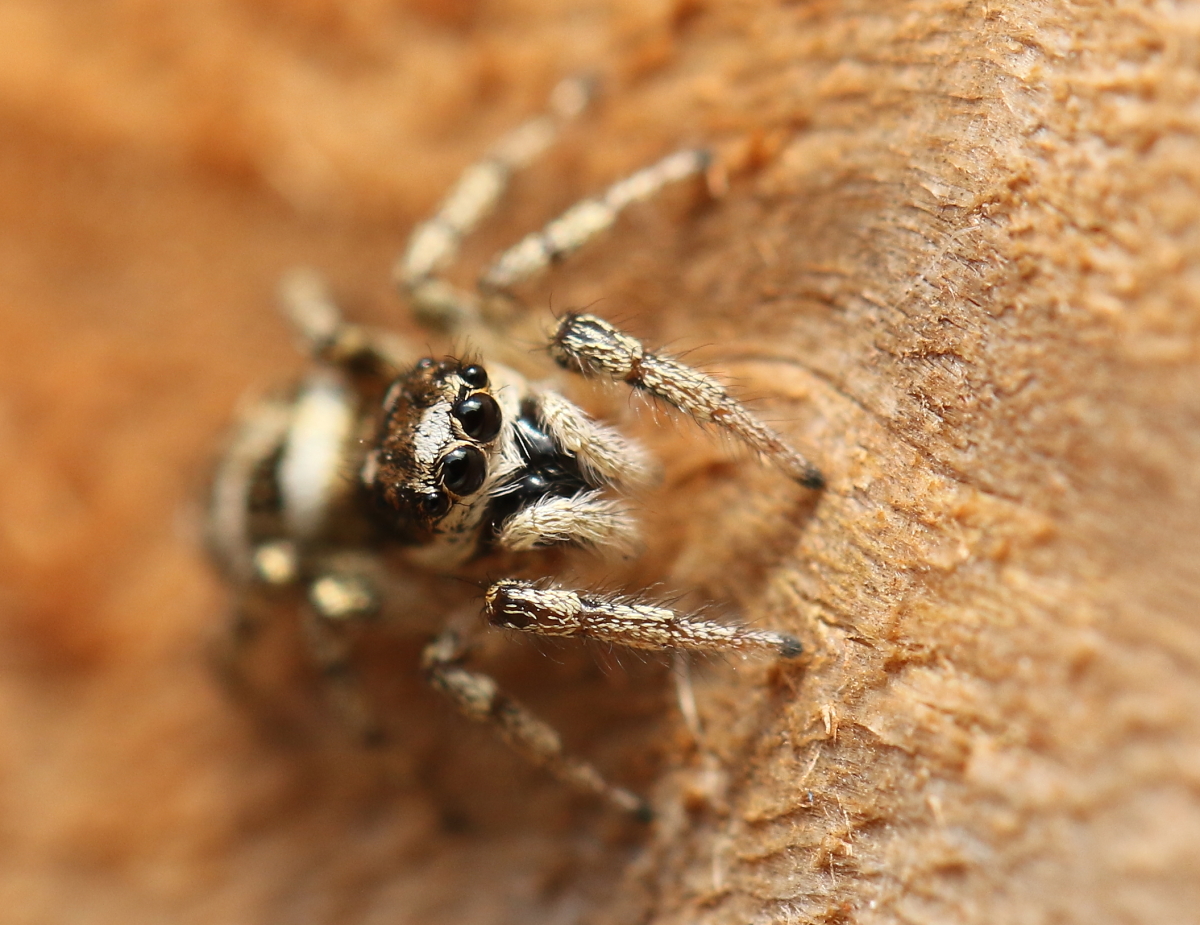
Zebra Spider © James Duncan
Comments
These delightful spiders have lived on our bungalow wall for many years . About the maximum we have seen at one time is twelve and this year they are not quite so much in evidence yet with just a maximum of five. watching them hunt tiny flies w.o.w.
05 May 2020 17:41:00