
Species of the day: Wood Anemone
By James Duncan
Learning and Engagement Officer
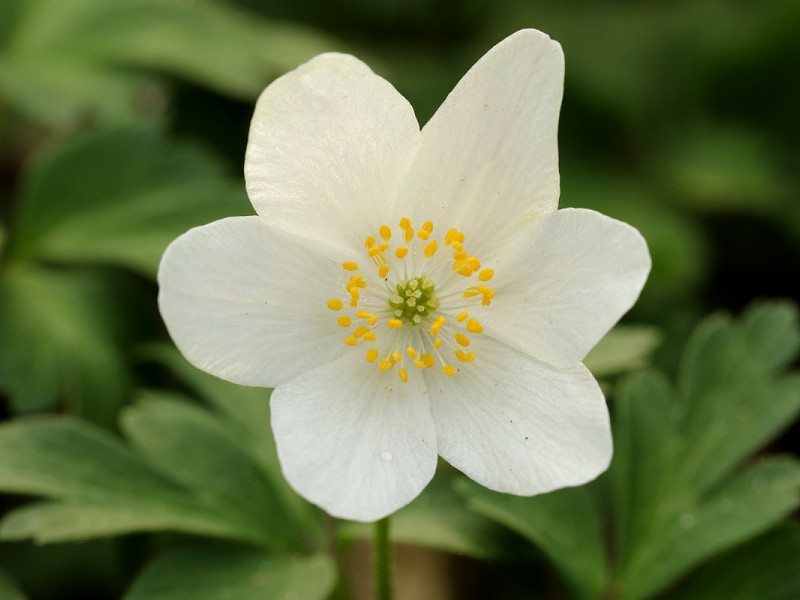
The Wood Anemone (Anemone nemorosa) is a beautiful species that may carpet a deciduous woodland in spring with its beaming star-shaped flowers. It is in fact a key indicator species of ancient woods, pointing to the fact its special habitat has been continually forested for the last 400 years. It's one of the first to bloom in March, taking full advantage of the open canopy and volume of light arriving at the forest floor. Indeed, by May, as the ever-expanding foliage of the forest closes up, the Wood Anemone is finally deprived of light, its flowering over. It seems to display a human trait, appearing happiest when the sun is shining, for its flowers droop gracefully until awakened by the sun's light. This makes it slow-growing in the extreme - it may take a hundred years or more to spread a couple of metres across the woodland floor. Unfortunately for the Wood Anemone its seeds are frequently infertile and it relies on the extension of its rhizomes (modified horizontal underground stems) to promote new growth, though it's highly susceptible to trampling. English poet John Clare summed it up rather nicely in his poem of the plant's name. Here's an excerpt -
"What pretty drooping weeping flowers they are:
The clipt-frilled leaves, the slender stalk they bear
On which the drooping flower hangs weeping dew,
How beautiful through April time and May
The woods look, filled with wild anemone;
And every little spinney now looks gay
With flowers mid brushwood and the huge oak tree."
Wood Anemone is a member of the Buttercup (Ranunculaceae) family and like all anemones is poisonous, owing to the toxic compound anemonin. To humans it certainly has a musky, unpleasant aroma though it may on occasion be eaten by some animals. It is particularly favoured by Hoverflies, who are likely one of its predominant pollinators. It's also quite unusual in not possessing true petals. This may not appear to be the case, but the 'petals' are in fact modified sepals (typically offering protection for a flower in bud) which have assumed the characteristics of petals.
As with other members of its genus, the Wood Anemone is also known as 'windflower.' The naming relates to the Greek Wind-God - anemos. It's believed by the Greeks that Anemos sent Anemones in early spring to herald his coming. Pliny the Elder (Roman author of Naturalis Historia) later wrote the flowers were so named as they wouldn't open until the wind blew. Ultimately it's very much the sun that controls the Wood Anemone, not the wind. Humans also play a pivotal role in its conservation, as traditional practices like coppicing help to 'open up' woodland in order to provide the essential sunshine required.

Wood Anemone © James Duncan

Wood Anemone © Nigel Symington
Comments
I’ve heard them called moon flowers here in Sussex
Beautiful name18 Apr 2021 19:23:00
Thank you for this beautiful description of the Anemone.
23 Jul 2025 15:11:00