
Species of the day: Treecreeper

By James Duncan
Learning and Engagement Officer
The delightful little Treecreeper (Certhia familiaris) is a bird that truly lives up to its name. In fact it has had a variety of 'tree-based' vernacular names over the ages, some of the most memorable including 'bark runner' and 'tree mouse.' Though the word 'mouse' in old English may not have been directly indicative of the respective rodent, it coincidentally describes its habits rather well for it is eminently mouse-like. Perhaps the most surprising thing about the Treecreeper is the population size considering its supremely inconspicuous nature. There are well over two hundred thousand pairs in Britain, which is not only similar to the more visible Nuthatch but substantially exceeds that of the rather more conspicuous Great-spotted Woodpecker, both species with similar habitual preferences. The Treecreeper family (Certhiidae) actually comprises a variety of similar species found predominantly in the Northern Hemisphere, though confusingly our resident species (C. f. britannica) is just one of around ten subspecies of the Eurasian Treecreeper, depending on your taxonomic viewpoint.
A feature adding to the Treecreeper's unassuming nature is its minute size. The lengthy scimitar-like beak and stiff pointed tail certainly lend it an appearance of being larger than it truly is. The body is in fact roughly the size of a Wren. A key point for the recognition of a distant Treecreeper is its distinct habit of creeping up a tree, 'corkscrewing' its way round, before taking off abruptly and beginning the same process from the bottom of an adjacent tree. This may be a rather fabulous adaption by virtue of saving on unnecessary 'energy-hungry' level flight. Treecreeper's are also staunch in their feeding behaviour and won't work their way down trees in the style of the Nuthatch. Their movements tend to be jerky and jittery and their superb bark-like camouflage offers them good protection from being spotted, particularly when 'frozen' in position to avoid predators. That being said, they're not typically that nervous and may prove surprisingly approachable. They're a year-round resident species in Britain and even though they may leave their breeding grounds in autumn, they rarely venture far.
The Treecreeper is perfectly adapted for an arboreal (tree-dwelling) lifestyle. Its scything beak is able to probe beneath the bark, excavating all manner of insects from the cracks and crevices where they reside. The super-stiff tail also acts as a brilliantly invaluable aid to climbing, bracing them against the tree as they forage. During times of insect shortage and particularly during the winter, they may shift their diet to take a variety of seeds to aid survival. Nest construction will utilise moss, grass, lichen and spider silk which the breeding Treecreeper will wedge tightly into a suitable aperture, typically behind a loose flap of tree bark. Though this will seem particularly overcrowded when full of five to six squabbling young, it ultimately serves to offer increased protection for the nest. Though usually a highly solitary species, their habits may shift upon the conclusion of the breeding season - not only will they join feeding parties amongst other species, they may even roost communally in the crevice of a tree in order to keep warm.
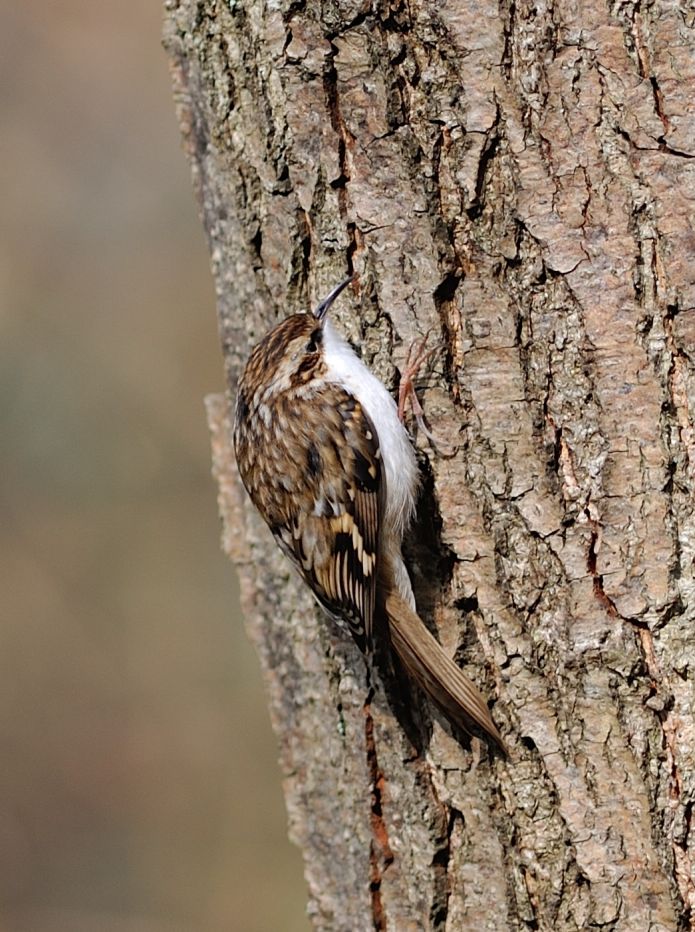
Treecreeper © Tom S B Lee
Comments
I found a tree creeper which had died just outside my house in Etchingham. I noticed its curved beak and its small size very similar to a wren but quite pale cream and brown speckled feathers. Good camouflage for getting insects from bark
15 Nov 2020 20:52:00