
Species of the day: Tawny Owl

James Duncan
Learning and Engagement Officer
The Tawny Owl (Strix aluco) is by far and away our most numerous nocturnal bird of prey, heard regularly, but in stark contrast, seen far less often.
Its night-time habits within both broad-leaved and mixed woodland keep it largely elusive, though its adaptability may see it living within large urban parks and even suburban gardens - provided there's enough cover, suitable cavities for nesting and an abundance of prey. The Tawny Owl's numerous subspecies are distributed widely, stretching across the Palearctic, though they're absent from both Ireland and many of the less-forested areas of Northern Scotland.
This highly sedentary species has always shown a reluctance to cross open bodies of water, though there have historically been irregular breeding attempts on some of the UK's nearby islands. There can truly be few birds more faithful to a territory than the Tawny owl, particularly long-established pairs who will probably never leave their home range. This extreme level of site-faithfulness means the Tawny is able to gain a superb understanding of its surroundings, largely through spatial memory, critical at times when food is in short supply.
It is of course the powerful and evocative vocalisations that are most familiar to us. The commonly known transliteration of the call is probably known better than that of any other bird, something that's survived in folklore for centuries. It is of course "tu-whit, tu-woo", a phrase even referenced by Shakespeare in the sixteenth century in 'Love's Labour Lost.' The call is so memorable that William Wordsworth also described the 'surprisingly effective' technique for calling a Tawny Owl in his poem, There was a boy.
Of course the most important thing to remember about the call is it's really rather misleading, an ornithological inaccuracy. The reason being that it's not generated by an individual, for the Tawny's 'renowned call' comprises both a female and male calling to each other, a duet of sorts. The female generates the 'tu-whit' (actually a "Ke-wick") contact call, whereas a male's response represents the 'tu-woo' (actually a "hooo.....hu...hu-hu-hu-hooo"). Both sexes may actually exhibit a surprising range of vocalisations, even including a 'less polished' reversal of their typical calls. The somewhat haunting nature of the calls of the Tawny Owl have long given it mythical associations as a harbinger of doom.
 Tawny Owls © Darin Smith
Tawny Owl vocal behaviour changes throughout the year, but it's in autumn when things really heat up. This is a time when young birds are attempting to establish their own winter territories and competition becomes particularly fierce, especially when population densities are high.
Owing to their sedentary nature, youngsters will rarely disperse more than a couple of miles, which ironically may bring them into direct conflict with their own parents. In a rather ungrateful manner, youngsters born earlier in spring may attempt to evict the adult birds leading to vociferous proclamation of hard-won territories. The result of this may very well be birds heard calling not just at night, but in broad daylight. Tawny Owls are not only protective of territory, they're also renowned for the ferocious defence of their nest and young.
Should either be threatened they'll rightfully attack with talons extended, something that's unlikely to be seen coming owing to their ghostly, silent flight. In common with many owl species they employ asynchronous hatching - one egg laid every few days, a strategy to ensure the survival of the oldest chicks should food not prove plentiful. Prior to fledging the young pass through a 'branching' phase, taking their first exploratory steps amongst their arboreal world. They remain reliant on the adults for food for a few months after fledging, their cryptic camouflage helping them to blend in amongst the foliage.
The Tawny Owl is very much an opportunistic feeder, its diet rather extensive. Small mammals provide the bulk, its ability to snatch mice and voles from the forest floor within pitch-black environments truly exceptional. Their huge eyes and closely-packed retinal rods ensure high levels of sensitivity to light, whilst their superb hearing, many times better than our own, enables them to pinpoint the tiniest of movements. The facial disc acts to channel sound waves toward the ears, which are positioned asymmetrically, helping the owl to determine the slightest differences in the directional nature of the sound.
Showcasing their versatility, they'll regularly predate small birds, amphibians, bats, large insects and earthworms too - they have on occasion even been witnessed fishing. Their position at the top of the 'owl tree' means other British owl species may even fall victim to the Tawny Owl.
Despite their numbers, it's thought their overall population has seen a long-term decline. Though not well understood, changes in woodland management, increasing urbanisation and the effects of climate change on their prey may be strong contributing factors.
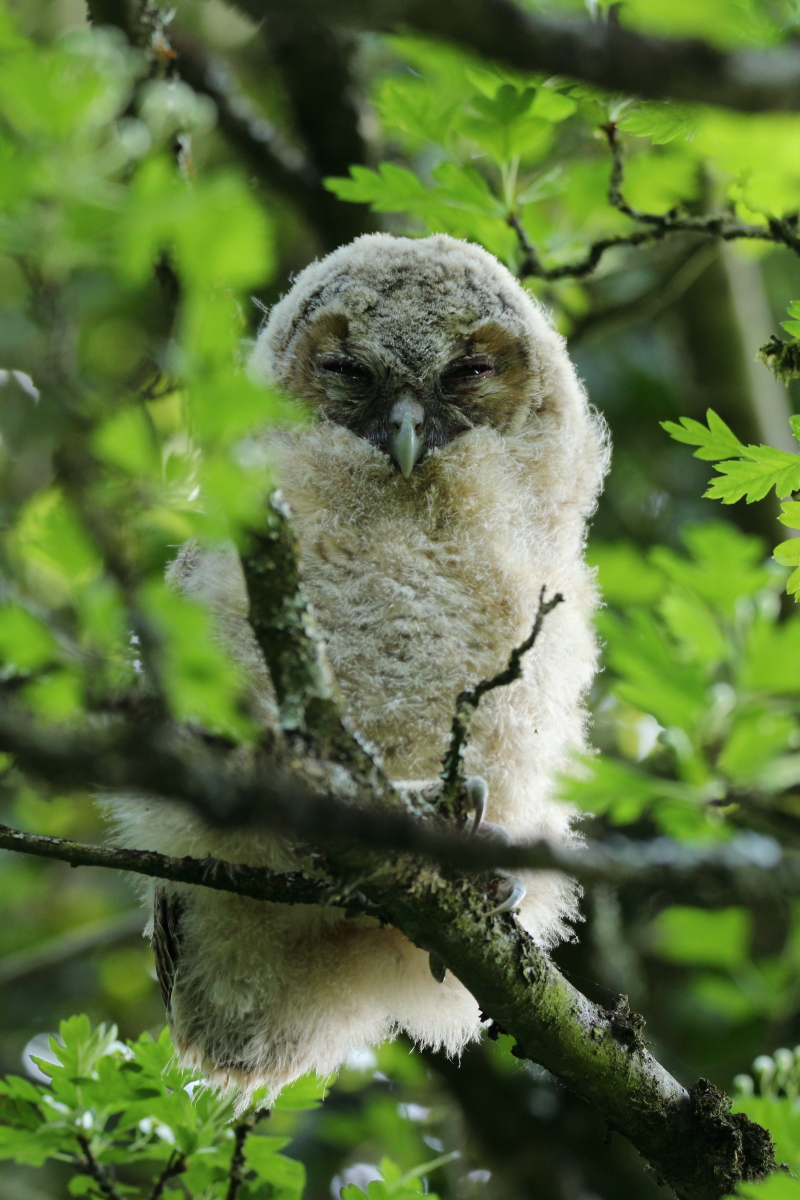 Tawny Owl juvenile © James Duncan
Originally published May 2020
Comments
Hear occasionally now but as you said much more in Autumn and Winter. Live next to South Downs National Park (West of Eastbourne). BN20 7XT. Have seen on gate post near Birling Gap in late August I think but only once and were in the car. Thanks for information
02 Jun 2020 06:35:00
Hi. Been listening to calls at dusk for over a week now. Live on coastal farm land at west wittering. Doing the same this evening and 99% sure I have just been fortunate enough to see one this evening. Left the neighbouring field from what sounded like the call location and flew towards the exchange call passing me about twenty yards away. Light underside. Steady, gliding flight pattern. Gentle wing beat. Tremendous to watch.
07 Sep 2020 19:47:00
Great account. Thank you very much.
As Voluntary Warden for Lake Wood I thought you might like to see where I regularly encounter Tawny Owls and much much more (see website video).
https://www.youtube.com/watch?v=tluez9u9zww23 Sep 2025 19:47:00
Great photos and very informative text.
Thanks so much
24 Sep 2025 09:00:00
Great account. Thank you very much.
As Voluntary Warden for Lake Wood I thought you might like to see where I regularly encounter Tawny Owls and much much more (see website video).
24 Sep 2025 11:19:00
Lovely account. I had the joy one Christmas morning watching a tawny owl perched on a bench outside my kitchen window where it had been hunting mice feeding on nuts out of a fallen window feeder. It was being mobbed by other birds so wasn’t moving away. Half an hour – the whole family came to view it. What a Christmas present! More to the point, very interesting re young and adults disputing territory at this time of year – in Petworth town this autumn 2025 I can hear them calling in the early hours of morning and I now understand better from this article the actual calls I am hearing. Many thanks
14 Oct 2025 09:28:00
Absolutely fascinating read, Thank you.
12 Dec 2025 12:14:00