
Species of the day: Speckled Wood
By James Duncan
Learning and Engagement Officer
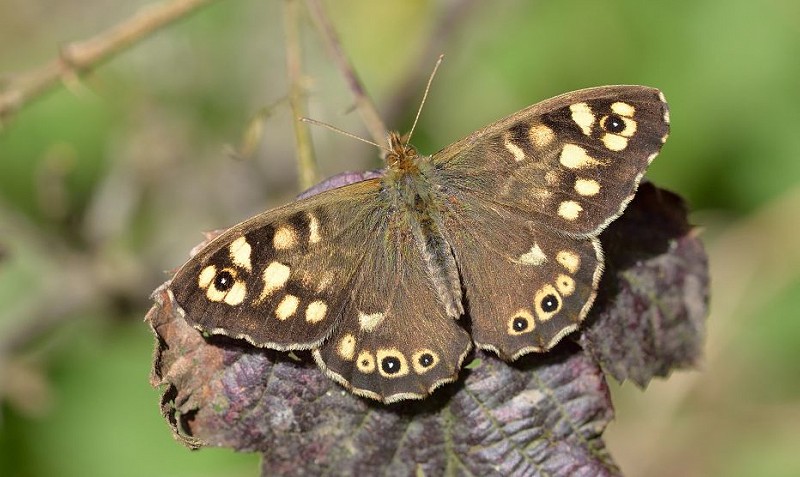
The Speckled Wood (Pararge aegeria) is a remarkably familiar butterfly species, found most frequently living up to its name in woodland areas. Unusually amongst British butterflies, it displays a high capacity for thriving in closed-canopy shaded habitats and may well be spotted even on overcast days. Indeed, their very appearance perfectly mimics their favoured conditions, for the chocolate-brown wings and pale eye-spots replicate the dappled sunlight on a woodland floor. When in flight, they cool rapidly and it's only through 'basking' in sunny spots that they're able to raise their body temperature. Open rides and glades, hedgerows, gardens and scrubby lanes will all support Speckled Woods as they flit between sun and shade. Interestingly this rather understated species displays a surprising level of diversity, including both seasonal and regional variation in both size and colouration. Sexual dimorphism typically results in females having larger cream spots than males, whilst colour polymorphism may result in darker second brood individuals. Their geographical distribution plays a significant part in appearance, with their spots changing from orange in continental locations to white in northerly extremes. This has in fact split the Speckled Wood into a number of subspecies, with the cream-spotted subspecies P. aegeria tircis found across England.
Aside from their unconventional preference for shade, the Speckled Wood has a totally unique trait amongst British butterflies - its overwintering strategy. Whereas most will undertake survival through the coldest months in a single form, the Speckled Wood may enter winter as either a caterpillar (larvae) or a chrysalis (pupae). This of course helps to maximise the chances of survival and the end result is a mixed breeding strategy and complicated yearly pattern of emergence, with adults on the wing all the way from March to October. During this time you may well spot them engaged in combat, for the males ferociously contest territory. In the manner of a sentry, perched males will keep a watchful eye for intruders and should an incursion occur, battle will commence. The clashing males will spiral in an aerial dogfight, ascending rapidly in a kind of 'butterfly vortex.' It's quite a sight to behold and somewhat belies the peaceful and care-free notion we hold for our butterflies.
The competitive behaviour of the males makes them the most conspicuous, though the fierce disputes arise through a tactical difference in finding a mate. Some will perch, waiting for an unsuspecting female to flutter by. Some will patrol a territory, searching actively for a freshly emerged female. The perching males tend to be the most successful as the thermoregulation they employ by perching enables them to fly for longer. Their ability to hold territories is also indicative of their strength and high genetic quality. Unlike the males the females are monandrous, mating just once in their lifetime, so the continuing attention of males may quickly become tiresome, something that may even result in a temporary trick of 'playing dead.' Speckled Wood numbers fell spectacularly from the latter part of the nineteenth century and it's only in the last half-century that their fortunes have comprehensively turned round. They have undoubtedly benefited from the effects of a warming climate, their distribution and abundance increasing extraordinarily in just the last few decades. Even allowing for continuing threats to their critical woodland habitat, they're still one of the very few butterflies that have fared well in recent years, thriving at a time when the fluctuating fortunes of many others species are in direct contrast.

Speckled Wood © Derek Middleton
Comments
I love watching these.. they aren’t the most colourful but have a fascinating rustic sort of charm
04 Jun 2020 18:48:00