
Species of the day: Orange-tip
By James Duncan
Learning and Engagement Officer
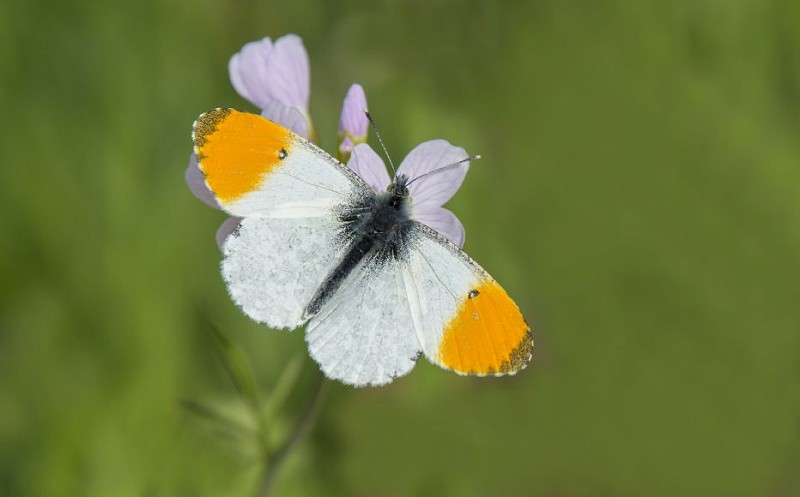
The Orange-tip (Anthocharis cardamines) really is the butterfly that most beautifully epitomises spring. Of course we're familiar with seeing others at this time, those such as Peacock, Brimstone, Red Admiral and Comma, but there's one key difference. Those species have all overwintered as adults (imago), whereas the Orange-tip takes one of the other forms of its four-stage life cycle, the pupa. The caterpillar of the Orange-tip will climb to an appropriate height on suitable vegetation and undertake a final moult, braving the worst of the year's weather as a rigid chrysalis. It's a marvellous bow-shaped structure that's cunningly orchestrated to perfectly resemble either a thorn or seed-pod. Should it remain undetected, the magnificent Orange-tip will usually emerge late March - April, ready to begin its wandering ways along our hedgerows, margins, verges and embankments. This is one British butterfly that displays strong sexual dimorphism, and it's the males that are overwhelmingly more distinctive. In fact it is them alone that gives the species its name, with the tips of their forewings appearing to have been dipped carefully in a resplendent orange paint. The females lack these, looking superficially more similar to the other members of their family, the Whites.
Though their upper-wings may be markedly different their underwings certainly aren't, a patchwork of fuzzy green helping to conceal them perfectly within vegetation should they need to avoid danger. As with most animals that exhibit patterns, stripes and shading, it serves as a form of disruptive camouflage, breaking up the outline of the wing shape. As with all butterflies, it's the delicate scales attached to the wing membrane that creates their colouration - in the case of the Orange-tip a combination of both black and yellow scales create the illusion of green. This is particularly important for the female as it helps disguise her during egg-laying. The vivid orange exhibited by the male also serves as a stark warning to predators that they may not find him palatable owing to an accumulation of mustard oils, gained during the larval stage. Their favoured food-plants are undoubtedly Crucifers or members of the Cabbage family (Brassicaceae), with Garlic Mustard and Cuckooflower preferred. Their species name of Cardamines is a direct reference to this.
Orange-tips also show a surprisingly effective strategy for passing their genes to the next generation. As the females lay eggs they mix a pheromone that typically deters other Orange-tips from laying on the same plant. This is particularly important as there's rarely enough food in the required seed-pods for more than one caterpillar. In the event this doesn't happen, the caterpillars will happily cannibalise the rivals of their own species. They are indeed a butterfly species that's doing well, gradually expanding their range ever further. Their early emergence in spring acts as a useful marker of ongoing climate change and is perhaps best summed up by their name in French - L'aurore or 'The Dawn.'

Female Orange-tip © James Duncan
Comments
Wehave had four male orange tips in our garden during the week until april 16th flying up and down our sunny border and occasionally landing on honesty flowers.
18 Apr 2020 09:12:00
Was lucky enough to see some is these this morning in Highwoods today – was magic watching them!
19 Apr 2020 19:40:00