
Species of the day: Mute Swan
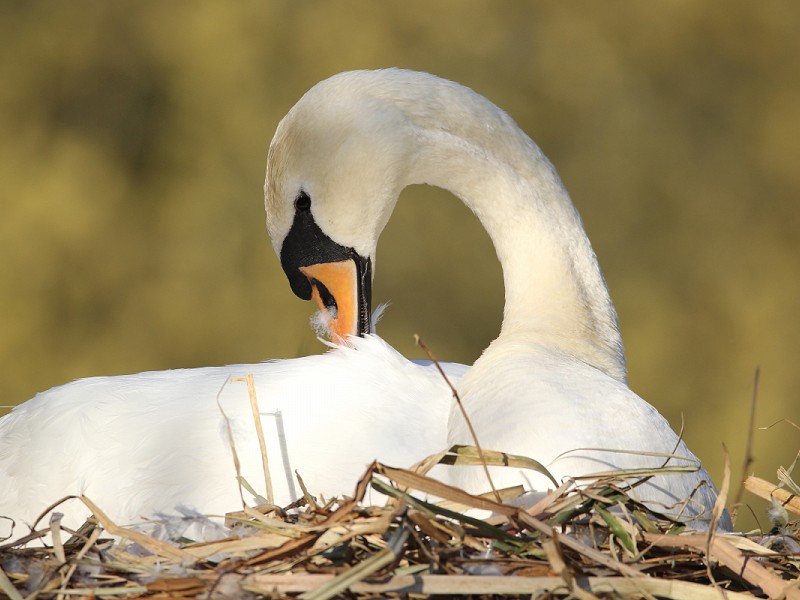
By James Duncan
Learning and Engagement Officer
The Mute Swan (Cygnus olor) is both one of the UK and world's largest and heaviest birds. It's also far and away the biggest bird you're likely to see within a short distance from your house. To give a sense of scale, a large male Mute Swan weighs around the same as 2500 of our smallest species, the Goldcrest, which is certainly indicative of the sheer diversity within the kingdom of birds. Of course it's not just size that defines the Mute Swan, it's symbolism is legendary. It was renowned as a traditional symbol of beauty, love and tranquility in greek mythology and Aphrodite has frequently been depicting riding upon one. There's little doubting the graceful elegance they exhibit as they glide on the water's surface. Here in the British Isles they're regarded as symbols of loyalty and strength, though their gentle demeanour actually somewhat contradicts the powerful potential of such a large bird. There can be no better known ornithological myth than that of "keep your distance from a swan as they can break your arm with a flap of their wings." The bones in birds are actually far lighter than those in mammals, many of which are hollow and filled with air-spaces (pneumatized construction) to enable flight - not for breaking human arms. Of course that isn't to say they're not territorial and as with most animals, they'll aggressively defend both their breeding territory and cygnets.
Swans are also strongly associated with fidelity and monogamy, owing to the belief they mate for life. This both is, and isn't true. Though they certainly do tend to form a strong 'pair bond' and the overwhelming majority are monogamous, the bond isn't unbreakable. It's likely that unsuccessful breeding may occasionally cause pairs to split and look for new partnership. The death of one of the pair will also usually result in a new pairing for the surviving partner. Courtship for Mute Swans typically takes place in late winter and consists of beautifully executed synchronisation between the pair, a real pleasure to watch. It is possible to tell the difference between the male (cob) and female (pen) not just by size, but by the significant protuberance on the male's beak that swells during the breeding season. Once the cygnets hatch it will be three to four months before they're finally able to lift their bulk into the sky.
Mute Swans have also played an integral part in human history since medieval times. Unfortunately they were once prized as food for banquets, a single swan potentially providing a hugely expensive royal meal. The penalties for theft of a royal swan would have been severe, though were only really in place to protect them as a financial resource. Indeed, Mute Swans are still considered to belong to the crown, though the Queen only truly exercises that right on stretches and tributaries of the Thames around Windsor. The Mute Swan was, in the Middle Ages, considered a valuable commodity and was traded between noblemen, governed by the 'Act for Swans' which dates from 1482. Swans were marked by individual owners, cutting distinctive cuts or brands onto the upper mandible of the beak. Technically any swan unmarked on the Thames is still regarded as belonging to the crown, though it should be noted that none of the royal swans continue to be marked. A ceremony still exists to this day to celebrate the Mute Swan in our culture, the annual 'swan-upping.' Just two livery companies remain, that continue to uphold the tradition of 'owning' swans - Vintners and Dyers. If nothing else, the tradition now serves as a useful conservation tool for keeping track and analysing the health of Mute Swan populations.
The treatment of this revered bird over the ages has undoubtedly been cruel. Surprisingly it's quite likely that it was in fact instrumental in their continued survival. Whilst populations across Europe declined, the 'Act for Swans' protected the birds from over-hunting. It wasn't until the mid nineteenth century that the concept of swan 'ownership' began to decline, mainly owing to the labour costs involved in catching them. It was at this point that their steep decline began, a statistic that's only recovered in the last 100 years. Sadly there have been a number of other dangers in recent times, the most destructive being lead poisoning from both fishing weights and shotgun cartridges. A 1987 ban on fishing weights has certainly helped assist a partial recovery.

Mute Swans © James Duncan
Comments
The Mute Swan is such a beautiful bird and a real pleasure to watch. The fact that they mostly pair for life makes them even more special.
12 Nov 2024 08:00:00