
Species of the day: Marmalade Hoverfly
By James Duncan
Learning and Engagement Officer
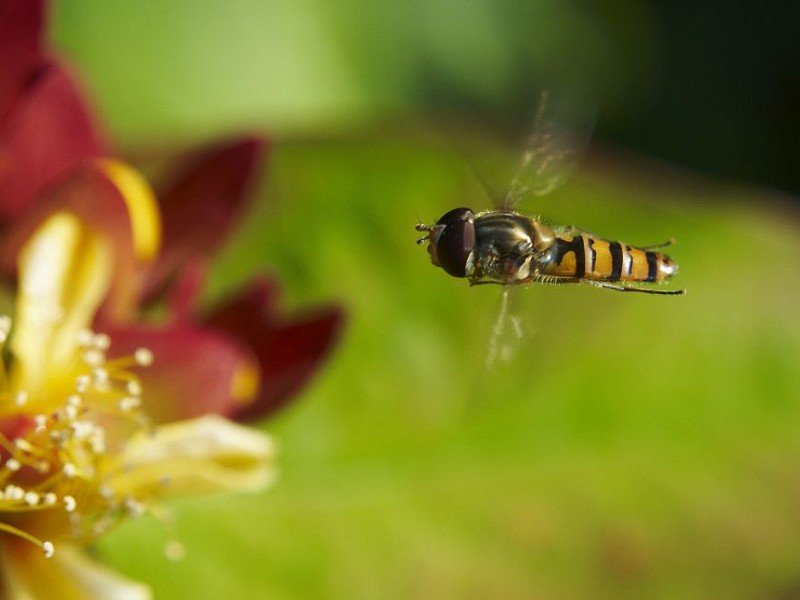
The Hoverflies form a large and diverse group of more than 280 British species. A familiar resident of gardens and one of the few to have obtained a common name is the Marmalade Hoverfly (Episyrphus balteatus). It's a distinctive double-striped member of its global family (Syrphidae) who all display remarkable abilities in flight. You'll see them hanging magnificently in the air, darting around at speeds so fast it's hard for the eyes to keep up. Like many other Hoverflies they exemplify what's known as batesian mimicry, a key aid in survival as part of the 'evolutionary arms race' between predators and prey. Batesian mimics are harmless species, evolved to mimic creatures a whole lot more harmful. The colouration of the adult marmalade fly is of course representative of a wasp, though it's so utterly harmless that it 'wouldn't harm a fly.' It wouldn't, in fact, harm anything at all, for it feeds entirely on nectar and has no weaponry of any kind.
Most surprisingly the Marmalade Hoverfly is not just a resident breeding species. It's also a migrant, and seemingly a successful one. There's little doubt that insect pollinators are largely in decline, though amidst this it appears migrating insects may be faring somewhat better. A 2016 study by the University of Exeter concluded that hundreds of millions of 'marmalades' are in fact arriving on British shores each spring, having crossed the channel from the continent. The ecological benefits this provides cannot be overstated for the Marmalade Hoverfly is a critically important pollinator. It's also a generalist (polylectic) feeder, nectaring on a wide variety of flowers, a necessity as it has only a short tongue. The generalist approach implies adaptability in feeding and may well explain the stability of their population. The sheer volume of their numbers dictate their global importance, the Exeter study indicating that Episyrphus, along with another common Hoverfly (Eupeodes corollae) may well transport a total amount of pollen equivalent to that of all the UK's Honey Bees.
Though the adults are harmless, the larvae are quite the opposite and are highly effective predators. Complimenting their merit as pollinators, the larvae offer a marvellous environmental service for crop protection as they're a ruthless devourer of pest species, and in particular, aphids. The sheer volume of Marmalade Hoverflies create a huge biomass, consuming simply staggering numbers of aphids and making them one of our most advantageous garden companions. Considering many of our most beneficial insects are in decline, it's likely that Hoverflies will continue to play an essential role in perpetuating vital ecosystem services.
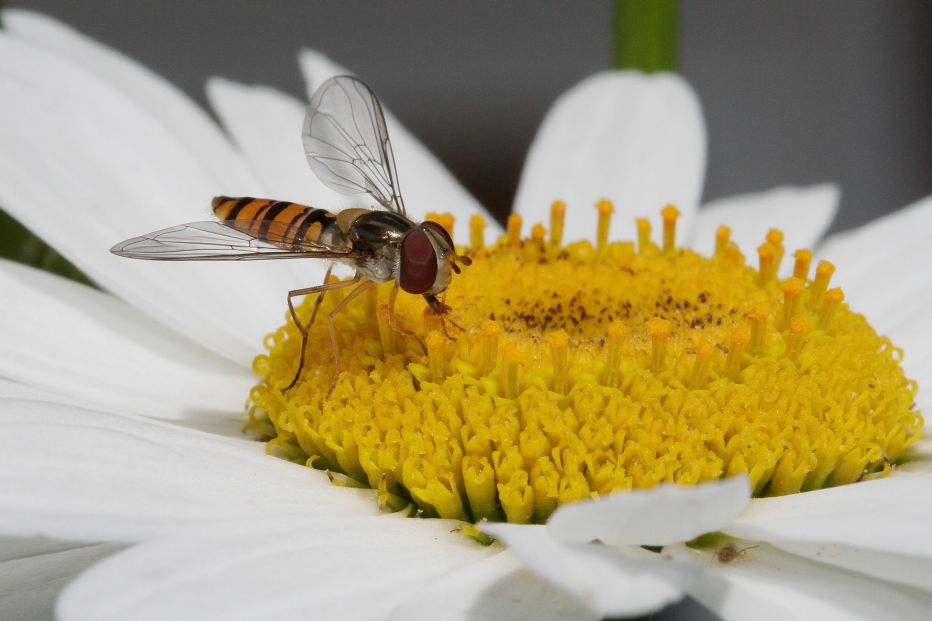
Marmalade Hoverfly © Neil Fletcher
Comments
Thanks James. I have been watching these in my garden this week and did not know they had a common name. Nice to know they feed on aphids.
03 May 2020 12:27:00