
Species of the day: House Sparrow

By James Duncan
Learning and Engagement Officer
In the latter part of the twentieth century there's little doubt the chirpy House Sparrow (Passer domesticus) was one of Britain's commonest resident birds. In fact, most would probably state that to be unequivocally so. Unfortunately for the House Sparrow this is no longer the case having suffered a monumental population slump in recent years - shockingly, we've lost in the region of 6.5 million pairs since the 1970s. Now, it should be stated that the House Sparrow is still one of the planet's most widely distributed birds, present on every continent except Antarctica. However, they have dispersed far more widely than they would have naturally following introduction to both the Americas and Australasia. There really is no bird associated with humans more than the sparrow - they're embedded in our culture and even the species name of domesticus indicates it 'belongs to the house.' It could be said that it is in fact our most steadfast avian companion as true to its name it may seem almost domesticated at times. It's surely this close association with us that's made their gradual disappearance all the more obvious. In the ultimate irony, the species had long been considered a pest for centuries leading up to their decline. They were slaughtered in vast numbers owing to supposed crop damage, though paradoxically their diet included insects harmful to arable crops.
Traditionally sparrows have exploited every possible man-made opportunity, from nesting locations and materials to food garnered from our 'throw-away' society. But amazingly it seems the development of human civilisation may have driven the evolution of urban House Sparrows. A study published by the Royal Society in 2018 concluded that a pair of genes active in urban sparrows, but not in rural populations, has likely had considerable impact when favoured by natural selection. The first regulates development of the skull, leading to a larger beak and tougher skull more useful for tackling larger seeds used in agriculture. The second utilises the enzyme amylase enabling the birds to digest complex starches, critical to thriving in a modern farming, and indeed urban, landscape. It's remarkably interesting to considerate the evolutionary stories tied in with our own as we change the face of the planet and continue to encroach into wild habitats.
The House Sparrow's an exceedingly social species. They live in extended family groups, occupying a small territory and frequently roosting together, bathing together, nesting together and singing together. They were also once widely associated with promiscuity. This was largely due to the perceived public nature of their copulation. It's probable the promiscuity wasn't entirely unfounded as recent studies have suggested approximately fifteen percent of sparrow offspring are the result of polygamy, where the young are unrelated to the female's mate.
The House Sparrow, though found all over the UK has now become 'locally common' as opposed to being the universally common bird it once was. The reasons for its decline remain slightly unclear, though our tidy modern ways have certainly reduced available habitat and pesticides and agricultural intensification continue to take their toll on rural populations. It's now a Red-listed bird of the highest conservation concern and even though we may have changed the way it lives, it continues to struggle in twenty-first century Britain.
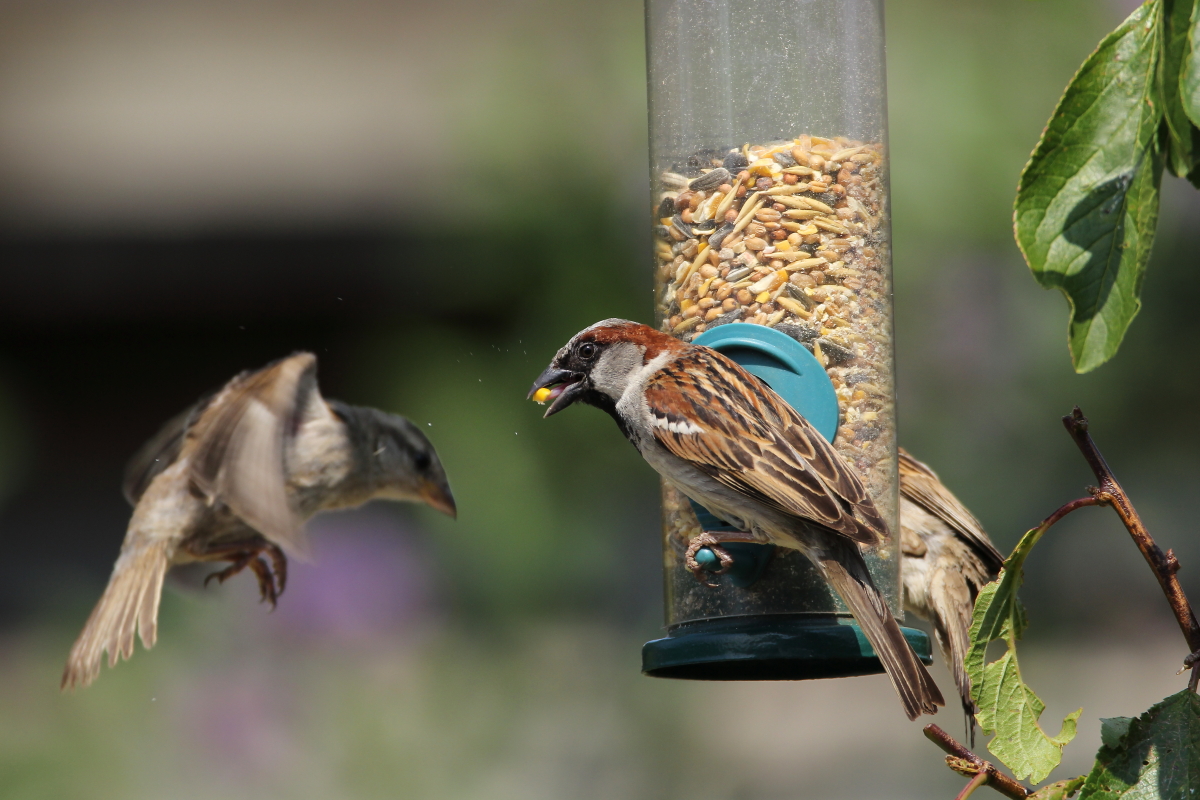
Female & Male House Sparrow © James Duncan
Comments
It is still locally common in my garden in Shoreham. I get up to 20 feeding and bathing in the pond with larger flocks in the winter. The biggest count was over 80 a few years ago. I am not sure where they are all nesting locally. some are in the roof of a house below us along with starlings, but that will soon change as the property is being redeveloped. I have put up a Sparrow box but it is yet to be used.
19 Apr 2020 19:28:00
When I first lived here in Eastbourne I used to (2003-9?) get masses of these jostling through a bushy shrub outside my study window. They made me happy with their enthusiastic busyness. They seemed a fixture but I haven’t seen them for years.
11 Feb 2022 07:27:00
I have been in St Leonard’s on sea for past 40 years. The house sparrow colony has grown and grown. I can’t count the numbers now. During this time I have always put feed out but in addition a hawthorn hedge was installed along the road about 35 years ago. The neighbour’s bay tree has got larger and I have shrubs in my garden so they have plenty of places to flee to should a predator fly by.
21 Mar 2024 17:36:00