
Species of the day: Gorse

By James Duncan
Learning and Engagement Officer
An old proverb states that when "gorse is in bloom, kissing's in fashion." This shouldn't give anybody immediate cause for concern as it's not often that Gorse (Ulex sp.) isn't in flower. Folklore around Gorse simplifies this somewhat, as there are actually three species in the UK, Common, Western and Dwarf, though it's the Common Gorse (Ulex europaeus) that's most widely distributed. There are probably few other plants that have such a distinctive effect on the UK landscape as Gorse. Its vibrant yellow flowers are often the only splash of colour on a bleak winter's day and the scent, so reminiscent of coconut, can be quite remarkable. Victorian novelist George Meredith captured the essence nicely -
"Yonder came smells of the gorse, so nutty,
Gold-like and warm: it's the prime of May.
Better than mortar, brick and putty
Is God's house on a blowing day"
There's little doubt that Gorse is one tough plant. It frequently grows in the most exposed of places, where wind, water loss and frost damage are rife, though it has effective strategies to cope. It's a sprawling evergreen shrub, rarely reaching a height of more than 2.5m and comprising leaves which have become specially modified into rigid, needle-sharp spines. In fact, its so entirely impenetrable that it does a great job as livestock fencing. Amazing to consider it's also been used as livestock fodder, though admittedly without the spines in situ. Gorse isn't particularly long-lived, but propagates with ease and can rapidly become invasive if not properly managed. Gorse is also nitrogen fixing - it uses bacteria in its roots to convert atmospheric nitrogen to a usable form. This can result in the displacement of other native plants as it tends to further acidify soils that are already poor quality.
Over the ages Gorse has had many benefits for humankind. Its highly combustible tendencies have enabled its use as fuel for cooking and its spiky foliage a suitably grippy, but impromptu washing line. These of course are far outweighed by its advantages to our wildlife. Its radiant flowers attract a number of pollinating insects and its dense foliage is favoured and inhabited by a number of bird species. These include birds of the highest conservation priority such as Linnet and Yellowhammer, though Dartford Warbler and Stonechat are perhaps the two species with which it is considered most synonymous.

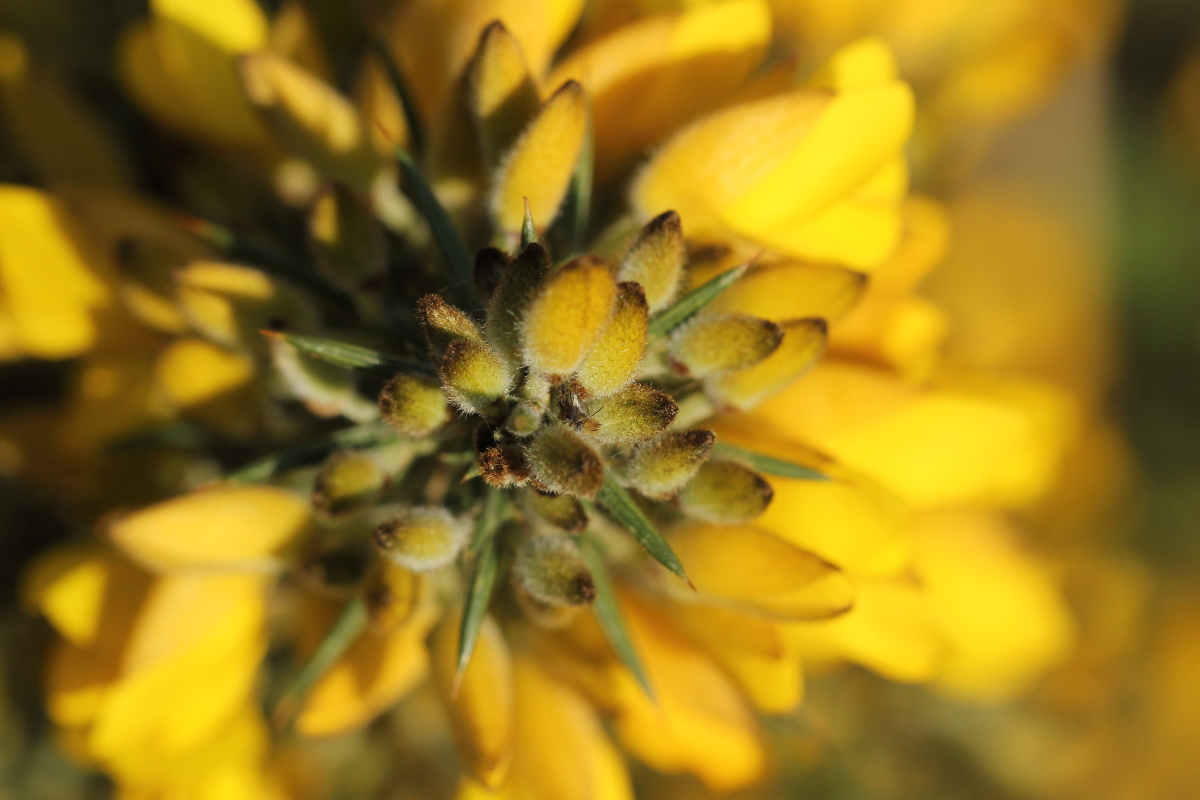
Gorse © James Duncan
Comments
Not only birds. Dodder, Mites, deer grazing and Dormice. probably many more. Martin
16 Apr 2020 13:41:00
It makes a wonderful coconutty flavoured vodka . Pick a few yellow blossoms -From a few plants . Never too much from one. put them into a jar . Pour vodka over to cover them . Shake each day for a week & then strain it off. Its delicate flavour mixes well with a light posh tonic. Yum !
16 Apr 2020 15:09:00
Why is the gorse in East Sussex – for instance on the Downs and Ashdown Forest – turning brown? Is it part of a natural cycle?
20 May 2021 20:33:00
Gorse can be impacted by spider mites but this could be caused by dry conditions and late frosts – the weather has been challenging recently. Gorse is resilient though and should bounce back.
21 May 2021 08:20:32