
Species of the day: Early Purple Orchid
By James Duncan
Learning & Engagement Officer
The Orchids are a staggeringly large family of flowering plants (Orchidaceae) found across the globe. With estimates of more than 30,000 species (and many times more hybrids), a good fifty can be found in Britain - it's likely that there are still many more to be discovered worldwide. One that very much lives up to its common name is the Early Purple Orchid (Orchis mascular), whose purple blooms emerge from April, prior to almost all other British family members. The Orchids are very much the 'supermodels' of the botanical world, their iconic, elegant and truly exquisite flowers giving them a sense of mystique that seems to set them apart from all others. For nearly two hundred years humans have been obsessed with their innate beauty, the Victorian desire for discovery and collection so intense that it's rather wonderfully known as 'orchidelirium.' Of course the Orchids were traditionally associated with virility in Ancient Greece, the word 'Orchis' meaning 'testicle', a nod to the plants' bulbous roots. They've long been seen as a symbol of wealth within European society and continue to be associated with rarity, luxury and strength.
Perhaps the feature that has seduced generations more than any other is their sheer uniqueness and diversity of form. In fact not just a uniqueness in look, for they have a number of features which have very much assisted in their evolution. For one, they tend to produce huge quantities of exceedingly lightweight seeds, which may appear a wasteful strategy, but pays off owing to mycorrhizal relationships with fungus that will feed the emerging seedlings. Some Orchids may have this relationship with many species of fungus, some with just one, and some not requiring the relationship at all. Methods of pollination are also highly specialised as they produce vast quantities of pollen, but it's typically not free-floating and is produced in sticky packets with an overwhelming dependance on insects. Though not unique in itself, the strategies employed in order to attract insects are highly ingenious forms of sexual deception. These include pseudocopulation, where male pollinating insects attempt copulation with the flowers due to their resemblance to the female parts of the insect, and pseudoantagonism, where male pollinators attack the flowers owing to their visual similarity to intruding insects, both resulting in attachment of the pollen packet. Orchids are outstanding mimics and have evolved with staggering complexity, over vast time periods. In fact, genetic sequencing has in recent years revealed that their evolutionary lineage may extend back far further than once thought - to at least 85 million years, a time in the late Cretaceous when dinosaurs still roamed.
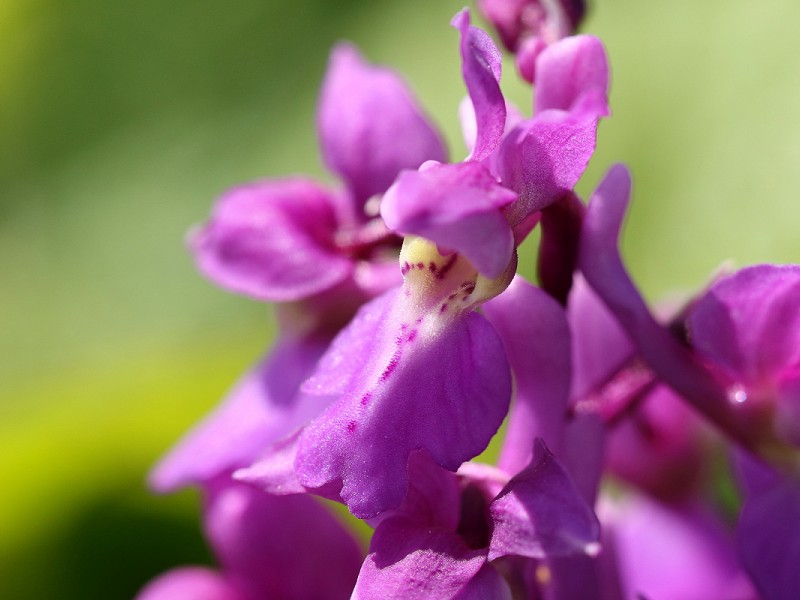
Early Purple Orchid is a widespread species, found across Europe, with a fondness for Calcareous soils, one that may be discovered in meadows, woodland, chalk downland, roadside verges and on cliff edges. Its distinctive spikes may house up to fifty individual flowers and are not the only part of the plant coloured purple, for its blade-shaped leaves also have characteristic purple blotches. The three-lobed bottom lip of the flower serves as an effective insect landing-platform, the deceiver in this case providing no nectar reward. Though the Early Purple smells sweetly when first flowering, it becomes quite the opposite once fertilisation has been achieved, supposedly smelling of cat urine. The underground tubers of Early Purple Orchid have seen much use over the ages, ground up for culinary use and often mixed with spices, honey or milk to create the hot beverage salep. Associations with virility are well documented in Classic times, with mixes using either the roots or flowers considered an aphrodisiac. Though a numerous species, it continues to be threatened by loss of habitat, particularly the ongoing destruction of ancient woodland and grassland through changes in farming.

Early Purple Orchid © James Duncan

Early Purple Orchid © Nigel Symington