
Species of the day: Drone Fly
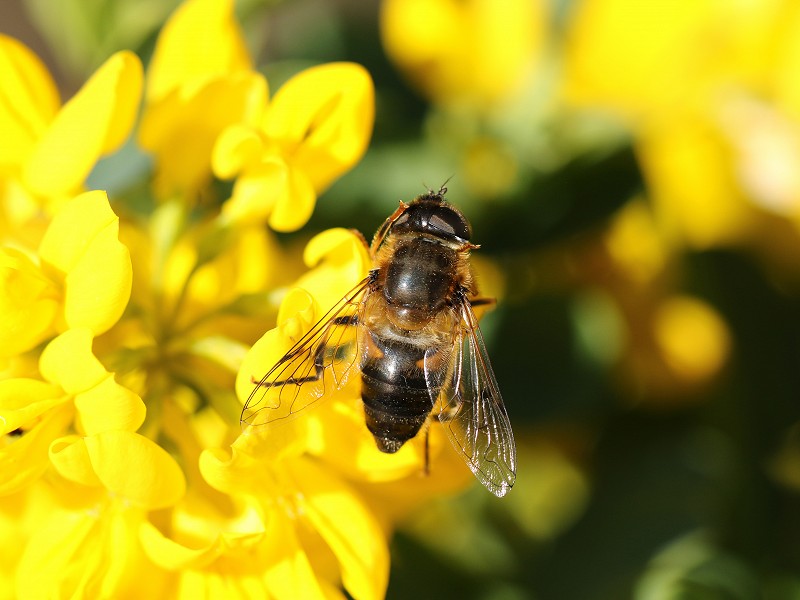
By James Duncan
Learning and Engagement Officer
The Drone Flies are some of our commonest Hoverfly species, belonging to the substantial genus of Eristalis. Two of the most numerous in British gardens are the Common Drone Fly (Eristalis tenax) and the Tapered Drone Fly (Eristalis pertinax). As soon as the sun shines they're out in force, seemingly defying the laws of physics as they appear to teleport themselves from one location to the next. However, when on the hunt for nectar their flight behaviour seems quite different. Recent science has discovered they actually fly more like Honeybees than other flies, moving erratically back and forth between flowers.
This brings us back to the name - Drone Fly. They're so called as ultimately they also masquerade as Honeybee drones, looking remarkably similar on first acquaintance. They're a perfect example of Batesian mimicry; appearing to look like something a whole lot less palatable. Once stung by a Honeybee it's less likely a predator will eat something that looks like one! The convergent evolution that enables this type of mimicry is certainly a creative method for outsmarting adversaries.
Drone Flies avidly search for nectar in order to power their flight, sucking mouthparts hoovering up pollen simultaneously, the proteins released helping them to reproduce effectively. They're regular visitors to a wide variety of flowers all year round and it's important to note that they (amongst other flies) play an important role in not just the pollination of wildflowers, but also of crops.


Drone-flies © James Duncan
Comments
Very confusing when first seen!
02 Aug 2021 19:17:00