
Species of the day: Cuckoo

By James Duncan
Learning and Engagement Officer
There may be no summer migrant more familiar to the British population than the the Cuckoo (Cuculus canorus). Ironically it's a bird whose scattered distribution and secretive habits mean that many may never have seen one. It is of course the overwhelming clarity and simplicity of its diagnostic call that cements its stature as a symbolic harbinger of spring. Many may feel that spring has not truly arrived until the first Cuckoo is heard. Its unmistakable "COO-coo" calling card can be copied and imitated quite easily, perhaps another reason why we feel such affinity. We may not technically think of the Cuckoo as a 'song bird' but the common call of the male is in fact very much its song, delivered to serve both a territorial and mate-attracting purpose. As with the majority of avian summer migrants, the Cuckoo's time in Britain is short-lived for it's here for a mere few months. Two thirds of its year is spent either on migration or within the steamy equatorial jungles of central Africa.
Adult Cuckoos are a remarkably distinctive and attractive bird, a piercing yellow eye punctuating blue-grey plumage and beautifully contrasting barring on the undersides. The breeding season is undoubtedly the optimum time to spot one as they'll often perch in the open - when doing so, they look like little else. When in flight however, confusion can arise (particularly at distance) as they're similar in size and appearance to our smaller birds of prey. With scythed, pointed wings they may appear somewhat Falcon-like and the barring underneath is reminiscent of Sparrowhawk. Fortunately their profile is significantly different, with wings that beat below a horizontal plane, a body held rigidly straight and a tail that's both long and graduated. Whilst the familiarity of the male's calls are unquestionable, those generated by the female may not be as widely known. It's a bubbling little chuckle, a consistent liquid note that slows toward the end of the verse. It's somewhere between the higher-pitched, 'tittering' Little Grebe and much harder-edged and slower Green Woodpecker. Whatever the sex, there's one thing overwhelmingly distinctive about the voice of the Cuckoo - it's being heard less and less, all across Britain.
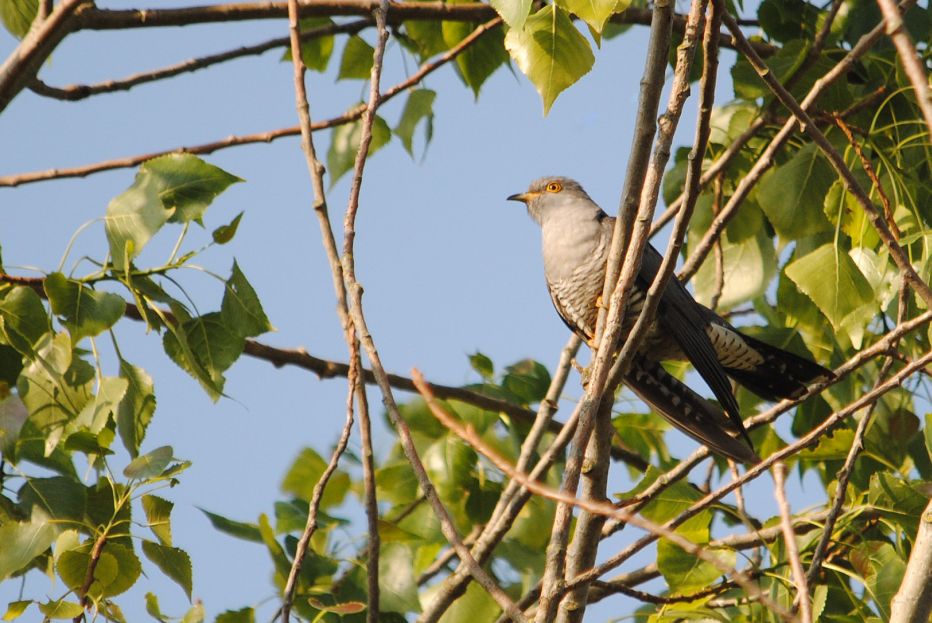
Cuckoo © Amy Lewis
Chances are, if you live in England, you'll have noticed the conspicuous drop in Cuckoo 'visibility' in recent years, whereas in Scotland numbers have actually increased. This hasn't altered the simple fact that we've rapidly lost around 70% of the population since the mid 1990s - the Cuckoo has now been a Red-listed bird of the highest conservation concern for more than ten years. At present it's the heather-covered uplands that support the highest numbers, whereas the farmed lowlands have seen an almighty drop. Understanding the reasons for this hasn't been easy as there seem to be a good few. One may relate to the Cuckoo's highly specialised diet of 'hairy' caterpillars. It is in fact one of the few birds prepared to tackle such a meal, though the decline of this food-source, through both habitat change and intensive insecticide use, has huge implications for adult Cuckoos. Another reason may involve a decline in their 'host' species and climate-induced changes in their breeding time, negatively affecting the availability of potential nests. Another more recently studied phenomenon is that relating to the migration itself. There's little doubt the perilous annual migration is a high-risk strategy for all bird species - British Trust for Ornithology (BTO) satellite-tracking and studies since 2011 indicate that Cuckoo's undertake a selection of wholly different migration routes through Europe. The decision they make could well prove fatal as mortality on route is intricately connected, correlating with breeding population data across the UK.
The Cuckoo is of course the most famous parasitic animal species in Britain, its breeding behaviour causing ceaseless controversy over the ages. Known technically as 'obligate brood parasitism' the strategy the Cuckoo employs for reproduction is surely one of the most magnificent 'cons' in the natural world. The Cuckoo has been recorded as using well over one hundred species to host its single egg, with more than fifty in Britain alone. The lack of parental responsibility and leisurely egg-laying may seem lazy, but the Cuckoo is actually at war with the host species, locked in an 'evolutionary arms race.' It must employ a whole host of tactics to ensure it isn't rumbled, for if the hosts are even slightly aware of a Cuckoo's presence they're more likely to reject eggs. The female is a symbol of stealth and will complete her egg-laying operation in a matter of seconds. Cleverly, Cuckoo eggs have also evolved to closely mimic that of their hosting species, essential as many birds have developed the art of spotting and destroying the egg. The bulk of these in Britain comprise Meadow Pipit, Reed Warbler and Dunnock, though strangely, the Dunnock is the one whose eggs are entirely different from those of the Cuckoo. This may either be a reflection of poor parental instincts or that it's a recent host and there hasn't been time for the egg mimicry to develop. As a whole, brood parasitism is undertaken by a relatively small number of bird species, making it all the more fascinating.