
Species of the day: Common Toad

By James Duncan
Learning and Engagement Officer
The Common Toad (Bufo bufo) is one of our two most familiar amphibians. Its widespread distribution is markedly similar to that of the Common Frog (Rana temporaria) though it's generally less frequent within its range. Toads are largely a secretive species that have discriminating habitat requirements (woodland, scrub and rough grassland) and desire large, permanent bodies of water for breeding. However, you may well spot one in your garden as human habitation provides them many spots to hunker down for the winter. They don't enter complete hibernation as milder weather will occasionally bring them out for sustenance. Though they'll often bury themselves in mud, under logs and amongst leaf litter, they're also quite fond of human ornaments, so don't be surprised to find one keeping cool and conserving energy underneath your flower pot.
The slumber of the Toad will cease during mild, damp conditions and spring offers the best opportunity to see them owing to their annual migration. We often think of this as the predominant preserve of birds and mammals, but in truth it's widespread across the animal kingdom. The Toad has a strong migratory instinct and will return each year to its ancestral spawning grounds, forming large aggregations. Adults may undertake a journey of a kilometre or more, and females can expect to be ambushed on route. In their desperation, amorous males will often look to 'piggy-back' the female prior to her arrival in a mating grip known as amplexus. Competition for mates is intense, males sometimes outnumbering females by ten to one. Amplexus won't prevent other males from trying to wrestle their competitor away and this may take the form of either furious kicking or an attempt to wedge themselves between the pair. Their journeys make them highly susceptible to predation, mopped up by a large variety of predators. Most have the issue of dealing with the tough, warty, foul-tasting skin as the Toad's paratoid gland produces a rather nasty compound, known specifically as a 'Bufotoxin.' This distastefulness even extends to the tadpoles, though most predators have found ingenious ways of eating them successfully. Though the toxin produced defensively by a toad may be unpleasant, there's absolutely no truth in the saying that "touching a toad will give you warts."
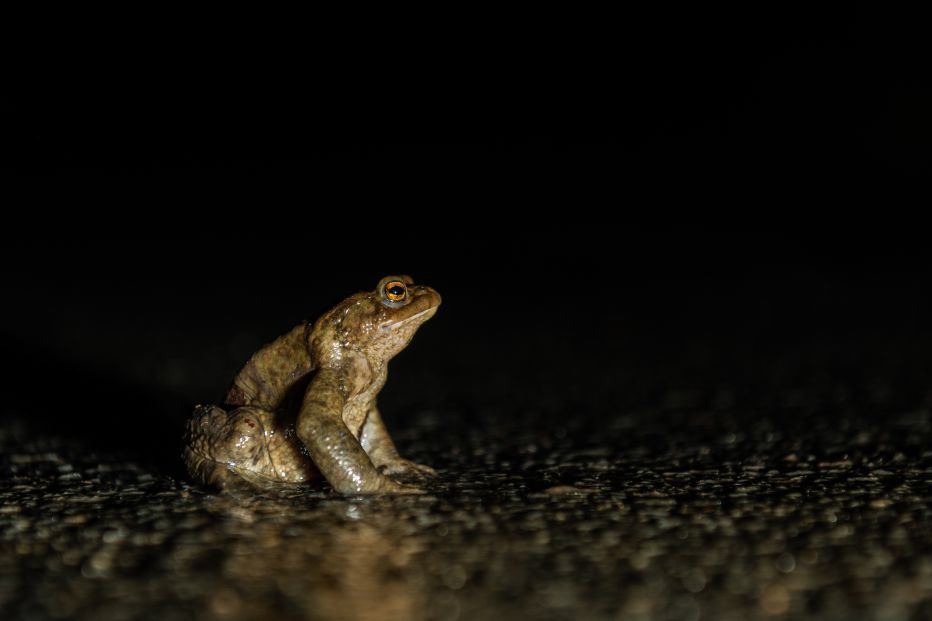
Common Toad © Peter Brooks
Breeding complete, it's usually at dusk that they choose to emerge, for the toad is a nocturnal hunter with exceptional eyesight. Toads have often been depicted in folklore and fiction as large-mouthed and greedy, and this isn't far from the truth as they've a substantial appetite. They'll happily gulp down anything that passes too close, a flick of their sticky tongue dealing with insects, arachnids, crustaceans and molluscs. They won't stop there though, a strong toothless jaw allowing an ability to predate small grass snakes, slow-worms, and even mice. They're also far from averse to opportunistic cannibalism, sometimes feeding on both tadpoles and toadlets, occasionally their own!
In Britain the Common Toad is unfortunate amongst native amphibians in being subject to sustained long-term declines. Figures produced by Froglife & the University of Zurich in 2016 have indicated we've seen losses of 68% in the last 30 years, and the South-East has been one of the hardest hit regions. Increasing urbanisation has served to fragment their habitat, drainage of land and removal of ponds has deprived them of breeding grounds and our heavily trafficked roads kill a serious number during migration. Unfortunately this decline in amphibians is sweeping across the entire planet. They appear to be some of the worst hit by the continued loss of biodiversity, loss of habitat and fast-changing climate. Recent statistics have indicated more than 30% of the world's amphibians are classified as 'threatened.' With a history dating back 300 million years, tetrapod amphibians are our oldest known terrestrial vertebrates, so their worldwide conservation status seems all the more concerning. Many people surely hold charismatic childhood memories of the Common Toad and it's vital to consider their decline in the UK equals that of iconic mammals such as the Hedgehog and Water Vole.