
Species of the day: Common Shore Crab
By James Duncan
Learning & Engagement Officer
June 8th is a day to celebrate the overwhelming importance of our planetary oceans, both as a recognition of the pivotal ecosystem services they provide and a consideration of the urgent need to protect them. The focus for 2020 is 'Innovation for a sustainable ocean', a theme more important than ever owing to the impact of unprecedented climate change, worldwide rise in sea temperatures and ever increasing plastic pollution. The health of our oceans is of course intrinsically tied in to our very survival, the need for sustainable practices imperative to combat the challenges faced. The staggering biodiversity and sheer wealth of life present in our oceans is without doubt something to cherish, providing inspiration to both protect species and manage resources through a global network of protected marine areas.
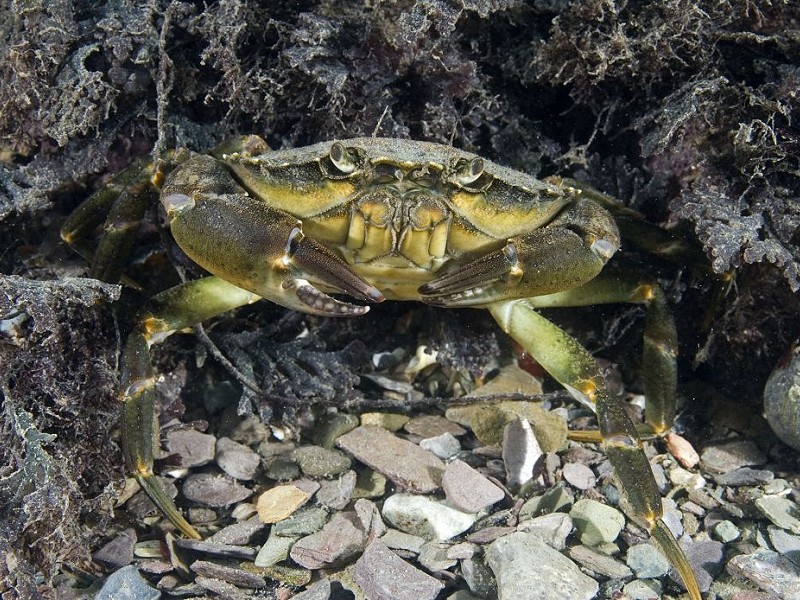
Perhaps one of the most regular contacts we have with the marine environment in Britain is the Common Shore Crab (Carcinus maenas), a species familiar to anybody who's been rock-pooling around the coast. This ubiquitous crab is native to Britain, Europe and the North-east Atlantic and thrives in a range of habitats, though typically it'll be found in shallow water intertidal zones and brackish estuarine habitats. It's what is known as euryhaline, meaning it can tolerate a huge variation in salinity, and is able to osmoregulate (control the body's water content), enabling survival in waters ranging from near freezing to positively balmy. This has undoubtedly contributed to its global success, though its accidental introduction in other areas of the world has it classed as a problematic invasive species. It also goes by another common name, the 'Green Crab', largely indicative of its general colour, though it's a highly variable species where grey, brown and even orange and red are not uncommon - juveniles are especially changeable and more heavily patterned. Whilst there's certainly a component of individual genetic variation, the colour polymorphism demonstrated by the Shore Crab may also be indicative of environmental factors relating to camouflage, particularly when considering its abundance in a wide range of marine zones.
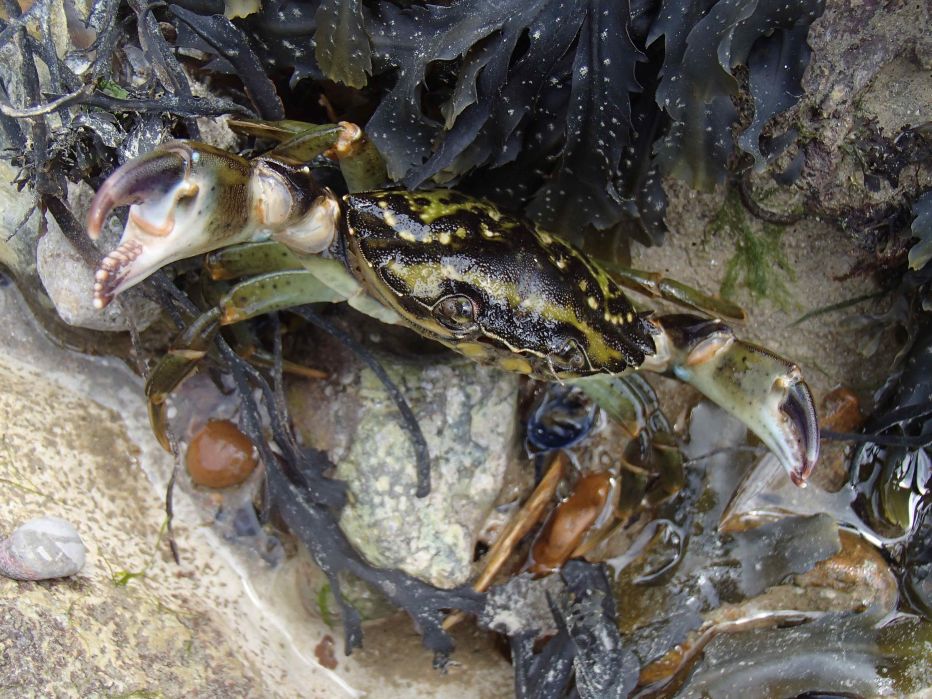
Common Shore Crab © Olle Akesson
The Shore Crab belongs to an Order of Crustaceans known as the Decapods (Decapoda). Included within this are some other familiar groups such as lobsters, crayfish, shrimps and prawns. Decapod quite literally translates to 'ten-footed', though some members of the order may in fact have substantially more appendages. However, as a rule only ten are considered true 'legs.' Perhaps surprisingly the Shore Crab is one of around sixty-five crab species found in British waters, though it has a uniquely distinctive carapace (or shell) - there are five spiked teeth on either side of the rim behind the eyes and three lobes between the eyes. The carapace is also broader than it is long, usually around 8cm's across in adults. Whilst the Shore Crab is highly predatory it may also be deemed an 'opportunistic scavenger.' Ultimately it's not too fussy, feeding on any organism it can get its pincers on, dead or alive. Whilst their bulky and powerful front claws may be used for breaking into mollusc shells, the crab will also show surprising dexterity by using them to pass food carefully to its mouth.
At certain times it may seem common to find large quantities of seemingly 'dead' crabs along the shoreline. The explanation is often something totally different, for the crabs may not be deceased at all - the lifeless bodies are their moulted exoskeletons. As a member of the Arthropods, the Shore Crab has a real obstacle to continued growth as its rigid skeleton is external, unlike our internal endoskeleton. The only way it can accommodate new growth is through 'moulting' its shell, a process that must happen once or twice a year depending on the crab's maturity. Each moult may enlarge a crab by between one-fifth to one-third of its previous size. It's a fascinating process, usually undertaken at night, beginning with the absorption of calcium carbonate from its old exoskeleton. The crab then secretes an enzyme to break down the connections between the shell, muscles and tissues and begins to secrete a new, soft shell. It'll then begin to take on seawater, puffing it up like a balloon, the expansion finally cracking the shell and forcing it open along a special seam. The shell remains hinged at the front and the crab climbs backwards from the old exoskeleton, leaving an intact, but thinner shell behind. This isn't quite as straight-forward as it sounds for it takes a bit of time for the crab to force itself from the open seam. The soft crab that emerges is delicate and incredibly vulnerable, having little choice but to hide during the few weeks required to fully harden the shell. The Shore Crab continues to fill its tissues with water, ensuring the new shell is slightly too big and therefore allowing it a chance to grow.