
Species of the day: Common Bird's-foot Trefoil
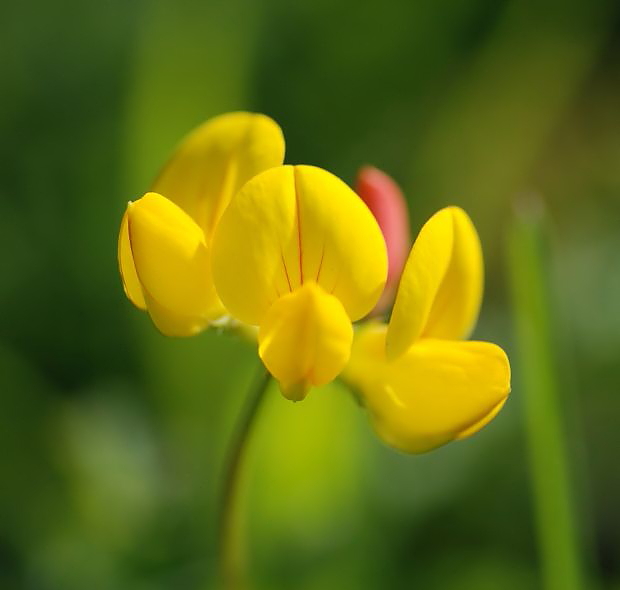
By James Duncan
Learning & Engagement Officer
The attractive yet unassuming Common Bird's-foot Trefoil (Lotus corniculatus) is an abundant and widely distributed sprawling perennial of meadows, roadside verges and grassland areas. It belongs to one of the largest families of flowering plants, the Peas or Legumes, also including vetches, beans and clovers, which are typically recognised by the arrangement of their flowers, seed pods and distinctive compound leaves (where several 'leaflets' are attached to a single stem). It's a rather resilient species, its hardy nature enabling a resistance to close grazing and mowing and an ability to tolerate a variety of conditions and soil types. You'll likely find it thriving anywhere from limestone cliffs to sandy dunes, and everywhere in between. In fact, it's only some of the highest peaks and stickiest peat bogs in Scotland that have remained uncolonised. Like many legumes, it has an ability to 'fix' nitrogen when growing in the right conditions, improving the fertility of the soil. This comes about through a mutualistic relationship with soil-dwelling bacteria. These convert gaseous Nitrogen into Ammonia that the plant uses for growth, whilst the bacteria gain sugars produced by the plant in return.
Common Bird's-foot Trefoil certainly seemed to fascinate our ancestor's imaginations for it has clocked up a substantial number of vernacular names. Perhaps one of the most commonly recited is 'Eggs and Bacon', referring to the red and yellow colouration of the flowers as they open - some flowers will often retain a partial red flush when in full bloom, particularly when old. Amongst the more evocative are 'Grandmother's slippers', derived from the shape of the clustered flowers, and the rather amusing 'God-Almighty's Thumb and Finger', taken from the shape of the seed-pods. Poor Granny is even referenced again in 'Grandmother's toenails.' Of course the avian 'claw-like' seed pods ultimately give rise to the 'Bird's-foot' common name. The name 'Trefoil' is slightly misleading in an anatomical sense, suggesting a triplet of leaflets (trifoliate), though upon closer inspection it actually carries another pair close to the stem.
The Common Bird's-foot Trefoil's ability to grow almost anywhere is no bad thing, for it's adored by a range of insects as a great source of nectar. They won't, however, give it up easily for the Trefoil's zygomorphic flowers (bilaterally symmetrical) are shaped specifically to enable the effective attachment of pollen. In fact, it'll require a robust insect like a bee or wasp to deal with the complex morphology and force its way into the flower to obtain nectar. Bumblebees, honeybees and solitary bees are all exceptional pollinators of this plant, with some species so specialised towards individual legumes that their very survival depends upon them. The Red-tailed Bumblebee (Bombus Lapidarius) may be one of the species seen nectaring most commonly. Though unlikely to assist pollination, a number of Lepidoptera (Butterflies and moths) utilise this Trefoil as a food-plant, both as adults and larvae - moths such as the distinctive Burnet family, including the Six-spot Burnet, and butterflies including the Common Blue, Green Hairstreak and Clouded Yellow plus a number of UK Biodiversity Action Plan (BAP) Priority species such as the Silver-studded Blue, Wood White and Dingy Skipper.

Common Bird's-foot Trefoil © Paul Marten

Common Bird's-foot Trefoil - seed pods © Neil Fletcher
Comments
I love this little plant and have it growing in my wildflower boarder along with perennials/hb such as Sainfoin, Cytissus, Cornflower, Echium, Corn Poppy, Hypericum, Betony and Verbena Santos just a little helping hand for the wildlife. It absolutely buzzes with need especially on a hot sunny day, although I’m still waiting for my Betony to flower for it’s first time. I also planted some Cocksfoot Grass as one particular bee friendly site says that it’s been observed at Kew that need have been ignoring their usual favourite plants for the Cocksfoot Grass once it produces pollen. My bees must be of a different nature (and l have 10 homemade bee boxes that have been continually busy in this year’s hot spell) but alas mine visited the Grass. But l will keep hoping. Bye Ray
09 Jun 2020 18:44:00