
Species of the day: Cockchafer

By James Duncan
Learning & Engagement Officer
The bumbling Cockchafer (Melolontha melolontha) is a rather amusing member of a family held as sacred by the Ancient Egyptians, the Scarab Beetles (Scarabaeidae). It's the most sizeable and conspicuous member of its extended British tribe, the ninety or so species of which show significant variation in size, from just a few millimetres to 3.5cm in the Cockchafer's case. The Cockchafer is known widely as the 'May bug', indicative of the adult's time of emergence, a month which lends itself to the colloquial name of many a species, eg. may tree, mayweed, mayfly. The May bug may in fact be spotted whirling around in the tree canopy right through to July, though the adults usually live for just six weeks. The warmer the spring, the earlier they typically emerge. Their buzzing, spluttering flight has also given rise to the nickname of 'Doodle-bug', a reference to their similarity to the humming German V1 Rockets of World War II - both share the unfortunate propensity for crash-landing in undesirable locations, catastrophically so in the V1's case.
Some chafer beetles often display the most beautifully exotic, iridescent wing cases, or elytra - in comparison the Cockchafer is somewhat more restrained, though its terracotta elytra usually look dusty as they're covered in short hairs. Cockchafers do, however, display the most magnificent head-dress, for their superb, fan-like antennae give them real character. Seen directly from the front they almost have an appearance of somebody holding their hands up in surprise, having been discovered when up to no good. It's even possible to determine their sex, for the males have an additional antennal segment (lamellae), seven as opposed to six. These are used to 'sniff-out' the chemical signals given off by vegetative matter and by potential mates. The additional 'leaf' carried by the male assists in detecting the pheromone used as reproductive enticement by the female. You might see them clattering around haphazardly at dusk, desperate to find each other before colliding disastrously with some aspect of the landscape.
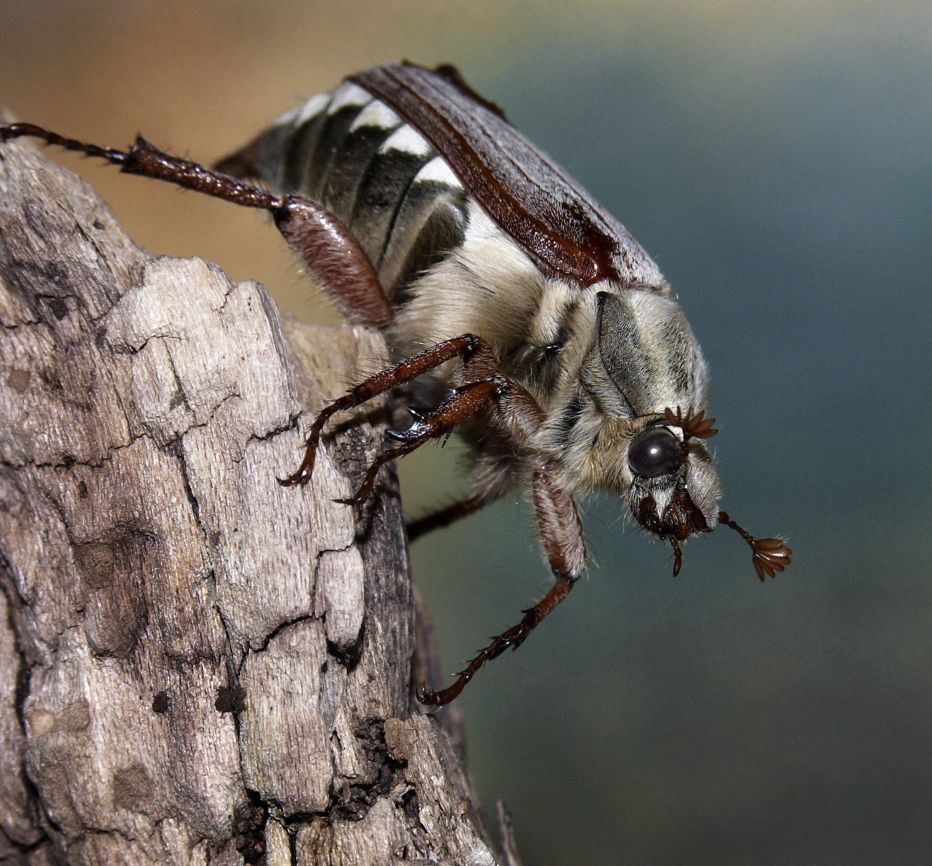
Cockchafer © Alan Price, Gatehouse Studio
The female will display a pointed tip to her abdomen, known as a pygidium, often confused for an intimidating sting. They are in fact utterly harmless to humans and the pygidium is used for nothing more than pushing eggs into the soil. The curved larvae that hatch are usually more sizeable than the adults, up to 5cm long, known often as 'rookworms.' They're loved by Corvids, such as Rooks, for they're fatty and protein-rich. Cockchafers spend a good few years in larval form, a time of life that made them a devastating cereal crop pest in the mid-twentieth century. The horrific pesticides used to control them (chlorinated hydrocarbons) were so devastating that Cockchafers were almost completely eradicated. Fortunately recoveries have been made in the last forty years. Bizarrely, they're also one of the few animal species to be taken to court - in 1320 a court in Avignon, France, sentenced them to exile in a specially designated area. Somewhat unsurprisingly, they wouldn't comply and were promptly rounded up and killed.

Cockchafer - larva © Alan Price, Gatehouse Studio
Comments
I saw one on a plant in my garden in Sussex never seen before but my son looked it up It was alive but didn’t fly off as I took pictures It was quite big.I would like. to have seen it in flight.
07 Jun 2025 17:04:00
Last eve while walking my dog I was aware that a few of these I have only know them as a child as July bugs they were swarming around me and getting tangled ci y hair I always thought they were sticky and once tangled can’t untangle themselves last time I got literally chased by these bugs was in the early 1870’s when I was in my early 20’svicthought had died out as I’ve not seen them until this eve
13 Jun 2026 22:36:00