
Species of the day: Chiffchaff

By James Duncan
Learning and Engagement Officer
The Chiffchaff (Phylloscopus collybita) may be one of the most recognisable birds in Britain, not by virtue of its looks, but because of its song. Judged on looks alone it's quite possibly one of the most inconspicuous birds we have, a compact species the size of a Blue Tit with typical plumage ranging from dull olive-brown on top to buff off-white below. It's the Chiffchaff's song that announces its presence, and unfortunately it's not the most tuneful to say the least. It is however, eminently memorable for the bird is named onomatopoeically - its little twin noted ditty is piercing, forceful and insistent, each note monosyllabic. The actual notes have been a tad lost in the English word chiffchaff, and its song is certainly better represented by the Germans, who know the bird as Zilpzalp. Individual birds do tend to show variation in song, so don't be surprised to hear repetition of each note as opposed to a definitive sway from one note to the other.
The Chiffchaff's a member of the extensive Warbler family, of which there are thirteen species breeding regularly in the UK. They're regarded as one of the trickier groups to identify, particularly for novices, as plumage characteristics aren't instantly apparent and the colouration of many is somewhat restrained. Indeed their songs are often pivotal in recognition. The Chiffchaff is one of the so-called 'Leaf' (Phylloscopus) Warblers which befits their personality as they flit boldly between branches looking for insects, frequently low in the canopy. They may often prove surprisingly approachable though they're an active, restless bird who rarely sit still for long.
Perhaps the most delightful aspect of hearing a Chiffchaff is knowing they're the precursor of the torrent of birdsong that arrives in Spring. This is due to their early arrival time (typically in March) from wintering grounds around the Mediterranean, and hence they're almost always the first migrant to sing. They tend to over-winter further North than the remarkably similar-looking but longer-winged Willow Warbler. It wasn't until 1768 that renowned Ornithologist Gilbert White was finally able to ascertain the differences between the two birds. It should also be noted that the Chiffchaff has a number of races (subspecies), some of which are now treated as species in their own right. Undoubtedly they're a bird benefitting from a warming climate as they have an unusual trait amongst their family - a proportion stay here through the winter. It's possible some are our own breeding birds, though it seems that many are in fact birds of eastern descent taking advantage of our less brutal climate.
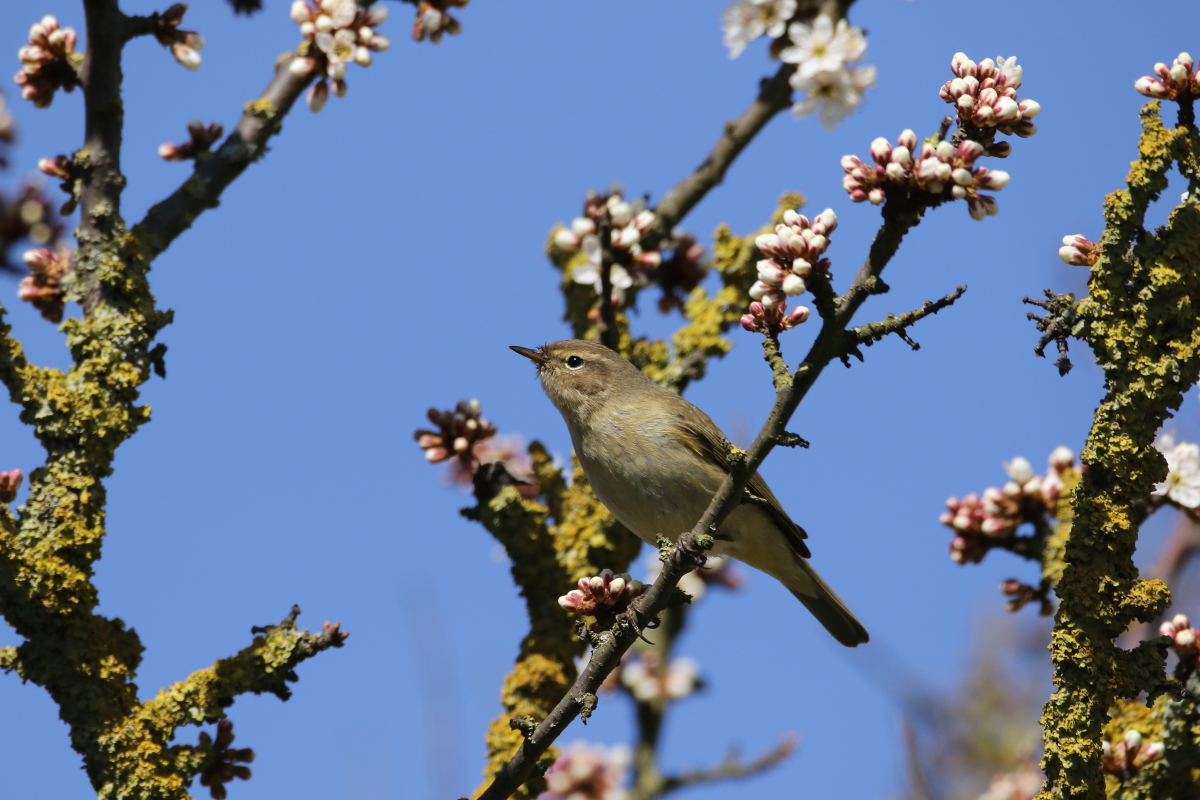
Chiffchaff © James Duncan