
Species of the day: Buff-tailed Bumblebee

By James Duncan
Learning and Engagement Officer
It may come as some surprise to learn there are approximately 275 species of Bee in the UK. Of those, 27 are represented in the genus Bombus by the widely recognised Bumblebees. This genus contains not just the more familiar 'social bumblebees,' but parasitic species known as 'cuckoo bees' too (for obvious reasons). One of the most widespread, and regular visitor of British gardens is the Buff-tailed Bumblebee (Bombus terrestris). During a poll to find our favourite insect in 2015 (conducted by the Royal Society of Biology) the Buff-tail was voted in first position as the nation's best-loved. It's certainly seen as a charismatic harbinger of spring, its emergence typically the earliest of all the Bumblebees, where it can be spotted almost anywhere across lowland habitat. The Queens, who are usually just shy of 2cm, can often be seen busily bumbling around on sunny days in February, having recently emerged from hibernation. Surprisingly, and somewhat uniquely, this isn't the earliest in winter you might see them, for it's eminently possible a warming climate may be changing their behaviour. In the South of Britain, some Buff-tails may be seen nectaring on winter flowers during any of the coldest months. Of course there are very few native plants in bloom, so winter colonies are likely to be wholly reliant on non-native garden substitutes such as Mahonia. The Buff-tail is found across Europe, and it should be stated that feeding in both late autumn and winter isn't necessarily unusual in the warmer parts of their natural range.
The Buff-tailed Bumblebee is regarded as one of the 'big seven' most abundant and numerous Bombus species. Once a buff-tailed Queen has awoken from hibernation she desperately needs to feed up for it's predominantly the pollen, not nectar, in her diet that fuels ovarian development. With such a huge body, even getting moving is a quite a task. Though the furry body provides excellent insulation, it's shivering that'll really get her going as she'll be unable to take flight until the muscles in her thorax reach around 30°c. Ingeniously she'll rapidly vibrate the flight muscles, but hold the wings in place, in effect taking the wing mechanism 'out of gear.' This is a brilliant method of creating heat, though it's essential to keep the bee consistently warm. Extended periods of inactivity when gorging on substantial nectar sources can necessitate a 're-heat.' Queens typically nest underground in structures that may formerly have belonged to mice or voles. Unlike many bee species that err towards a sunny south-facing nest site, buff-tails aren't too fussed by shade and may use a surprisingly lengthy nest tunnel. Buff-tail colonies can be truly substantial, with the largest comprising over 500 individuals in three distinct caste divisions - Queen, female workers and male drones.
Buff-tails are what's known as polylectic, indicating their trait of foraging on a wide variety of flowers of unrelated species - they're not fussy unlike many other bumblebees which have distinct preferences. During the early stage of nesting a Queen may have to visit thousands of flowers every day to gather enough nectar to preserve the body heat required to brood her eggs. This is clearly no mean feat and looking for any advantage, they are prone to thievery. Nectar robbing in fact. This species has a particularly short tongue, leaving many long-tubed flowers unavailable for traditional nectar collection. To overcome the issue, the bee will bite a hole in the corolla close to the nectary, lapping up the sweet reward. This is certainly unrewarding for the plant in question as it avoids necessary pollination. Its propensity for nectar-robbery aside, we should definitively not underestimate its vital importance as a pollinator as it dances from flower to flower through our towns and countryside.
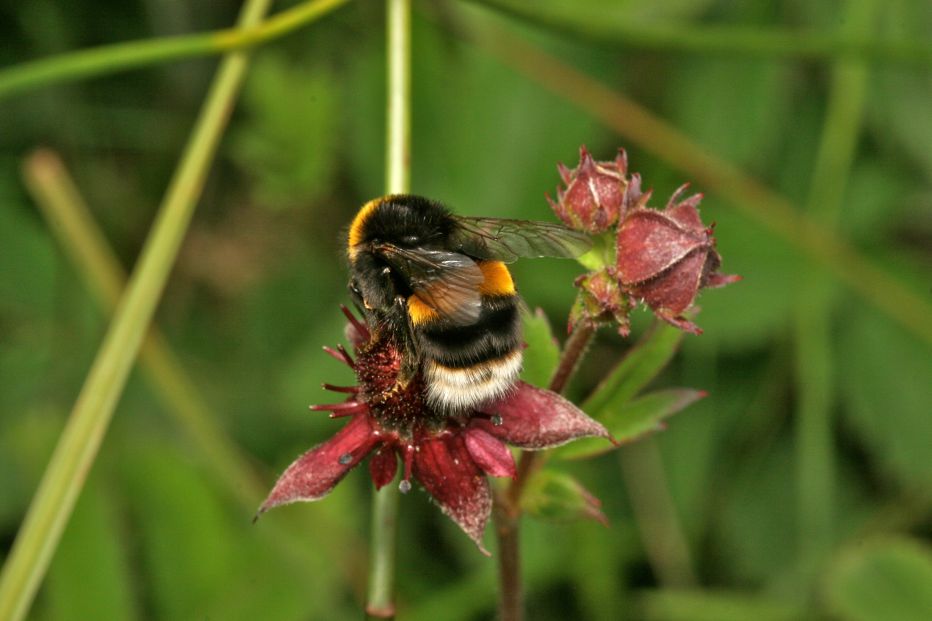
Buff-tailed Bumblebee © Neil Fletcher
Comments
In our Woodingdean garden, this year has been the best year ever for the buff tailed bumble bee. They are everywhere ! and we reached 100 sightings by March 30th. Strange then that i have yet to see one Red Tailed Bumble ????
20 Apr 2020 17:49:00