
Species of the day: Blackbird

By James Duncan
Learning and Engagement Officer
The Blackbird (Turdus merula) may well evoke a stronger sense of connection to us than any other bird. Our affection for them is largely universal and they're certainly exceedingly characterful. There are endless stories of unusually tame Blackbirds entering houses and exhibiting specific habits to make individuals distinguishable from one another. Amongst a hugely variable diet, they'll happily feast on our kitchen scraps and it's quite remarkable just how approachable they can be. Their perky nature has them hopping around our lawns in a somewhat indignant manner, flicking their tails and viciously tugging earthworms from their subterranean habitat. You may spot them 'cocking' their heads as they listen carefully for the faintest movements underground. The striking male, black with a bright yellow-orange beak and yellow eye-ring is a handsomely unmistakable bird. The female, by contrast, is altogether more modest, her mottled sooty-brown plumage lending her the appearance of a darker version of other Thrush family members. Behaviour aside, the Blackbird has perhaps the quintessential song of the English summer, a fruity melodic warble loved by so many and summed up beautifully by nineteenth century English poet William Ernest Henley -
"The nightingale has a lyre of gold,
The lark's is a clarion call,
And the blackbird plays but a boxwood flute,
But I love him best of all.
For his song is all of the joy of life,
And we in the mad, spring weather,
We two have listened till he sang
Our hearts and lips together."
Perhaps the most surprising thing about the Blackbird is how its sheer adaptability has radically altered its habits. It seems logical to think that its long been a species associated with humans, but interestingly this may only have happened in the last few hundred years. It's likely the Song Thrush was in fact the commonest member of the family and the Blackbird was historically a retiring and well-camouflaged bird of dense woodland, its low-frequency song travelling far and wide within the impenetrable canopy. Even now they're as happy to live in the remotest of habitats, in stark contrast to their prolific urban image. We may well see them dash at low-level from garden to garden and this most likely serves as a vestige of former habits, an effective method for avoiding hawk predation within thick forest. With the arrival of late summer, breeding complete, the Blackbird reverts to its former state as a secretive bird, keeping quiet and lying low whilst moulting its feathers in readiness for the colder months to come.
Blackbird's seem to be one species that are particularly prone to leucism, a condition where feathers, skin, hair or even scales may look either completely white or have a distinctly pale appearance. These plumage abnormalities in leucistic birds result from a partial loss of pigmentation, as opposed to albinism, where there's a complete absence of the colour pigment melanin. Blackbirds with leucism may display anything from a few patchy white weathers to full-body coverage, somewhat contradicting their naming. Leucistic birds aside, the naming seems entirely logical, for what could be a more appropriate name for a 'black bird' than Blackbird. Of course, this does raise a question as to why the Blackbird was named this way, in preference to our other 'black' birds, namely the Crows. Very simply, it relates back to a time when birds weren't known as 'birds' at all, they were known as 'fowls.' The term 'bird' was reserved for young birds or fledglings and it wasn't until around the fourteenth century this began to change. The naming of the Blackbird ultimately made complete sense at a time when all large bird species were fowls, something that remains evident to this day in the terms 'waterfowl' and 'wildfowl.'
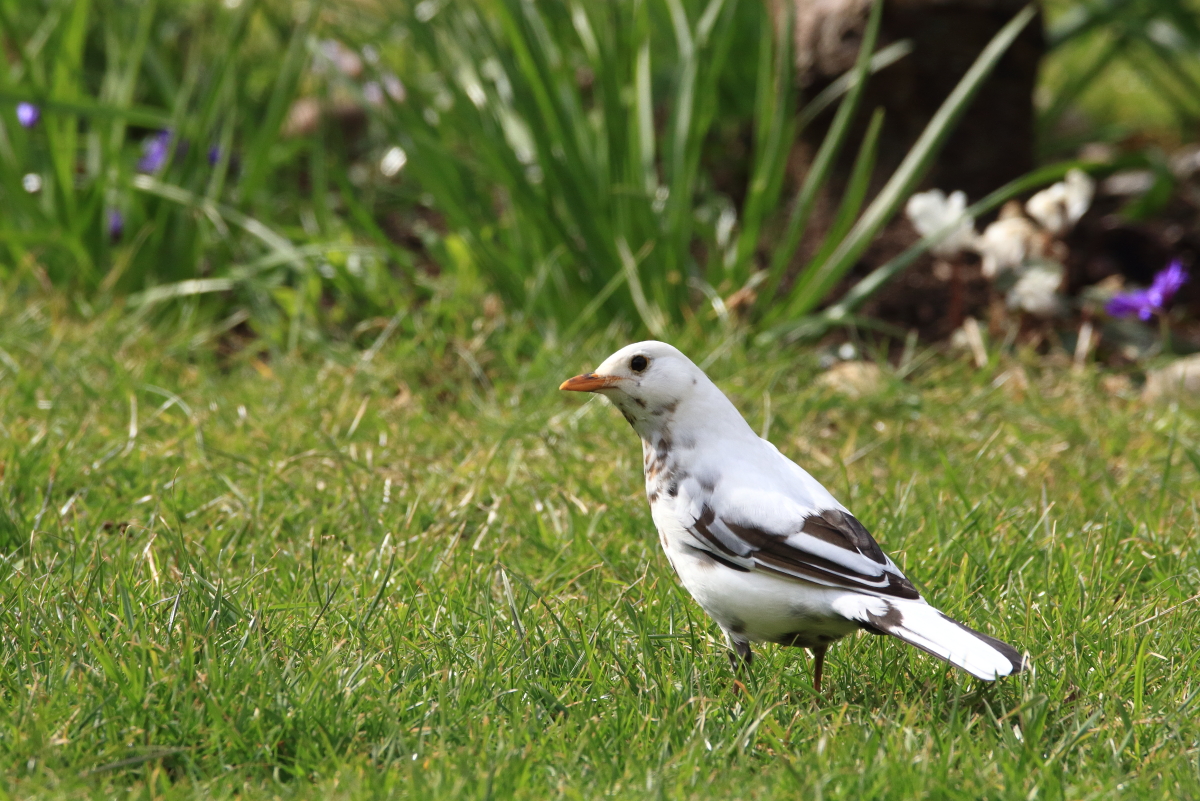
Leucistic Blackbird © James Duncan
Take Action for Wildlife
With so many species on the red list and at risk of extinction, we need to do all we can to stand up for wildlife. One of the best actions you can take to help is by joining us as a member or making a donation.
Comments
Have loved reading your daily species of the day James , found them very interesting & informative . Have gained a lot of snippets from the articles , some of which I want to use in my garden for the wildlife that visits it . Keep them coming .
06 May 2020 12:49:00
Ah, I wondered about the few white feathers on my visiting Blackbird, it helps me recognise regular visitors! Such interesting and informative info.
15 Feb 2022 08:36:00
We have a mating pair of blackbirds that are always busily hopping about our garden. I have been intrigued by the way the male occasionally raises a crest on the top of its head when it is either on guard or alarmed or squabbling over a worm with his lady friend. The feathers raise almost like that of a cockatoo but obviously not so noticeable and bold but there is definitely a distinct crest but shorter .. I’ve searched the internet and found nothing relating to blackbirds having a crest.
28 Apr 2022 08:23:00
Sussex Wildlife Trust:
Birds often fluff their feathers to make themselves appear larger and more threatening, and this can include the feathers on their head.
My neighbour needs damp proofing treatment on her wall but a blackbird is nesting in the climbing shrub in front of it. Can you give us an idea of when she could book the work given that I see Blackbirds can return to the same nest for more than one brood?
30 Apr 2026 12:44:00
Sussex Wildlife Trust:
Hi Jennifer, it would be best to schedule the work for after the breeding season which is March to August, ensuring that no birds are nesting or other wildlife is using the shrubs before work commences.