
Slippery as an Eel
By Charlotte Owen, WildCall Officer
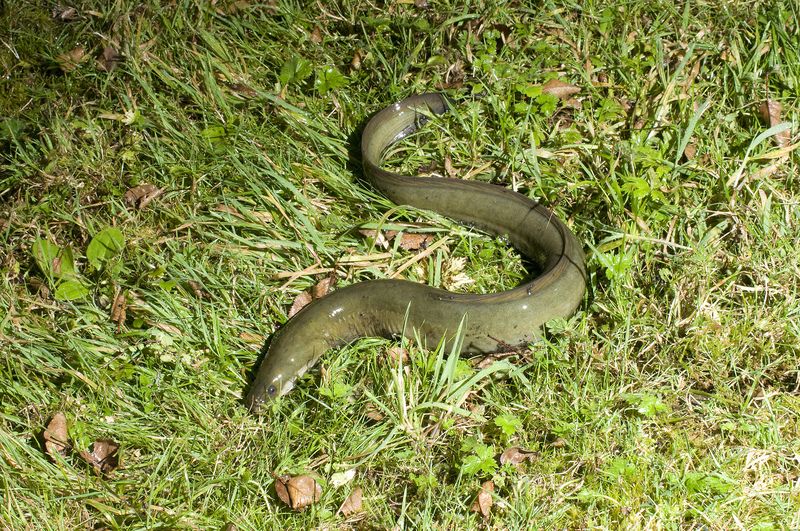
The European Eel is a snake-like fish, its muscular body propelling it through the water – and sometimes over land - in a series of sinuous waves. For centuries people had no idea what this mysterious creature was or where it came from, guessing that Eels were born from the mud, oozed out of the roofs of thatched cottages or were created by the action of sunlight on dewdrops. Such confusion arose because nobody had ever seen a juvenile Eel – or at least, not knowingly.
Young Eels look nothing like the adults and start life as flat, transparent larvae. We now know that they are born three thousand miles away in the Sargasso Sea, a remote region of the North Atlantic next to the mysterious Bermuda Triangle. It is the only sea without a land boundary, defined instead by four swirling ocean currents that together form the North Atlantic Gyre. The waters within the Gyre’s turbulent embrace are eerily still and beautifully blue. Here, the Eel larvae drift about feeding on ‘marine snow’ – tiny organic particles that shower down from the surface - until they enter the Gulf Stream and begin the first leg of a mammoth migration towards the UK. Carried along by the current, they metamorphose into cylindrical glass Eels, still small and see-through but growing gradually longer over several years as they drift ever closer to our shores. Eventually they will arrive at an estuary and make their way upriver on an incoming tide. As they enter the fresh water they start developing some colour and are now known as elvers. It will take at least another decade for them to grow into fully mature adults, at which point they will make the same epic journey in reverse and swim all the way back to the Sargasso Sea to spawn, and then - presumably - die.
For a variety of reasons, some still unknown, Glass Eel numbers have plummeted in recent years and the European eel is now critically endangered. Thankfully, now that we have a better understanding of its amazing lifecycle, we can take effective action to save this slippery character from sliding into the history books.