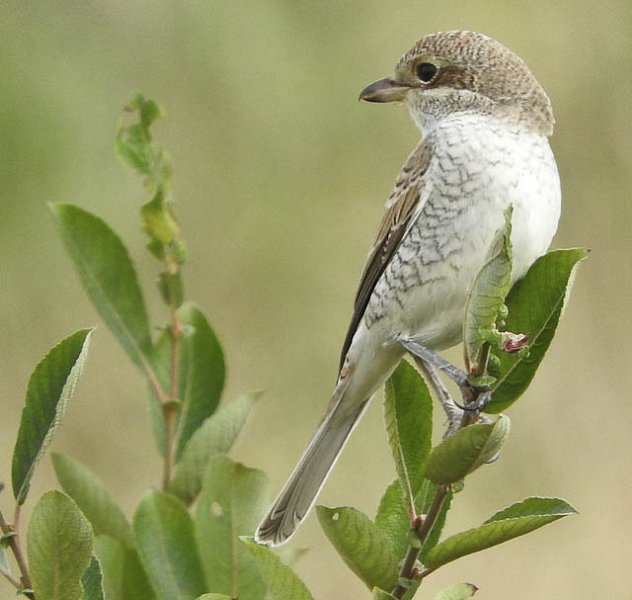
Bird highlight during September was a juvenile red-backed shrike which was present briefly to the north of Harbour Farm on 3rd. This species used to be a common summer visitor to the UK, with perhaps several hundred pairs breeding. However the late 20th century saw a rapid decline in numbers, with regular breeding coming to an end in 1988, though since then pairs have bred occasionally, particularly in South-west England, Wales and Scotland. Red-backed shrike feed on invertebrates or even small mammals, birds or reptiles, often impaling their prey on thorns or even barbed wire and these predatory habits have earned the species several slightly sinister local names including ‘butcher bird’, ‘destroying angel’, ‘worrier’ and ‘throttler’!
Passage migration was in full swing, so a good selection of species was present on the reserve. Numbers were provided by lapwing, with 1500 on Castle Water on the 5th and curlew (315 on the Beach Reserve on the 21st), while FlatBeach played host to 180 dunlin (above) on the 11th and 78 golden plover on the 25th. Notable sightings included wood sandpiper at Castle Water on the 1st and Harbour Farm on the 12thand 27th , an avocet on Flat Beach on the 11th and a little ringed plover at Castle Water on the 5th, while up to 24 knot were present on Flat Beach on the 24th, 16 black-tailed godwit on Flat Beach on the 16th and 29 ruff at Castle Water on the 29th. Interesting waterfowl during September included up to three great white egret on Castle Water and Harbour Farm on the 13th and a spoonbill on Harbour Farm on the 29th and 30th, while raptors included merlin on Beach Reserve on the 3rd and hobby at Castle Water on the 8th (two) and 25th. Still a few Sandwich tern around during the month, with 170 present on Flat Beach on the 12th, while on the same date a little gull was on Flat Beach (with one over Long Pit on the 13th) and five Arctic skua were present on the shore and over the sea. Hirundines late in the month included over 1500 swallow and 400 sand martin on the 19th and around 400 house martin on the 25th, while up to nine swift were seen early in the month. The Beach Reserve also played host to good numbers of passerines, with 200 linnet on the 11th, 160 siskin on the 8th and 150 each of yellow wagtail and meadow pipit on the 3rd and 25th respectively, while at least 30 wheatear and 11 whinchat were present here on the 19th. Other notable migrants included two tree pipit on the Beach Reserve on the 26th, a wryneck on 19thredstart on the Beach Reserve on the 3rd (two) and Castle Water on the 4th, and four spotted flycatcher at Castle Water on the 4th with a firecrest here on the 5th. In addition, four raven were at Castle Water on the 15th, while a treecreeper here on the 8th was something of a surprise!
Some good migrant species in the Lime Kiln moth trap this month, with the highlights being vestal,scarce bordered straw and best of the bunch a great brocade on the 10th, only the fourth reserve record and the first for almost 10 years. Similarly, though butterfly numbers were dropping off there were several sightings of clouded yellow during the month. Probably the most notable non-avian record during September was of two gilthead bream (below) found in the new saltmarsh channel by Lime Kiln Cottage on the 9th. This species is common further south in Europe, but uncommon in British waters and these individuals constituted the first reserve record. Also new to the reserve was the uncommon vagrant blowfly Stomorhina lunata, with two found on Harbour Farm on the 10th. Plants in flower included least lettuce, stinking hawksbeard, sea aster, marsh mallow and hawkweed oxtongue.
Cookie settings
We use cookies to collect and analyse information on site performance and usage, to improve your browsing experience and show personalised content. You are free to manage this via your browser settings at any time. To learn more about how we use the cookies, please see our cookie policy.